What Is PEVA and Is It Food-Safe for Cooler Bag Linings?
PEVA is an ethylene-vinyl acetate copolymer sold as a chlorine-free substitute for PVC film, and it is weldable by radio frequency. It is not automatically food-safe: safety is a declaration backed by migration data for the specific grade, tested at the contact time and temperature the bag will actually see.
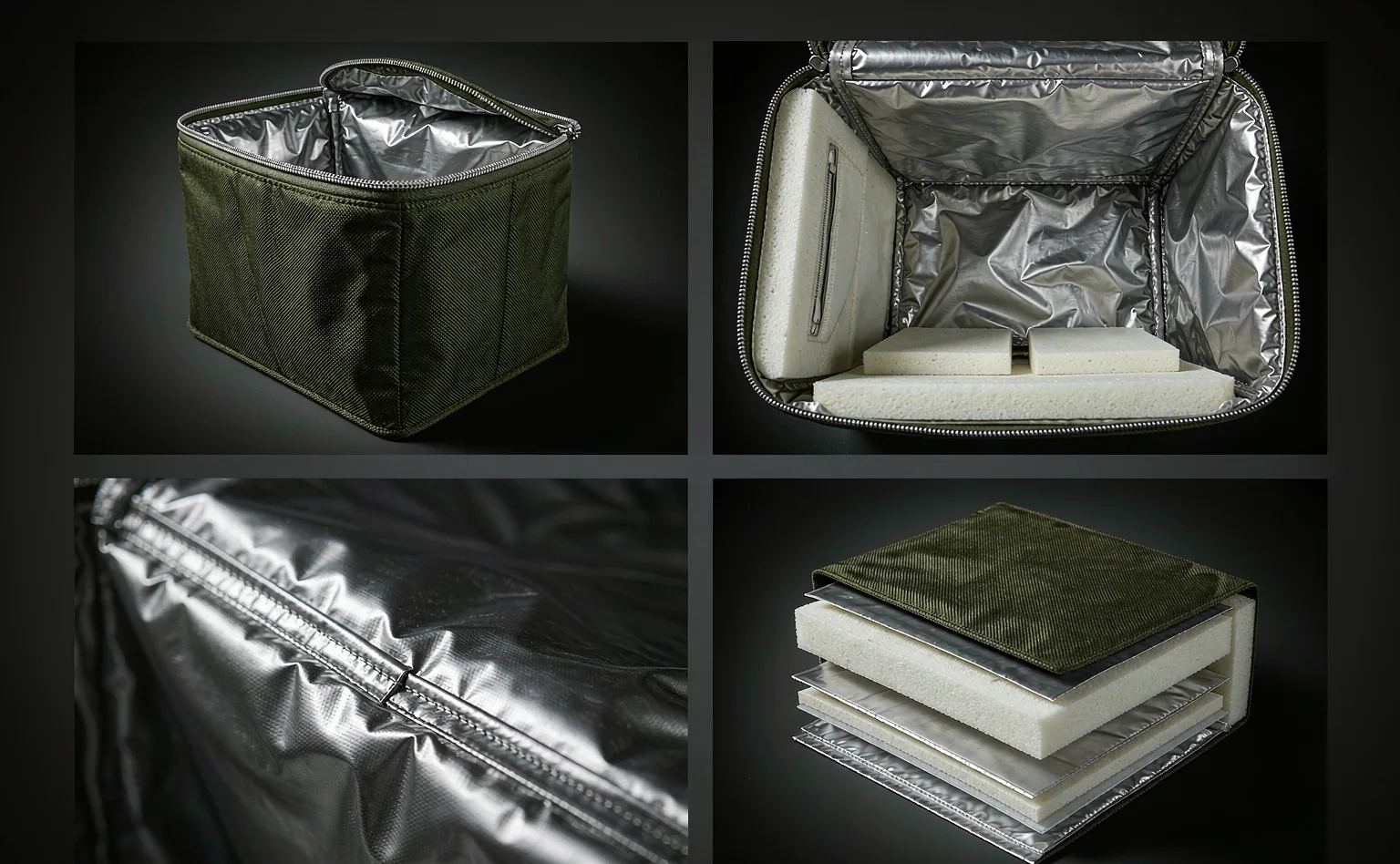
PEVA is a copolymer of ethylene and vinyl acetate, sold as a chlorine-free replacement for PVC film. It is not automatically food-safe: food contact depends on the grade, the additives and a declaration backed by migration data. In the EU the film must satisfy Regulation (EC) No 1935/2004 with the plastics measure Regulation (EU) No 10/2011; in the US it must fall within FDA 21 CFR 177.
PEVA is the default liner film in the insulated bag trade and the least documented. Buyers order it because it is chlorine-free and weldable, and then discover at a retailer compliance review that nobody can produce a declaration naming the polymer and the additive package. This piece sets out what PEVA actually is, how it differs from the materials it replaced, what a defensible food-contact file contains in each market, and how to write the film into a specification so it can be re-ordered without a new compliance review.
What Is PEVA, Chemically?
PEVA is a trade shorthand for a copolymer of ethylene and vinyl acetate, usually with a vinyl acetate content somewhere between 5 and 18 percent. The vinyl acetate comonomer disrupts the crystallinity of the polyethylene chain, which makes the film softer, more flexible and more polar than polyethylene; the polarity is what allows it to be radio-frequency welded, and the softness is what allows a liner to fold without cracking at low temperature. Higher vinyl acetate content means a softer, more weldable, more permeable film.
The trade name hides real variation. Two films both sold as PEVA can differ in comonomer content, in the slip and antiblock package, in the stabiliser system and in whether a calcium carbonate or talc filler has been added to reduce cost. Each of those changes weld behaviour and each can change the migration profile. That is why a specification should name a grade and a supplier rather than the four letters.
Is PEVA the Same as EVA, and Is It the Same as PVC?
PEVA and EVA are the same copolymer family; the "P" in the trade name is marketing rather than chemistry, and it exists to signal that the film is offered as a chlorine-free substitute for PVC. PVC, polyvinyl chloride, is a different polymer entirely: rigid until plasticised, weldable beautifully because it is strongly polar, and carrying a plasticiser and stabiliser package that is the reason the material has been progressively withdrawn from food-contact and children-product applications.
The practical differences fall into three groups. Regulation: PVC draws scrutiny under REACH for plasticisers on the candidate list and under California Proposition 65 for listed phthalates, while a well-formulated PEVA does not. Processing: both weld by radio frequency, but at different parameters. End of life: PVC is harder to recycle in the streams most brands now commit to, and several retailers simply exclude it. None of that makes PEVA automatically compliant; it makes it easier to make compliant.
| Property | PEVA / EVA copolymer | PVC film | Why it matters on a liner |
|---|---|---|---|
| Chlorine content | None | Roughly 57% by mass | Retail restricted-substance lists and end-of-life commitments |
| Plasticiser | Usually not required | Required for flexibility | The plasticiser is what drives REACH and Prop 65 exposure |
| RF weldability | Yes, polarity rises with vinyl acetate content | Excellent | Both weld; the parameter sets differ |
| Low-temperature flex | Good, improves with vinyl acetate content | Good with the right plasticiser | Cold-chain bags that fold in a freezer |
| Odour | Low, but can carry a vinyl acetate note | Can carry a plasticiser odour | Food-contact complaints usually start with odour |
| Typical gauge | 0.10-0.20 mm | 0.15-0.30 mm | Thicker film welds slower and costs more |
What Does Food-Safe Actually Mean for a Liner Film?
It means that the material, as supplied and as used, does not transfer constituents to food in quantities that endanger health or change the composition of the food. In the European Union that obligation sits in the framework Regulation (EC) No 1935/2004, and for plastics the specific measure is Regulation (EU) No 10/2011, which sets an overall migration limit and specific migration limits for listed monomers and additives, together with the simulants and test conditions to be used. A compliant film therefore has a declaration of compliance and supporting migration data, not a marketing adjective.
In the United States the equivalent is the indirect food additive system in FDA 21 CFR 177, with the section depending on the polymer: olefin polymers, and for the ethylene-vinyl acetate family, the section covering EVA copolymers. A supplier citation should name the section and confirm that the additive package is within the permitted list for that section. In both markets the declaration has to name the polymer, and in both it has to cover the film as supplied by the named supplier.
Which Migration Limits Apply and How Are They Tested?
Under EU 10/2011 the overall migration limit is 10 milligrams per square decimetre of contact surface, or 60 milligrams per kilogram of food simulant where the surface-to-volume relationship is not known; specific migration limits apply substance by substance and are tighter. Testing uses food simulants — for example 10% ethanol, 3% acetic acid and, for fatty foods, a vegetable-oil or substitute simulant — at contact times and temperatures chosen to represent the worst foreseeable use. A bag that carries fatty or acidic food is tested against a harsher simulant than one that carries dry goods.
The conditions matter as much as the limits. Migration roughly doubles for every 10 °C rise in contact temperature over the relevant range, so a liner tested at 20 °C for two hours is not evidence for a bag that holds a warm meal at 60 °C for an hour. State the worst foreseeable contact time and temperature in the test request, and reject a report that was run at conditions milder than the product will see.
Does a Food-Contact Declaration Cover the Whole Bag?
No, and this is the most common gap in a compliance file. A liner declaration covers the film. The print inks, the seam tape or weld, the zipper tape and any coating on the shell are separate articles with their own position. A bag can have a fully compliant liner and still fail a retailer review because the print sits on a panel the food touches, or because the seam tape is a different polymer with no declaration.
The practical fix is a component-level bill of materials, with a compliance statement per component that can contact food, plus a note on which components are outside the food-contact zone. Where the print is inside the bag, specify a low-migration ink system and a barrier or a print-free margin at the contact area; where the print is outside, say so in the file. Both are lower-cost decisions at sampling than at a retailer review.
What Else Does a Restricted-Substance File Have to Cover?
Four regimes come up repeatedly. REACH, Regulation (EC) No 1907/2006, requires a declaration against the current candidate list of substances of very high concern, and the list is updated twice a year, so a declaration has a date on it and expires in practice. California Proposition 65 requires a warning or a demonstration of exposure below the safe-harbour level for listed substances, and phthalates and heavy metals in soft PVC and in printed components are the usual exposure route.
CPSIA applies where the bag is a children product: lead and phthalate limits, a tracking label and a certificate based on third-party testing, with EN 71-3 migration of certain elements as the usual test for accessible components. And where a brand makes a recycled-content claim, the documentation is a transaction certificate rather than a test report; that is a separate file and a separate discipline.
| Regime | What it requires of a cooler bag | Document that evidences it | How often it changes |
|---|---|---|---|
| EU 1935/2004 plus EU 10/2011 | Framework obligation plus plastics migration limits | Declaration of compliance with migration test data | When the specific measure is amended |
| FDA 21 CFR 177 | Polymer and additives within the permitted list | Supplier citation naming the section | Rarely, but additive lists do change |
| REACH 1907/2006 | No SVHC above 0.1% in articles without registration | Declaration against the current candidate list | The candidate list is updated twice a year |
| California Proposition 65 | Warning, or exposure below the safe-harbour level | Exposure assessment or a labelled warning | The listed-substance list changes annually |
| CPSIA plus EN 71-3 | Lead and phthalate limits for children products | Third-party test report and a tracking label | On each material or design change |
How Does PEVA Behave on the Production Line?
Two properties decide whether a film runs well: its weld window and its slip. The weld window is the range of power, dwell and pressure over which the seam forms without burn-through, and it narrows as the vinyl acetate content rises and as the gauge falls. A film with a narrow window produces good samples and variable bulk, which is the failure pattern buyers describe as "the second run leaked". Specify the window as a recorded parameter set rather than as an outcome.
Slip, governed by the additive package, decides whether the film feeds and whether the panels slide against each other during assembly. Too much slip and the stack moves during cutting; too little and the panels drag. Both show up as seam defects rather than as film defects, which is why they are usually misdiagnosed. Ask the converter for the slip level and keep it constant between runs.
One more property deserves a line in the file, because it generates more customer complaints than migration does: odour. Residual vinyl acetate and some slip additives carry a sweet, acetic note that a customer notices the moment a food bag is opened, and it is the most common reason a compliant bag is returned. Specify a low-odour grade for food programmes and ask for an odour assessment after conditioning the film at a stated temperature for a stated time.
How Should PEVA Be Written Into a Specification?
- Material
- Ethylene-vinyl acetate copolymer film, not PVC
- Grade and supplier
- Named grade and supplier, or an approved equivalent
- Gauge
- Stated in mm with a tolerance, typically 0.10-0.20 mm
- Vinyl acetate content
- Stated, because it sets the weld window
- Additive package
- Named, and within the permitted list for the market
- Food contact, EU
- Declaration to 1935/2004 with EU 10/2011 migration data
- Food contact, US
- Citation to the applicable section of FDA 21 CFR 177
- Restricted substances
- REACH SVHC declaration and a Prop 65 statement
- Seam method
- RF welded, with the recorded parameter set
- Change control
- Written notice before any grade or supplier change
The last field is the one that saves the programme. A film substitution made for supply reasons silently changes the weld window, the migration profile and the odour, and none of those appear on a purchase order. Require written notice with a stated lead time, and require a re-test of both the weld and, where the grade has changed, the migration position.
What Does a PEVA Liner Cost Relative to the Alternatives?
Three films dominate: PEVA, TPU and a polyurethane-laminated textile. PEVA is the low-cost, weldable, compliant-with-effort option and it is the right default for most programmes. TPU costs more, welds well, resists abrasion and hydrolysis if the grade is chosen for it, and is the answer where the bag will be washed repeatedly or used in a wet service. PUL, a polyester knit laminated to polyurethane, behaves more like a fabric: it sews rather than welds, it is pleasant in the hand, and it is the usual choice for reusable food pouches.
The cost comparison should be made per bag, not per metre, because the gauge and the yield differ. A TPU at 0.12 mm can cost less per bag than a PEVA at 0.18 mm while performing better. Ask for the film cost as a line item in the bag costing rather than as a material rate, and the decision becomes arithmetic instead of habit.
What to take away about PEVA
- PEVA is an EVA copolymer, chlorine-free, and weldable by radio frequency.
- Food-safe is a documented position, not a property of the four letters.
- Migration limits depend on contact time, temperature and the food type.
- A liner declaration does not cover print, tape, coating or hardware.
- Name the grade and supplier, and put substitution under change control.
How Do the Programme Numbers Sit Around a Liner Decision?
The liner choice does not move the commercial frame: MOQ 500 pcs per style and colourway, sampling 6-10 working days from a signed-off tech pack, bulk production 35-50 days from sample approval, inspection at AQL 2.5 under ISO 2859-1 General Inspection Level II, T/T 30/70, FOB Xiamen. What it does move is the document set that has to be assembled before the first shipment, and that is the part that surprises buyers who planned the schedule and not the file.
Where the programme sells into more than one market, assemble the file market by market rather than once. The strictest market usually sets the material, and the others are then satisfied by the same evidence, but the declarations are addressed to different regulators and a single generic letter satisfies neither. Plan one document set per market at sampling, and the launch is not held up by a review that asks for a document nobody has.
Assemble three documents early: the declaration of compliance for the film, the restricted-substance declaration against the current candidate list, and the weld parameter record for the approved sample. All three are low in cost at sampling and all three are the reason a shipment is held at a port or a retailer review.
Get the compliance file right the first time
Send the market, the food type and the contact conditions. You get a film recommendation with the declaration set behind it, within one business day.

Frequently Asked Questions
Is PEVA food-safe?
It can be, but food safety is a documented position for a named grade, not a property of the acronym. Ask for a declaration to EU 1935/2004 with EU 10/2011 migration data, or an FDA 21 CFR 177 citation.
Is PEVA the same as PVC?
No. PEVA is an ethylene-vinyl acetate copolymer with no chlorine; PVC is polyvinyl chloride and needs plasticisers for flexibility, and those plasticisers drive the regulatory exposure.
Does PEVA contain phthalates?
A well-formulated PEVA does not need plasticisers, so phthalate exposure is uncommon. The risk appears when a soft PVC is supplied instead, which is why the film has to be named and tested.
Can PEVA be radio-frequency welded?
Yes. The vinyl acetate comonomer makes the film polar enough to heat in a dielectric field, unlike polyethylene or polypropylene.
What is the overall migration limit in the EU?
10 mg per square decimetre of contact surface, or 60 mg per kilogram of food simulant where the surface-to-volume relationship is not known, under Regulation (EU) No 10/2011.
Which FDA section covers EVA film?
The indirect food additive provisions in 21 CFR 177, with the section depending on the polymer; the ethylene-vinyl acetate family is covered by its own section. Ask the supplier to name it.
Does a liner declaration cover the whole bag?
No. Print inks, seam tape, coatings and hardware each have their own position, and a component-level bill of materials is what closes the gap.
Does REACH apply to cooler bags?
Yes, as an article obligation: no substance on the candidate list above 0.1% without registration or notification, and the list is updated twice a year.
When does CPSIA apply?
Where the bag is a children product. It brings lead and phthalate limits, a tracking label and third-party testing, with EN 71-3 for accessible components.
Why does a PEVA liner smell?
Usually residual vinyl acetate or a slip additive. Odour complaints are the most common food-contact complaint, and a low-odour grade is worth specifying for food programmes.
Is TPU better than PEVA?
It resists abrasion and hydrolysis and survives repeated washing, at a higher material rate. Where the bag is washed daily, the TPU grade pays for itself in service life.
Can I change the film supplier after approval?
Only with written notice and a re-test. A substitution changes the weld window and the migration profile even when the datasheet looks identical.
What gauge of PEVA is normal?
0.10 to 0.20 mm for a bag liner. Thicker film welds more slowly and costs more; thinner film has a narrower weld window.
What is the MOQ for a custom PEVA-lined bag?
500 pcs per style and colourway, with repeat programmes open to discussion at 300 pcs.
People Also Ask
What is PEVA material?
A copolymer of ethylene and vinyl acetate, sold as a chlorine-free substitute for PVC film and weldable by radio frequency.
Is PEVA safe for food contact?
Yes when the specific grade is supported by a declaration and migration data for the intended food type, time and temperature.
Is PEVA better than PVC for cooler bags?
For compliance and end-of-life, yes: no chlorine and usually no plasticiser, which is where the PVC exposure sits.
Can PEVA liners be welded?
Yes, by radio-frequency welding; polyethylene and polypropylene cannot be welded that way.
What documents prove a liner is food-safe?
A declaration of compliance with migration test data in the EU, and an FDA 21 CFR 177 citation in the United States.
Sources and further reading
Every figure on this page is either our own programme data or attributed below. Open the originals before you write them into a specification.
- Regulation (EU) No 10/2011 on plastic materials intended to come into contact with foodEuropean Union
- FDA 21 CFR 177 — Indirect food additives: polymersUS Food and Drug Administration
- REACH — Registration, Evaluation, Authorisation and Restriction of ChemicalsEuropean Chemicals Agency