How Are Cooler Bags Welded: RF vs Hot Air vs Sewn Construction
Three methods, chosen by film polarity before cost. Radio-frequency welding fuses PVC, EVA, PEVA and TPU in one to three seconds; hot-wedge welding handles polyethylene and thick stacks; sewn and taped construction covers the geometry that a welder cannot reach.
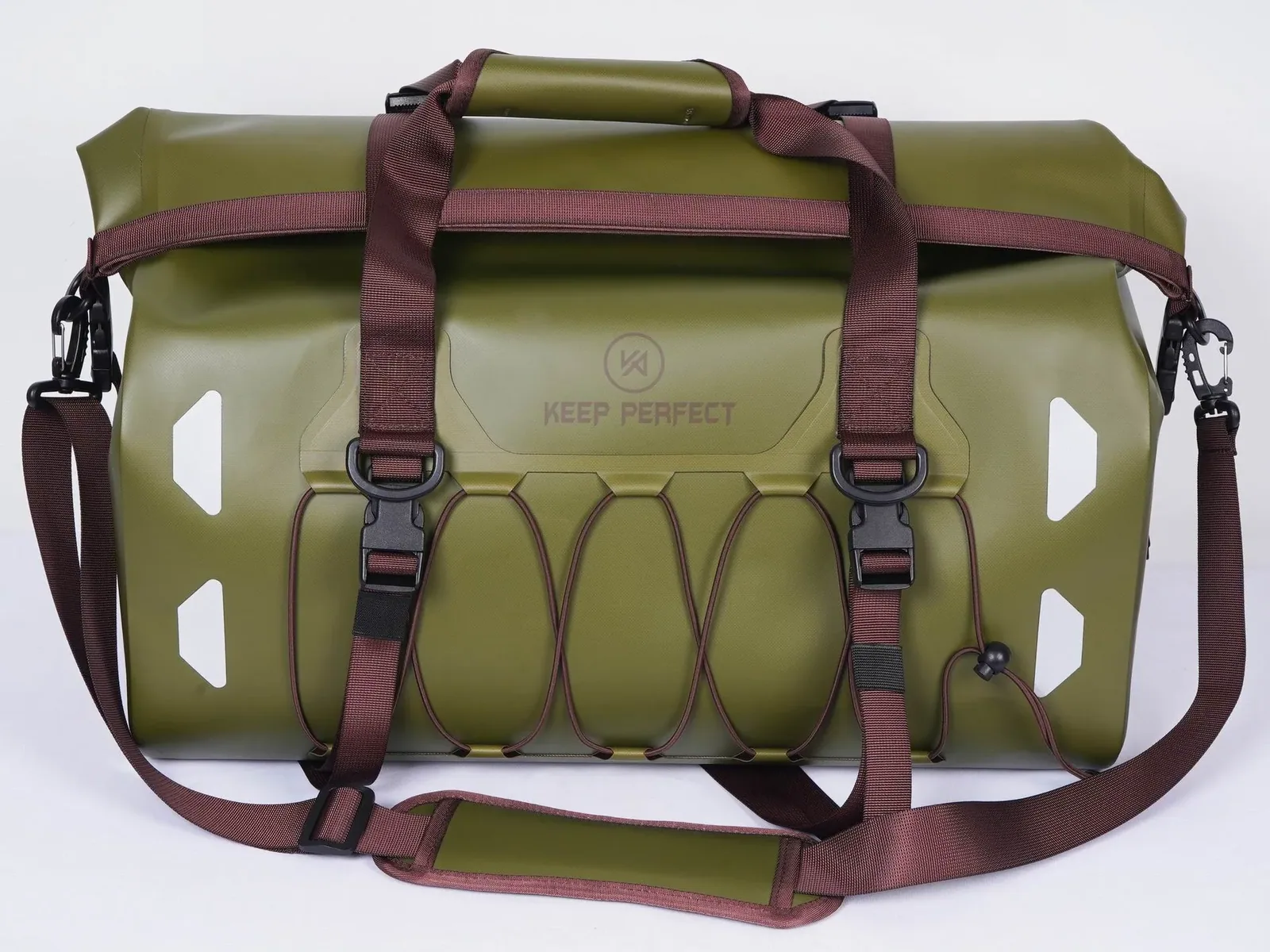
Three methods join a cooler bag liner. Radio-frequency welding fuses polar films such as PVC, EVA and PEVA and TPU in one to three seconds with a clean, airtight seam, and needs a tool per shape. Hot-air and hot-wedge welding handles PE and PP films and coated fabrics, runs slower and tolerates thicker stacks. Sewn construction with seam tape is the fallback for shapes a welder cannot reach, and it is the one that leaks first.
The seam is where a cooler bag fails, and the seam method is chosen by material compatibility before it is chosen by cost. That is the part buyers rarely see: a beautiful RF-welded sample quoted on a PEVA liner may not be reproducible if the production film is a different copolymer, because RF welding depends on the polarity of the polymer, not on the thickness. This guide sets out what each method can join, what it costs, how each one fails, and what has to be written into the tech pack so the second run matches the first.
What Are the Three Ways to Join a Cooler Bag Liner?
Radio-frequency welding, also called dielectric or high-frequency welding, puts the film between electrodes and applies a high-frequency field; polar molecules in the material rotate, and the friction heats the film from within. Hot-air and hot-wedge welding brings heat to the surface from outside, with or without a pressure roller. Sewn construction joins with thread and then relies on a tape, a coating or a sealant for the leak path. All three appear in one bag: a welded liner inside a sewn shell with taped corners is the industry norm.
The choice is made seam by seam, not bag by bag. The liner floor and the liner side seams are usually welded because they are flat and reachable. The corners are the hard geometry and are where sewing survives. The shell is sewn because it is a woven fabric and does not weld. A specification that says "welded bag" without saying which seams is not enforceable.
Which Materials Can Be Radio-Frequency Welded?
Only polar polymers heat in a dielectric field. PVC welds beautifully, which is why it dominated the category for years and why it persists despite its plasticiser question. EVA and PEVA copolymers weld, and so do TPUs, with weld strength depending on the grade. Polyethylene and polypropylene are non-polar: they do not heat in the field at all and cannot be RF welded at any power setting. A supplier who quotes RF welding on a PE film is quoting a seam that will not form.
That dependence on polarity is the reason film substitution is a compliance and a quality event at the same time. Two PEVA films from different suppliers can differ in vinyl acetate content and weld at different parameters, and a parameter set tuned for one will under-weld or over-weld the other. Specify the film supplier or an approved equivalent, and record the parameter set as part of the approved sample.
| Method | Materials it joins | Typical cycle | Tool requirement | Where it is used |
|---|---|---|---|---|
| Radio-frequency welding | PVC, EVA, PEVA, TPU; not PE or PP | 1-3 seconds per seam | A shaped electrode per seam geometry | Liner floor and side seams, flat panels |
| Hot-air / hot-wedge welding | PE, PP, PEVA, TPU-coated fabric | 3-8 seconds per seam | A wedge head; shape changes cost little | Long straight seams, thick stacks |
| Ultrasonic welding | Thin thermoplastic films and tapes | Under 1 second | A sonotrode per geometry | Tack welds, small components |
| Sewn with seam tape | Any film or fabric | Stitch speed plus a taping pass | Standard machines; tape applicator | Corners, curved geometry, shell panels |
Where Does Hot-Air and Hot-Wedge Welding Win?
Two places: where the film is polyethylene-based, and where the seam is long and straight. Hot-wedge welding puts a heated element between the two films and pulls them through a nip roller, which gives a consistent seam over a metre or more, and it does not care whether the polymer is polar. It runs slower than RF and it leaves a wider bead, which is visible on a thin film and sometimes unacceptable aesthetically.
It is also the more forgiving method on thickness variation. RF welding is sensitive to the gap and to the film gauge; a hot wedge with a temperature-controlled element and a proper nip pressure tolerates a thicker stack and a laminate with a scrim. Where the liner is a laminate rather than a monolayer film, ask for hot-wedge rather than RF, and ask what the nip pressure is, because that is the parameter most often left unrecorded.
When Is Sewn Construction Still the Right Answer?
For geometry a welder cannot reach, and for the shell. A bag with a boxed corner, a gusset or a curved mouth cannot be welded in one pass without an electrode that costs more than the order is worth, and sewing is the economical answer. The leak path is then managed with seam tape applied under heat and pressure, or with a liquid sealant, and the seam is tested by a leak test rather than by a peel test.
Where the shell is sewn, the stitch specification is a quality document. ASTM D6193 covers stitch types, stitch density and seam allowance, and ISO 13934-1 covers the tensile behaviour of the fabric; both should be named, with a stitch count per inch and a seam allowance in millimetres. Those two numbers decide whether a strap attachment pulls out, and they cost little to specify and are expensive to argue about afterwards.
What Parameters Decide Whether a Weld Holds?
Four, and all four have to be recorded: power or temperature, dwell or speed, pressure, and cooling time under pressure. RF welding adds a fifth, the electrode gap, and a sixth, the loss factor of the film, which is a property of the film and not of the machine. A parameter set recorded as "medium power, three seconds" is not a parameter set; it is an invitation to re-tune it on the next run, which is exactly how reorders drift.
Ask for the set as numbers with ranges, and ask what the operator is allowed to change without a new approval. A well-run line defines the window: power within a stated band, dwell fixed, pressure fixed, and any departure requiring a supervisor and a re-test. That is a process-control question, and it is the sort of thing an ISO 9001 system is supposed to capture.
How Are Welded Seams Tested and to What Standard?
Three tests, in order of how often they catch a real problem. A peel or tensile test on a welded strip measures the seam strength against the parent material; a good weld fails in the parent film, not at the seam. A leak test — inflation, or a water bath with a dye — finds pinholes that a peel test misses. A flex test, which folds the seam repeatedly wet, is the one that predicts the field, and it is the one most rarely run.
Seam strength for coated and laminated fabrics and for textile assemblies is covered by the ISO 13934 series and stitch practice by ASTM D6193; there is no single ISO number that governs a welded film seam in a bag, so the acceptance figure has to be written by the buyer: a minimum peel strength in newtons per 25 mm, a pass criterion for the leak test, and a cycle count for the flex test. Name all three, with the sample size.
| Failure mode | Method | What causes it | How it is caught |
|---|---|---|---|
| Cold weld | RF or hot wedge | Power or temperature too low, dwell too short, dirty film | Peel test; the seam opens at the interface |
| Burn-through | RF or hot wedge | Excess power or dwell, thin film, an electrode arc | Visual check and a leak test |
| Channel leak | Any welded seam | A wrinkle in the film at the seam line | Inflation leak test; the peel test passes |
| Tape lift | Sewn and taped | Tape applied below its activation temperature, or on a contaminated film | A flex test after wetting; not caught on day one |
| Corner split | Any method | Stress concentration at the corner radius | A drop test on a loaded bag |
How Does the Seam Method Affect the Thermal Result?
Not by conduction, which is negligible across a seam, but by water management. Every needle hole in a sewn liner is a path for meltwater into the foam, and foam that has taken on water loses most of its insulating value. A welded liner has no holes, so the foam stays dry through the life of the bag, which is the reason a welded liner is specified on any bag with a thermal claim longer than about six hours.
The second thermal effect is compression at the seam. Foam is compressed or absent where two panels meet, and a corner built with a folded seam has less insulation than a corner built with a foam insert. On a bag that tests short of its claim by an hour or two, the corners are worth auditing before the walls.
What Does Each Method Cost and How Does It Affect Lead Time?
RF welding needs a shaped electrode per seam geometry, which is a tooling cost and a sampling-line item; the cycle is fast, so the unit labour cost is low once the tool exists. Hot-wedge tooling costs little and is flexible, and the unit cost is slightly higher because the cycle is slower. Sewing with tape needs no tooling and adds a second operation, so its unit cost sits between the two and its quality depends most on operator consistency.
On the programme calendar, tooling is the only one of the three that can extend sampling. A shaped electrode for an unusual seam geometry can add days to the 6-10 working day sampling window; a hot-wedge or sewn construction does not. Where a programme has a fixed launch date and a complex shape, the seam method decision belongs in the first conversation, not in the tech pack review.
There is a second calendar effect that is less obvious: an electrode is a consumable as well as a tool. It wears, it is re-ground, and a re-ground electrode does not produce the same seam as a new one. Ask how electrode condition is tracked and when the parameter set is re-verified, because a seam that passed in run one can drift in run three for a reason nobody recorded.
Can One Bag Use More Than One Seam Method?
Almost always, and the specification should say so explicitly. A typical build is a welded liner floor and side seams, welded or taped corners, and a sewn shell with a taped or sealed top edge. Naming each seam removes the ambiguity that causes rework: a tech pack that says "welded" and a production floor that welds only the floor seams are both behaving reasonably and producing different bags.
Where two methods meet — a welded liner joined to a sewn and taped shell at the mouth — the transition is the weak point. The two materials move differently under load and the junction is where a leak starts. Specify the transition: an overlap width, a reinforcement tape, a stitch line that stays outside the weld, and a leak test applied to the finished mouth rather than to the panels.
Specifying seams so the reorder matches the sample
- Choose the method by film polarity, not by habit: RF needs a polar polymer.
- Name the method per seam, not for the bag as a whole.
- Record power or temperature, dwell, pressure, cooling and gap as numbers with ranges.
- Test peel, leak and wet-flex; no single one of the three catches every failure mode.
- Put the film supplier or an approved equivalent under change control.
How Do You Specify the Seam Method in a Tech Pack?
- Liner film
- Material, gauge and supplier, or an approved equivalent
- Seam method, liner floor
- RF welded, with the electrode reference
- Seam method, liner sides
- RF welded or hot-wedge, stated per seam
- Seam method, corners
- Welded with a foam insert, or sewn and taped
- Shell seams
- Sewn, stitch type and count to ASTM D6193
- Weld parameters
- Power, dwell, pressure, cooling time, gap — with ranges
- Acceptance, peel
- Minimum strength in N per 25 mm; failure in the parent film
- Acceptance, leak
- Inflation or water-bath method and pass criterion
- Acceptance, flex
- Cycle count wet, with a leak re-test at the end
- Change control
- Written notice before any film, tape or parameter change
One more field belongs on the seam specification, and it is usually missing: the re-verification trigger. Parameters drift as electrodes wear, as film lots change and as ambient conditions in the plant change through the year. Set a rule — re-verify the parameter set at the start of each bulk run and after any electrode change or maintenance — and the seam that passed in sampling has a chance of passing in run four.
Two clauses make the specification survivable. The first is that the approved parameter set travels with the approved sample: the same document carries the sample reference, the film lot and the numbers the machine was set to. The second is that any film or tape substitution triggers a re-test, because the substitution changes the weld window even when it does not change the compliance file.
Programme terms are unchanged by the seam decision: MOQ 500 pcs per style and colourway, sampling 6-10 working days and 12-15 where a shaped electrode has to be cut, bulk production 35-50 days from sample approval, inspection at AQL 2.5 under ISO 2859-1 General Inspection Level II, T/T 30/70, FOB Xiamen. Welding is the operation where the difference between a run that passes and a run that is re-worked is usually decided before the first unit is made.
Specify the seam before you specify the price
Send the liner material, the shape and the target quantity. You get a method recommendation with the acceptance tests behind it, within one business day.
Frequently Asked Questions
What is RF welding and when is it used on cooler bags?
Radio-frequency welding heats polar films from within using a high-frequency field. It joins PVC, EVA, PEVA and TPU in one to three seconds and needs a shaped electrode per seam geometry.
Can polyethylene film be RF welded?
No. PE and PP are non-polar and do not heat in a dielectric field. Use hot-wedge welding for polyethylene-based films.
What is the difference between hot-air and hot-wedge welding?
Hot-air directs a stream at the seam; a hot wedge places a heated element between the films and pulls them through a nip roller. The wedge gives a more consistent long seam.
Are welded seams stronger than sewn seams?
A good weld fails in the parent film rather than at the seam, so yes on strength and yes on leak-tightness. Sewing with tape is the answer for geometry a welder cannot reach.
Why do sewn liners leak later?
Needle holes let meltwater reach the foam, and the seam tape lifts after repeated wet flexing. Both effects appear after the first season, not on day one.
Which standards apply to bag seams?
ASTM D6193 for stitch types and density, ISO 13934-1 for tensile behaviour, and a buyer-written acceptance figure for peel, leak and wet-flex on welded film seams.
What weld parameters should be recorded?
Power or temperature, dwell or speed, pressure, cooling time under pressure, and for RF the electrode gap — each as a number with a permitted range.
How is a welded seam tested?
Peel or tensile against the parent film, an inflation or water-bath leak test, and a wet flex test with a leak re-test at the end.
Does welding change the thermal performance?
Indirectly, by keeping the foam dry. Wet foam loses most of its insulating value, so a welded liner protects the hours over the life of the bag.
Does welding add to the sampling window?
A shaped RF electrode can, where the geometry is unusual. Standard hot-wedge or sewn construction usually fits the 6-10 working day window.
What is the MOQ for a welded cooler bag?
500 pcs per style and colourway, with repeat programmes open to discussion at 300 pcs.
How do I stop a reorder welding differently?
Carry the parameter set with the approved sample, put the film supplier under change control, and require a re-test after any film or tape substitution.
People Also Ask
How are cooler bags welded?
By radio-frequency welding for polar films, by hot-air or hot-wedge welding for PE and PP, and by sewing with tape where the geometry prevents welding.
Can PEVA be RF welded?
Yes. EVA copolymers are polar enough to heat in a dielectric field; polyethylene is not.
Are welded cooler bag liners better than sewn?
For water management, yes: no needle holes means the foam stays dry and keeps its insulating value.
What makes a welded seam fail?
Cold welds from low power or short dwell, burn-through from excess, channel leaks from wrinkles, and corner splits from stress.
Which seam test matters most?
A wet flex test with a leak re-test, because it is the only one that predicts the field result.
Sources and further reading
Every figure on this page is either our own programme data or attributed below. Open the originals before you write them into a specification.
- ASTM D6193 — Standard Practice for Stitches and SeamsASTM International
- ISO 13934-1 — Textiles: tensile properties of fabricsInternational Organization for Standardization
- ISO 2859-1:1999 Sampling procedures for inspection by attributesInternational Organization for Standardization