Six categories are open: cooler and insulated, camera and equipment protection, team kit, wine and bottle, neoprene, and drawstring. Nothing outside that list is quoted. All six run on the same locked figures — MOQ 500 pcs per style and colourway, sampling in 6-10 working days, bulk in 35-50 days from sample approval, FOB Xiamen.
Six categories are open and each one has its own specification page: cooler and insulated, camera and equipment, team kit, wine and bottle, neoprene, and drawstring. MOQ is 500 pcs per style and colourway. Sampling runs 6-10 working days from a final tech pack and bulk runs 35-50 days from sample approval. Every lot is inspected at AQL 2.5 under ISO 2859-1 and ships FOB Xiamen.
What Are the Six Categories, and What Is Each One Actually Built Around?
A category is not a silhouette. It is a cluster of engineering problems that keep repeating: the same seam opening, the same closure wearing through, the same panel losing shape after a month in service. Once a cluster is familiar, a specification can be written before a sample exists — and a sample can then be judged against a written number rather than against somebody's impression of it. That is the entire reason this list is short.
Cooler & insulated bags
Thermal carriers and insulated delivery bags specified around foam thickness, liner weld integrity and condensation control. The two numbers that decide the build are how long the contents must hold temperature and how the liner is joined at the corners.
Camera & equipment bags
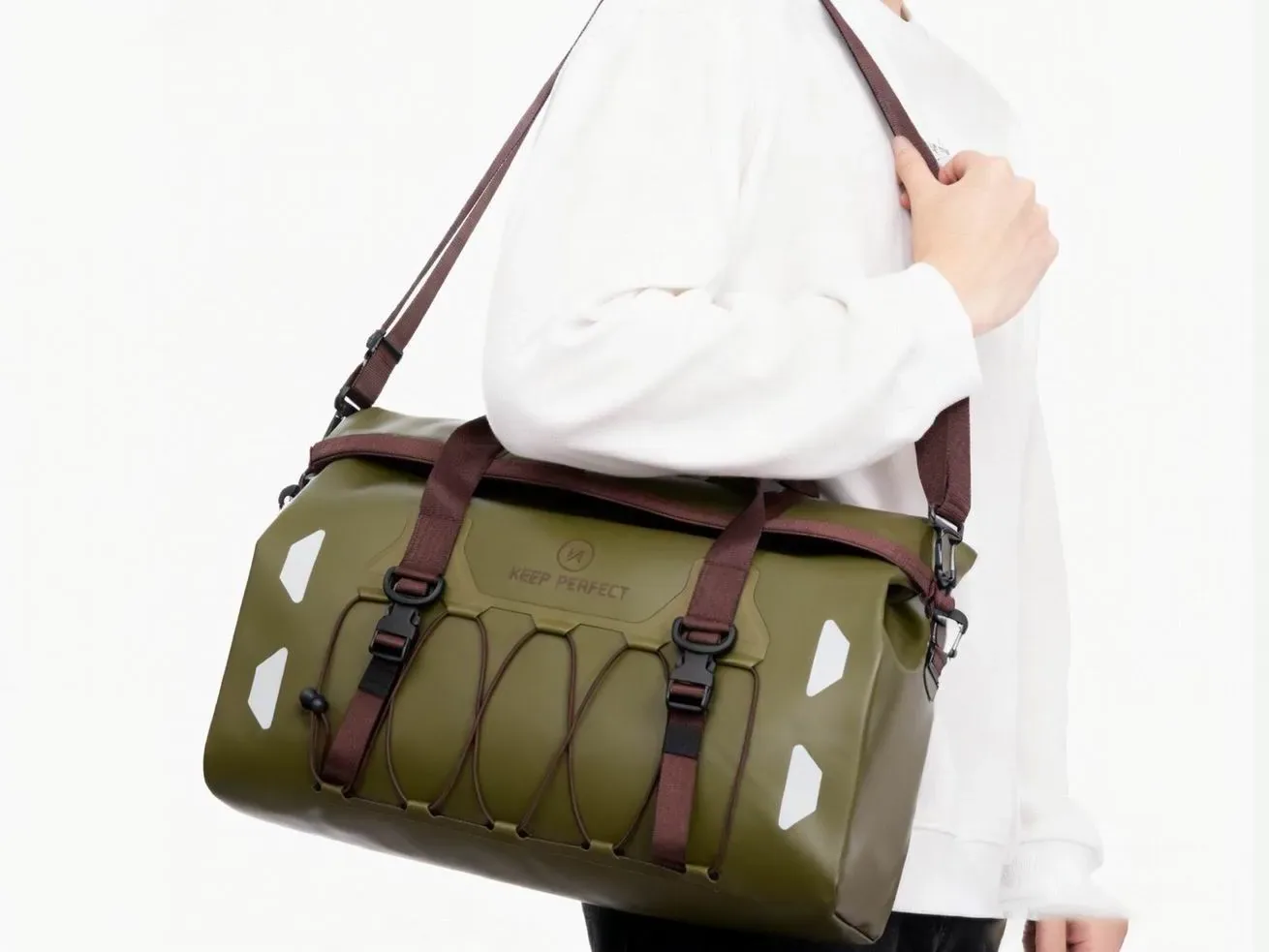
Protective carriers sized to a real kit rather than to a studio photograph. Padding thickness, divider attachment, a written drop protocol and shell abrasion resistance are the four decisions that decide whether a bag gets carried or sent back.
Team kit bags
Club, academy and squad carriers where capacity, colour matching and badge placement carry the brief. The recurring risk is colour drift between body panel and trim between one run and the next, so dyelot control is written into the pack.
Wine & bottle bags
Single, double and multi-bottle carriers decided by bottle geometry, divider structure and the load the handle has to carry. A standard 750 ml bottle sets a floor on internal height that no amount of styling moves.
Neoprene bags
Sleeves, pouches and shaped carriers where thickness, seam type and stretch recovery are the specification. Neoprene does not behave like a woven shell: it is cut to a tolerance and joined by a seam that has to stretch with it.
Drawstring bags
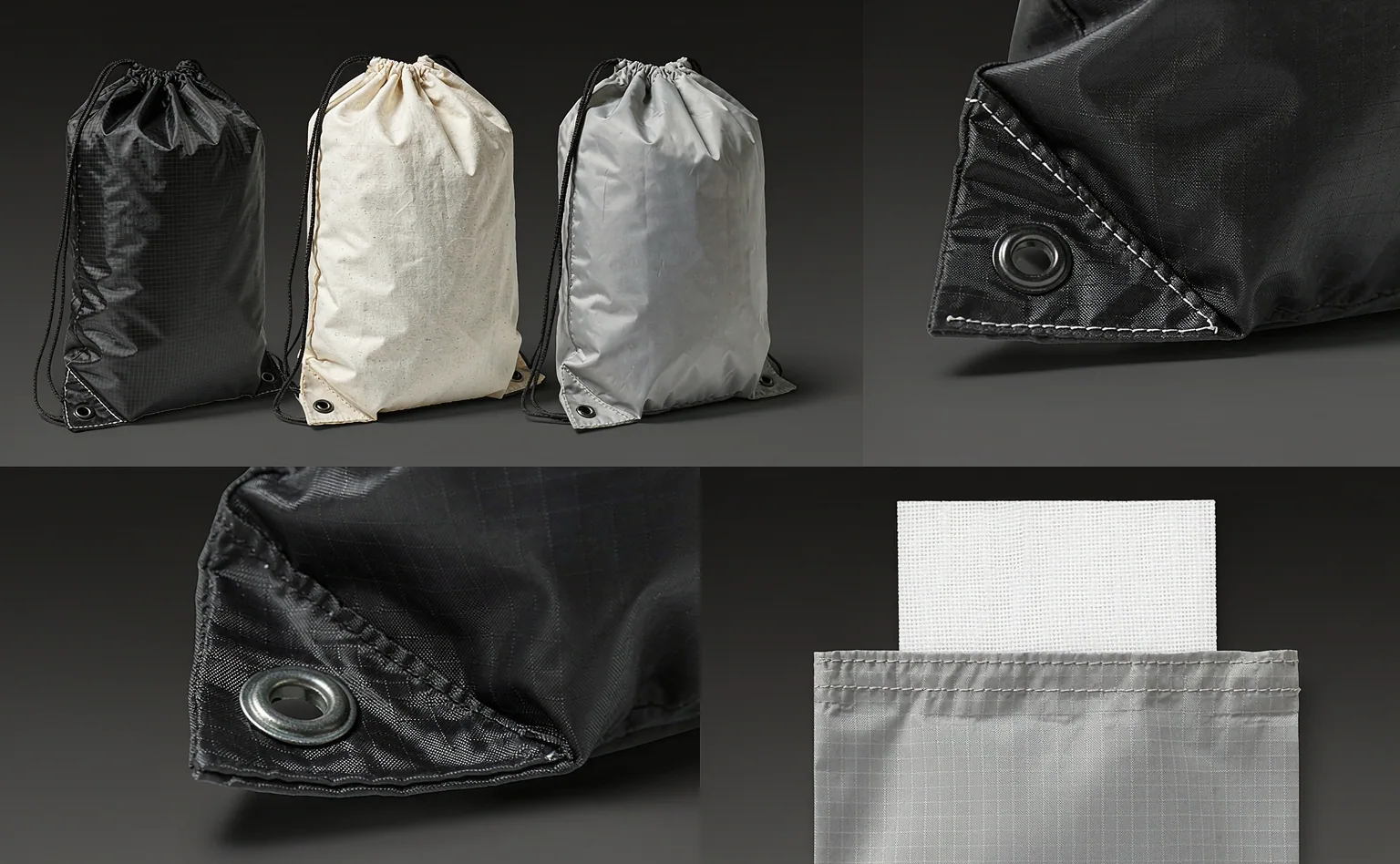
Cord-closure carriers for kit, laundry, footwear and event distribution. Three points fail before anything else does — the grommet, the cord channel and the bottom seam — and all three are decided before the fabric is chosen.
Each card above opens onto a page that carries only the decisions belonging to that category: foam and liner for cooler, padding and drop protocol for camera, capacity and colour for team kit, bottle geometry for wine, thickness and seam for neoprene, cord and grommet for drawstring. Read the matching page before the drawing is finished. Every one of those decisions costs less on paper than it does in a second sample round.
How Do the Six Compare on Structure, Material and MOQ Behaviour?
The comparison that matters is not price. It is what the construction demands from a factory floor and what it does to the minimum run. A welded liner needs a welding jig and an operator who has run one; a padded divider set needs cutting capacity that is not interchangeable with shell cutting; an embroidered badge needs a separate setup that has nothing to do with the body panel. The MOQ of 500 pcs per style and colourway exists because those setups exist, not because a number was picked for a rate card.
| Category | Typical structure | Common materials | MOQ note |
|---|---|---|---|
| Cooler & insulated | Foam-cored panel, welded or stitched liner | PE foam, PEVA or TPU liner, 600D-900D polyester shell | One colourway split across two liner finishes counts as two styles |
| Camera & equipment | Padded shell with movable dividers | Closed-cell foam 5/10/15 mm, 420D-1000D nylon or polyester | A second divider layout is treated as a second style |
| Team kit | Single or multi-compartment carrier with a badge panel | 600D polyester, ripstop lining, print or embroidery | Print and embroidery each carry their own setup, released together |
| Wine & bottle | Bottle cavity, divider, reinforced base | 600D polyester, EVA or PE board stiffener, non-woven divider | Two-bottle and six-bottle versions are separate styles |
| Neoprene | Cut-and-sewn shaped panel, flatlock or blind stitch | SBR or CR neoprene 3-5 mm with laminated face cloth | Thickness and laminate colour are fixed per style; mixing splits the run |
| Drawstring | Cord channel with grommet or bound eyelet | 210D-420D polyester or cotton, braided cord, metal or rubber grommet | Heavy print coverage moves the run onto a different print route |
Two rows in that table catch buyers out more often than the rest. The cooler row: a liner finish is part of the style, so a run that looks like one product to a merchandiser can be two styles to a production planner. The neoprene row: thickness is not a trim option. A 3 mm sleeve and a 5 mm sleeve are cut differently, joined differently and packed differently, and treating them as one style is how a quotation comes back fifty per cent above the number it was expected to be.
The practical rule is simple. A style is a single bill of materials plus a single artwork release. Change either one and you have a second style, with its own 500 pcs. That is not a commercial position; it is what happens when a cutting bed, a print screen and a welding jig each have to be set up separately. The contact page lists what to send so the count can be confirmed before anything is priced.
Why Only Six — Why Not Quote Whatever the Drawing Shows?
Because the failure modes are the product. Insulated construction fails at the corner weld. Camera protection fails at the divider attachment, not at the foam. Team kit fails at colour drift between runs. Bottle carriers fail at the handle load. Neoprene fails at the seam when it is asked to stretch. Drawstring fails at the grommet pulling through a channel that was never reinforced. Each of those has a written test or a written tolerance on the matching page, and each of those was learned on a real lot rather than invented for a content calendar.
Saying yes to everything is the standard posture in this industry, and it produces a particular kind of quotation: one built from a photograph and a guess about the construction. The guess survives the sample because a sample is made slowly, by the best operator, with the jigs set up by hand. It does not survive a run of 5,000, where the same construction is made at speed by three shifts. We do not promise the fastest 20 days. We promise a delivery date you can calculate — and a date you can calculate has to come from a construction we have already timed.
- A category earns a place only after a repeatable failure mode has been identified and written into a specification.
- Each category carries its own test protocol: weld peel, drop, load, colourfastness, seam stretch or grommet pull.
- Tooling, jigs and operator skill are category-specific, and they are what the 500 pcs minimum is actually buying.
- Sampling at 6-10 working days is only achievable when the construction has been sampled before at volume.
- Anything outside the six is referred rather than guessed, because a guess costs the buyer a season, not a sample fee.
The list is also deliberately narrow on the word-domain side. Brother sites in the same group hold other constructions, and overlapping ranges inside one group is how two pages end up competing for the same query and cannibalising each other. Six categories with six clear boundaries is a smaller footprint than twenty categories with blurred ones, and it is the version a buyer can navigate in one pass.
What Happens When an Enquiry Sits Outside the Six?
It gets an honest answer rather than a hopeful one. The first email back names the category it would fall under if it were ours, and if it is not ours, it says so in the first paragraph. That costs a few enquiries every month and it saves something larger: the buyer who discovers in week nine that the construction was never sampled at volume.
There is a second answer, which is more useful. Most enquiries outside the six are actually one of the six described in different words. An insulated lunch carrier is a cooler bag. A padded drone case is an equipment bag. A shoe sack with a cord is a drawstring bag. The first job is translation, and translation is free — send the drawing and the intended use and the mapping takes an email, not a meeting.
How Do You Choose Between Two Categories for the Same Brief?
Briefs overlap at the edges. A branded carrier for a drinks launch could be a wine bag or a drawstring bag depending on what it has to survive; a camera insert could be a neoprene sleeve or a padded equipment shell depending on whether it is carried alone or inside another bag. The tie-breaker is what the bag does when it is loaded and moving, not what it looks like empty on a table.
| If the brief says | It belongs to | Because |
|---|---|---|
| Contents must hold temperature for a defined number of hours | Cooler & insulated | Foam thickness and liner weld decide the outcome; nothing else on the list addresses heat transfer |
| Contents are fragile, expensive and shaped | Camera & equipment | Divider structure and drop protocol are the specification, and the shell is secondary |
| One club, one squad, one colourway, a badge on the panel | Team kit | Colour matching across a reorder is the hard part and it is a team-kit problem |
| It carries bottles upright and must not drop them | Wine & bottle | Bottle geometry sets internal height and the handle carries a concentrated load |
| It must stretch, hug a shape and bounce back | Neoprene | Only neoprene gives stretch recovery with a shaped, seam-joined panel |
| It closes by pulling a cord and gets handed out | Drawstring | The grommet, channel and base seam are the whole engineering content |
When a brief genuinely sits across two categories, say so in the enquiry and ask for both readings. Two quotations with two different constructions behind them is a better outcome than one quotation with a construction chosen for you. The tool index will price the landed side of either option once the specification is fixed.
What Are the Locked Numbers Behind Every Category Page?
- Categories open
- Cooler, camera, team kit, wine, neoprene, drawstring
- MOQ
- 500 pcs per style / colourway (300 pcs on a repeat)
- Sampling
- 6-10 working days (12-15 for complex builds)
- Bulk production
- 35-50 days from sample approval
- Inspection
- AQL 2.5, ISO 2859-1, General Inspection Level II
- Payment
- T/T 30/70
- Incoterm
- FOB Xiamen (CIF / DDP available)
- Programmes running since
- 2014
- Documents issued
- Tech pack, inspection report, packing list, commercial invoice
Those figures are identical on all six category pages and on every quotation that comes out of this office. If a number on a category page and a number in an email disagree, the page is right and the email is wrong, and that is worth checking before a deposit moves. The reason for the rigidity is that the same planning discipline produces all six, and a figure that floats between pages cannot be audited.
How Long Does Each Category Take From Tech Pack to Loading?
The window is the same across the six — 6-10 working days to sample, 35-50 days to bulk from sample approval — because the constraint is the same: material arrival, cutting, assembly, inspection and packing sit in that order and none of them can be pulled forward without dropping one of the others. What differs is which of those stages is most likely to stretch, and that is worth knowing before a launch date is promised to anybody.
| Category | Sampling window | Bulk window | What usually extends it |
|---|---|---|---|
| Cooler & insulated | 6-10 working days | 35-50 days | Liner material arriving late or a weld parameter that has to be re-qualified |
| Camera & equipment | 6-10 working days | 35-50 days | Divider layout revisions after the first fit test with a real kit |
| Team kit | 6-10 working days | 35-50 days | Colour approval cycles on the body panel or the badge thread |
| Wine & bottle | 6-10 working days | 35-50 days | Handle reinforcement upgraded after a load test result |
| Neoprene | 6-10 working days | 35-50 days | Thickness change late in development, which resets the cutting markers |
| Drawstring | 6-10 working days | 35-50 days | Print coverage increased after artwork sign-off, which changes the print route |
Five of the six extension causes in that table are revisions made after the sample, and all five are decisions the buyer controls. That is the honest version of lead time: the 35-50 days is not a negotiation position, it is the time the sequence takes when nothing is changed halfway through. The lead-time position sets out the milestone table behind it.
What Do the Six Share That a Catalogue Would Never Tell You?
Shared across all six categories
- One MOQ rule: 500 pcs per style and colourway, discussed down to 300 pcs on a repeat programme.
- One sampling window: 6-10 working days from a final tech pack, 12-15 where the build is complex.
- One bulk window: 35-50 days from sample approval, with milestones reported weekly.
- One inspection standard: AQL 2.5 under ISO 2859-1, General Inspection Level II, written into the purchase order.
- One commercial frame: T/T 30/70 and FOB Xiamen, with CIF and DDP available where the lane suits.
- One document set: tech pack, inspection report, packing list and commercial invoice issued under the same brand.
A catalogue lists products. This page lists six engineering problems and the pages where each one is written down. The difference shows up at the point where it costs money: a catalogue tells you what exists, while a specification tells you what will be checked, against which number, by whom, and what happens when a lot fails it.
What Should You Send to Open a Category Conversation?
Four things, and none of them is a finished drawing. The intended use, stated plainly. The quantity per style and colourway. The target delivery week at the destination port. And the one performance requirement that would kill the project if it were missed — holding temperature, surviving a drop, matching a Pantone reference, carrying a full bottle load. That last field is the one most enquiries leave out, and it is the one that decides the construction.
With those four, a category can be named, a construction proposed, and a landed figure estimated from the landed cost calculator before anybody talks about unit price. Without them, the first reply is a list of questions, which is a wasted round trip for both sides. The frequently asked questions cover the fields buyers most often miss.
Name the category, get the construction
Send the intended use, quantity per colourway and target delivery week, and we will come back with the category it belongs to, the construction we would specify, and the 6-10 working day sampling window and 35-50 day bulk schedule in writing. If it is not one of the six, that gets said in the first paragraph.
Frequently Asked Questions
How many bag categories are open for custom programmes?
Six: cooler and insulated, camera and equipment protection, team kit, wine and bottle, neoprene, and drawstring. Each has its own specification page carrying the decisions specific to that construction. Anything outside the six is referred rather than quoted, because the failure modes have not been mapped.
Why is the list limited to six categories?
A category earns a place only after its repeatable failure mode has been identified and written into a specification with a test protocol and a tolerance. Sizing, tooling and operator skill are category-specific. Saying yes to every construction produces quotations built from photographs rather than from timed work.
What is the MOQ across the six categories?
MOQ is 500 pcs per style and colourway on all six, and 300 pcs can be discussed on a repeat programme. A style means one bill of materials plus one artwork release, so changing either creates a second style with its own minimum. The minimum buys the setups on the cutting bed, print screen or welding jig.
Do all six categories share the same lead time?
Yes. Sampling runs 6-10 working days from a final tech pack, 12-15 for complex builds, and bulk runs 35-50 days from sample approval. What differs between categories is which stage is most likely to stretch, and most of those causes are revisions made after the sample rather than production delays.
Which inspection standard applies to every category?
Every lot is inspected at AQL 2.5 under ISO 2859-1 at General Inspection Level II, and the sampling plan is written into the purchase order before production starts. The plan gives the sample size and the accept and reject numbers against the lot size, so the outcome is not left to an impression on the day.
What payment and shipping terms apply?
Payment is T/T 30/70 and the default shipment term is FOB Xiamen, with CIF and DDP available where the lane suits. The same figures appear on all six category pages and on every quotation issued, so a number that disagrees with the page can be checked before a deposit moves.
Which category does an insulated lunch carrier belong to?
It belongs to cooler and insulated bags. The specification turns on foam thickness, liner material and how the liner is joined at the corners, because those decide how long the contents hold temperature. Insulated construction fails at the corner weld before it fails anywhere else.
Is a padded drone case a camera bag?
Yes, it falls under camera and equipment protection. The specification is built around the item being protected: divider structure, padding thickness per compartment and a written drop protocol. The shell fabric matters, but it is secondary to the interior structure.
Can I mix two colours into one 500 pcs run?
A colourway is part of the style definition, so two colours are normally two styles at 500 pcs each. On a repeat programme the minimum can be discussed down to 300 pcs, which is where a mixed run usually becomes workable. Confirm the split with the enquiry rather than after sampling starts.
What happens if my enquiry is not one of the six?
It gets an honest first paragraph saying so, plus the name of the category it would fall under if it were ours. Most enquiries outside the six turn out to be one of the six described in different words, so the first job is translation, which takes an email rather than a meeting.
Are neoprene thickness options part of one style?
No. Thickness changes the cutting markers, the seam and the packing, so a 3 mm sleeve and a 5 mm sleeve are separate styles. Laminate colour is fixed per style for the same reason. Treating thickness as a trim option is how a quotation comes back well above the expected number.
What documents are issued with a shipment?
Tech pack, inspection report, packing list and commercial invoice, issued under the same brand on every lot and every category. A certificate of origin is added where the destination requires it. The set looks identical whether the lot is neoprene or insulated, which keeps an audit trail consistent.
How do I know which category a brief belongs to?
Decide by what the bag does when it is loaded and moving, not by how it looks empty. Holding temperature points to cooler, protecting fragile shaped contents points to camera and equipment, matching a club colourway points to team kit, carrying bottles upright points to wine, stretching and recovering points to neoprene, and a pulled cord closure points to drawstring.
People Also Ask
How do I choose the right bag category for a custom order?
Start from the failure you cannot accept, then work backwards to the construction that prevents it. Holding temperature, protecting a fragile shape, matching a colour, carrying a bottle load, stretching to fit and closing with a cord each point at one of six categories, and each has its own specification page.
Why do suppliers limit the range of bags they quote?
Because tooling, jigs and operator skill are construction-specific. A welded liner, a padded divider set and a flatlock neoprene seam cannot be run on the same setup, and quoting a construction that has never been sampled at volume moves the risk onto the buyer's launch date.
What counts as one style for MOQ purposes?
One bill of materials plus one artwork release. Changing the fabric, the liner finish, the neoprene thickness or the divider layout creates another style with its own 500 pcs minimum. Printing and embroidery each carry a separate setup, released together on one artwork sign-off.
Do cooler bags and camera bags take the same time to produce?
The published windows are identical: 6-10 working days to sample and 35-50 days to bulk from sample approval. What differs is the revision most likely to push each one to the far end, such as a liner weld parameter or a divider layout change after a fit test.
What should I send before asking for a bag quotation?
Intended use, quantity per style and colourway, target delivery week at the destination port, and the single performance requirement that would kill the project if missed. Those four name the category, fix the construction and allow a landed estimate before unit price is discussed.
Sources and further reading
Every figure on this page is either our own programme data or attributed below. Open the originals before you write them into a specification.
- ISO 2859-1:1999 Sampling procedures for inspection by attributesInternational Organization for Standardization
- ASTM D6193 — Standard Practice for Stitches and SeamsASTM International
- ASTM D5034 — Standard Test Method for Breaking Strength and Elongation of Textile Fabrics (Grab Test)ASTM International
- Regulation (EC) No 1907/2006 (REACH)European Chemicals Agency