What Is the Best Foam Thickness for an Insulated Cooler Bag?
Eight millimetres of closed-cell PE or IXPE at 30-35 kg per cubic metre, because that is where the wall stops being the dominant loss path and the lid takes over. Five millimetres suits a window under four hours; ten millimetres suits an ambient above 30 °C or a twelve-hour route.
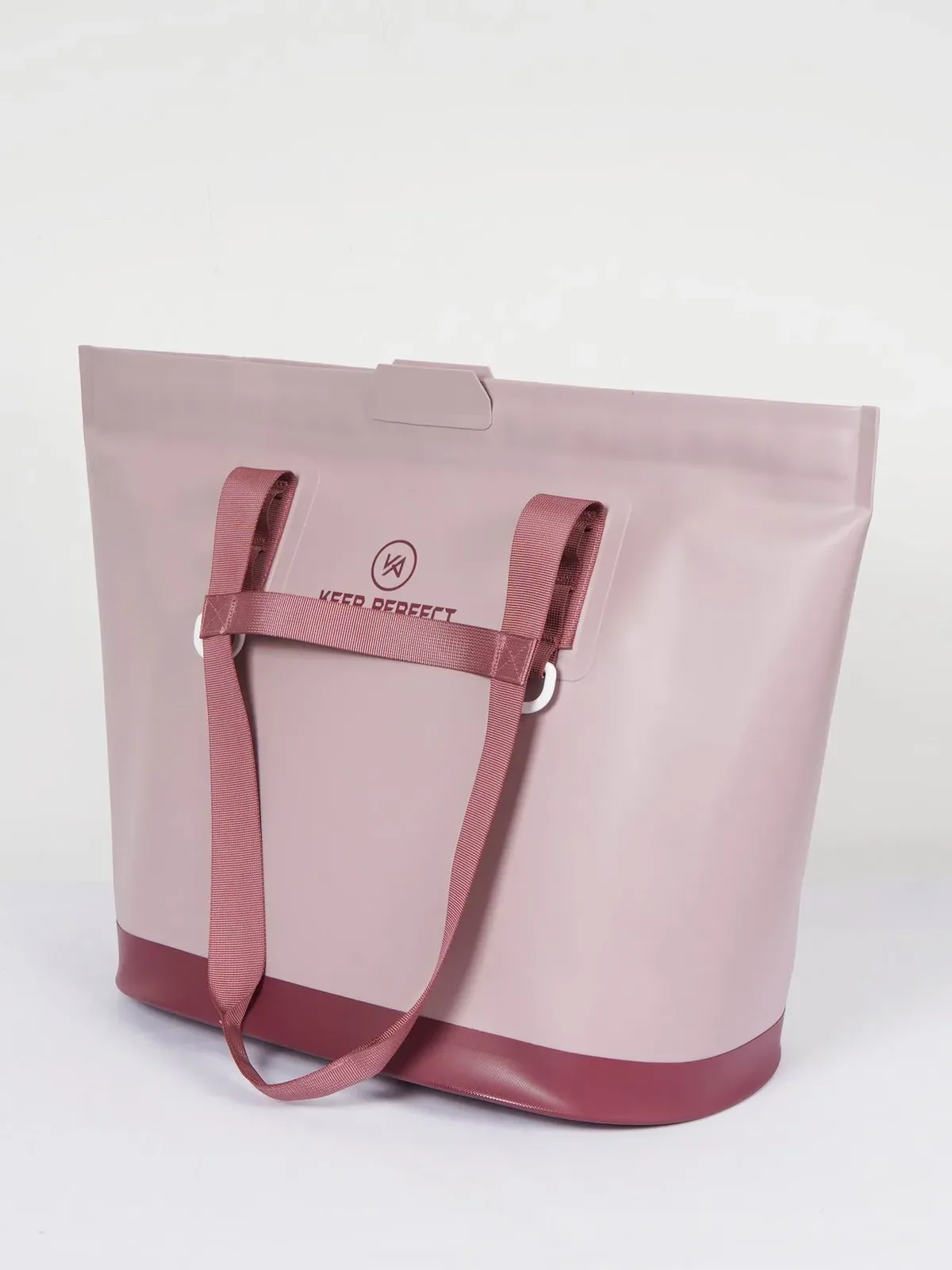
For a soft insulated bag the working answer is 8 mm of closed-cell PE or IXPE at 30-35 kg per cubic metre: it is the point where the wall stops being the dominant loss path, and it costs about 131 on a material index where 3 mm is 100. Use 5 mm where the window is under four hours, and 10 mm only where the ambient exceeds 30 °C or the route exceeds twelve hours.
Foam thickness is the first number a buyer asks for and the one most often chosen by habit. Ten millimetres sounds safer than eight, and eight sounds safer than five, but the return per millimetre falls away sharply and the cost — in weight, in carton cube and in a lid that will not close — keeps rising. This piece sets out the arithmetic behind the choice, the panel-by-panel answer that a real specification needs, and the two verification steps that stop the figure drifting between the sample and the container.
What Does Foam Thickness Actually Buy in Thermal Resistance?
Conduction through a closed cell wall is governed by the thickness divided by the thermal conductivity, so doubling the thickness doubles the resistance of that path, all else equal. The catch is that the wall is only one of several parallel paths. Once the wall resistance is high, the lid, the closure and the corner seams carry most of the heat, and adding to the wall moves the total only slowly. On a 20-can bag, 5 mm to 8 mm roughly doubles the window; 8 mm to 10 mm buys about a third again, and at a higher weight cost than the first step.
The material figure behind that is measurable rather than guessed. Steady-state thermal transmission of a foam sample is measured by the heat-flow-meter method in ASTM C518, and a specification worth defending asks for the result at a stated mean temperature rather than a catalogue figure measured at a different one. Ask for conductivity at the temperature the bag will actually run at.
| Nominal thickness | Wall resistance, relative | Ice retention, 20-can, 25 °C | Added weight | Material index |
|---|---|---|---|---|
| 3 mm | 1.0 | 2-3 hours | baseline | 100 |
| 5 mm | 1.7 | 4-6 hours | +90 g | 112 |
| 8 mm | 2.7 | 8-12 hours | +210 g | 131 |
| 10 mm | 3.3 | 12-16 hours | +320 g | 148 |
| 8 mm + aluminised facing | 2.7 plus radiant benefit | 14-20 hours | +250 g | 156 |
Why Does the Return Diminish After 8 mm?
Because the paths are in parallel, not in series. Total heat gain is the sum of what comes through the walls, the lid, the closure and the seams, and the arithmetic of a sum is that the largest term dominates. At 3 mm the walls are the largest term and thickness pays well. By 8 mm the walls have dropped below the lid, and further wall thickness is being spent on a term that is no longer in charge. The remaining money belongs on the lid panel, the storm flap and the closure.
There is a second reason, which is compression. A thicker foam layer in a soft bag is compressed more at the fold lines and under the load, and the effective thickness where it matters — at the corners, at the base, under the strap attachment — is below the nominal figure. A 10 mm specification that compresses to 7 mm at the corners performs like a 7 mm bag in the places that leak most.
A third reason is that thickness changes the internal volume available for the load, and on a fixed external dimension that is a real loss. A 20-can format taken from 5 mm to 10 mm in every panel gives up roughly two litres inside, which is three or four cans. Buyers who specify thickness without re-checking the internal dimensions end up with a bag that looks right and does not hold what the label says.
Does Foam Density Matter as Much as Thickness?
On a soft bag it often matters more, and it is the number buyers forget to specify. Two foams both sold as 8 mm can be 25 and 33 kg per cubic metre, and they behave differently in three ways that show up in the field: the lower-density board creases permanently at a fold, it recovers slowly after compression in a container, and it telegraphs its cell structure through a thin shell fabric. For a bag that ships flat and is expected to look flat on a shelf, density is the specification; thickness is only half of it.
Specify density with a tolerance and require a certificate with the foam lot. Then specify compression set or recovery: thickness retained after a stated load for a stated time at a stated temperature. A foam with a poor recovery figure will pass incoming inspection at nominal thickness and fail in service, which is the most expensive way to discover it.
Which Panel Should Get the Extra Millimetres?
Not the walls, in most cases. The base takes the load and loses heat into whatever the bag stands on, so it deserves full thickness. The lid is the shortest path to the load and the worst-performing panel in most bags, so it deserves the same thickness as the walls and a separate insulating flap over the closure. The side walls can run a millimetre thinner than the base and lid on a structured bag without measurable loss, which buys back weight where it is most visible to the user.
On a shoulder-carried insulated format the strap pad is worth specifying too: a strap carrying a 7 kg loaded bag concentrates load on a small area of the panel and compresses the foam under it. A reinforced patch that spreads the load protects both the foam and the weld line, and it costs less than the millimetre of wall foam it saves.
How Much Weight and Cube Does Each Millimetre Cost?
On a 20-can format, each additional millimetre of closed-cell foam across all six panels adds roughly 70 g at 30 kg per cubic metre, but the cube costs more than the weight. External dimensions grow by twice the thickness added per wall, so a bag taken from 5 mm to 8 mm grows about 18 mm in each dimension, which is a five to eight percent increase in packed volume. That increase lands in the container, not in the unit price.
The freight arithmetic is where the decision often reverses. A bag that is four percent dearer per unit and eight percent larger per unit can be dearer per delivered unit at the same freight rate, and the gap widens when rates rise. Run the landed-cost view before choosing a thickness, and run it again if the freight market moves between sampling and bulk.
What Happens to the Thickness Figure in Transit and Storage?
Foam is shipped and stored compressed, and it recovers at a rate that depends on the resin, the cell structure and the temperature. A roll of PE foam that has been stored flat under other goods for two months will not reach nominal thickness immediately after lamination, and a bag measured the day it is made can measure thin. The specification answer is to require a conditioning period before measurement and to measure at a stated temperature, because foam stiffness and recovery are temperature-dependent.
In transit the same effect is compressed further: cartons stacked five high put a sustained load on the bottom cartons. Ask how the cartons will be stacked, what the declared stack height is, and whether the pack-out uses internal supports. A programme that ships thousands of units a year should test a unit from the bottom carton of a real stack, not a unit from the top.
Storage temperature matters as much as load. Polyethylene foam becomes stiffer and slower to recover in a cold warehouse and softer in a hot one, so a bag measured in a cold room in January can read thin and the same bag measured in August can read full. State the conditioning temperature alongside the conditioning time; without both, two laboratories will disagree about the same foam.
Does the Shell Fabric Interact With the Foam Choice?
It does, through lamination and through what the fabric hides. Foam laminated to a woven shell with a flame or an adhesive bond adds stiffness, and a stiff panel resists the compression that costs the effective thickness, which is a quiet argument for a laminated build-up over a floated one. A floated foam layer inside a loose shell moves, creases and eventually settles into folds that leave gaps.
The second interaction is cosmetic and it drives returns: a low-density foam behind a light-coloured 210D or 420D shell telegraphs its cell structure as a visible texture once the bag is handled. Where the brand wants a smooth panel, either the foam density goes up or the shell weight does. Both cost money, and the choice belongs in the first costing rather than in a sample review.
Is 10 mm Ever the Right Answer?
Yes, in three situations: a route longer than twelve hours, an ambient that regularly exceeds 30 °C, or a bag that has to protect a frozen load rather than a chilled one. In all three the extra thickness is buying time against a large temperature difference, which is exactly the condition where wall resistance pays. It is also the right answer where the bag is structured rather than soft and the panel cannot compress, because then the nominal thickness survives to the field.
It is the wrong answer where the brief is a soft bag that must fold or pack flat, where the weight is carried on a shoulder strap, or where the carton cube is already tight. In those cases the same money spent on a reflective facing and a foam-filled lid flap buys more hours, weighs less, and folds.
Specifying foam thickness so it survives to the field
- Specify thickness and density together, each with a tolerance.
- Allocate the millimetres by panel: base and lid first, walls second.
- Ask for conductivity measured at the service temperature, not a catalogue figure.
- Require a compression-recovery figure and measure after a conditioning period.
- Run the landed-cost view, because cube costs more than the foam does.
Does the Foam Choice Change How the Bag Is Built?
Yes, in two ways that show up on the line. Thicker foam is stiffer, and a stiff panel does not turn a tight corner; a bag designed at 5 mm and rebuilt at 10 mm without a pattern change will have corners that resist closing and seams that are under strain at the fold. The pattern has to be re-cut for the thickness, which is why changing foam after sampling is a new sampling cycle rather than a material note.
The second effect is on the weld. Foam thickness changes the stack height at the seam and therefore the gap the welding electrode or the wedge has to bridge, and a parameter set tuned for one build-up under-welds another. Where the foam figure is likely to move during development, fix the weld parameters after the foam is fixed, and record both together on the approved sample.
How Do You Verify Thickness on Delivery?
Two measurements, done on the right sample. First, measure the foam sheet before lamination with a dial gauge at five points and record the mean and the range; a sheet outside tolerance costs less to reject than a bag. Second, cut a production bag and measure the build-up at the base, a side wall, the lid and a corner, because the corner is where the specification is most often quietly violated. Record the four figures with the unit identifier and the date.
| Verification step | Where it is done | What is recorded | Action if out of tolerance |
|---|---|---|---|
| Foam sheet gauge | Incoming, before lamination | Mean and range at five points | Reject the sheet lot; do not laminate and sort later |
| Cut-build check | One unit per inspection lot | Thickness at base, wall, lid and corner | Stop the line; re-set the lamination gap |
| Density certificate | Per foam lot | Density and lot number | Hold the lot pending a re-test |
| Recovery check | After a stated conditioning period | Thickness retained after load and dwell | Review the foam grade before the next run |
| Thermal re-test | Every programme, and after any foam change | Hours to the agreed endpoint | Treat as a new sampling cycle |

How Should Thickness Be Written Into the Tech Pack?
- Material family
- Closed-cell PE, XLPE or IXPE, named
- Thickness, base
- 8 mm, tolerance ±0.5 mm
- Thickness, side walls
- 8 mm, tolerance ±0.5 mm
- Thickness, lid
- 8 mm plus a 2 mm flap panel
- Density
- 33 kg/m³, tolerance ±2 kg/m³
- Thermal conductivity
- Stated at the service mean temperature
- Compression recovery
- Thickness retained after a stated load and dwell
- Facing
- Aluminised facing where the ambient exceeds 30 °C
- Verification
- Sheet gauge incoming, cut-build check per inspection lot
- Change control
- Written notice before any grade or supplier change
Two clauses close the specification. The first is change control: any change to foam grade, density or supplier requires written notice and a re-test, because a substitution that improves conductivity can still change compression, and compression is what fails in the field. The second is the retained reference sample: one unit from the approved run, held by both sides, against which the reorder is measured.
The programme arithmetic does not change with the foam figure: MOQ 500 pcs per style and colourway, sampling 6-10 working days, bulk production 35-50 days from sample approval, inspection at AQL 2.5 under ISO 2859-1 General Inspection Level II, T/T 30/70, FOB Xiamen. What changes is where in that window the thermal test sits, and the answer is early: run it on the sample, before the bulk clock starts.
Choose the thickness on numbers, not habit
Send the format, the window, the ambient and the freight constraints. You get a panel-by-panel build recommendation within one business day.
Frequently Asked Questions
What is the best foam thickness for an insulated cooler bag?
Eight millimetres of closed-cell PE or IXPE at 30-35 kg per cubic metre for a mainstream 8-12 hour bag. Five millimetres suits a window under four hours; ten millimetres suits a route over twelve hours or an ambient above 30 °C.
Is thicker foam always better?
No. The return per millimetre falls once the wall is no longer the dominant loss path, and the weight and cube costs keep rising.
Does foam density matter as much as thickness?
Often more. A low-density board creases at a fold, recovers slowly after compression, and telegraphs its cell structure through a thin shell.
Which panels need the most foam?
The base and the lid. The side walls can run a millimetre thinner on a structured bag without a measurable loss.
How much weight does 8 mm add over 5 mm?
About 210 g on a 20-can format, plus a five to eight percent increase in packed volume, which is the larger cost.
What standard measures foam thermal conductivity?
ASTM C518, the heat-flow-meter method for steady-state thermal transmission. Ask for the result at the service mean temperature.
Why does a 10 mm bag sometimes perform like a 7 mm one?
Compression. Thicker foam compresses more at the fold lines and under the load, so the effective thickness at the corners is below nominal.
How is foam thickness checked on delivery?
Gauge the sheet at five points before lamination, and cut one unit per inspection lot to check the base, a wall, the lid and a corner.
Should the foam be tested after the container journey?
Yes. Test a unit from the bottom carton of a real stack, because sustained stacking load is what reveals a poor recovery figure.
Does an aluminised facing replace thickness?
It is worth roughly an hour on a small format and more in sun, and it weighs almost nothing. It is an addition to 8 mm, not a substitute for it.
What tolerance should be written for foam thickness?
Plus or minus 0.5 mm on the sheet, with the same tolerance applied to the cut build-up at base, wall, lid and corner.
What is the MOQ for a custom foam build?
500 pcs per style and colourway, with repeat programmes open to discussion at 300 pcs.
People Also Ask
What foam thickness is best for a cooler bag?
Eight millimetres at 30-35 kg per cubic metre: the point where the wall stops dominating total heat gain.
Is 10 mm foam worth the cost?
Only for routes over twelve hours, ambients above 30 °C, or frozen loads. Otherwise spend it on the lid and a facing.
Does foam density affect ice retention?
It affects the delivered thickness after compression, which affects ice retention more than the nominal figure does.
How do I check foam thickness on a finished bag?
Cut one unit per inspection lot and measure the base, a side wall, the lid and a corner.
Why is my cooler bag thinner than specified?
Compression at the folds and under the load, plus insufficient recovery after storage or a container journey.
Sources and further reading
Every figure on this page is either our own programme data or attributed below. Open the originals before you write them into a specification.
- ASTM C518 — Steady-state thermal transmission properties by heat flow meterASTM International
- ISO 2859-1:1999 Sampling procedures for inspection by attributesInternational Organization for Standardization
- ASTM D6193 — Standard Practice for Stitches and SeamsASTM International