Cooler Bag vs Lunch Bag: What Is the Difference in Insulation?
The materials are the same; the geometry is not. A 5-litre lunch bag has about 58 square centimetres of wall per litre against 35 for a 13-litre cooler, so 6 mm of foam buys three to four hours in one and eight to twelve in the other.
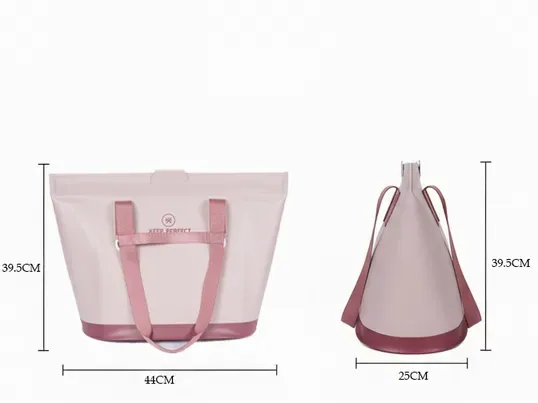
A cooler bag and an insulated lunch bag use the same materials and differ in geometry, and geometry decides the result. A 20-can cooler at 13 litres has roughly half the wall area per litre of a 5-litre lunch bag, so the same 6 mm of foam buys 8-12 hours in the cooler and 3-4 hours in the lunch format. Specify by the route or the day, not by the material list.
Buyers often treat cooler bags and insulated lunch bags as one category with two sizes, and then wonder why the small one underperforms. The materials are the same: closed-cell foam, a film liner, a woven shell, a closure. What changes is the surface-to-volume ratio, which changes the arithmetic of heat gain more than any material choice does. This guide separates the two formats on the numbers that matter to a specification — geometry, build-up, closure, test protocol and cost per hour of performance — and gives the decision rule for choosing between them.
Is the Difference One of Size or One of Construction?
It is a difference of geometry that forces a difference of construction. A lunch format is wide and shallow, because it has to take a sandwich box and a drink upright and it has to fit in a fridge or a locker. A cooler format is deeper and taller, because it takes cans lying down in rows and because depth reduces the area of the panel that leaks most, the lid. Once the geometry is fixed, the panel build-up follows: a lunch bag cannot carry 10 mm in the lid and still close, and a cooler bag can.
The practical consequence is that the two formats are quoted on different thicknesses for reasons that are structural rather than thermal. A lunch bag is typically 4-6 mm throughout with a 6 mm lid at best; a cooler bag is 5-10 mm with a lid that matches the walls. Any comparison between the two has to be made at the thickness each format can actually carry.
How Does Surface-to-Volume Ratio Change the Insulation Result?
Heat gain scales with area; the ability to absorb it scales with volume. A 5-litre lunch bag of roughly 240 x 150 x 180 mm has about 2,900 cm² of external area, or 58 square centimetres of wall per litre of capacity. A 13-litre cooler of roughly 360 x 230 x 250 mm has about 4,600 cm², or 35 square centimetres per litre. The small bag therefore loses heat about 1.7 times faster per litre of load, which is the entire reason a lunch bag cannot match a cooler bag on hours.
This is also why a half-empty cooler bag underperforms: filling it raises the thermal mass without changing the area. A 20-can bag loaded with six cans behaves closer to a lunch bag than to a cooler. Any performance claim should state the fill level, and for a route programme the fill level is part of the operational specification, not an accident of the day.
| Attribute | Insulated lunch format | Cooler format | Why it differs |
|---|---|---|---|
| Usable volume | 4-6 litres | 8-30 litres | Pack-out: a meal for one against cans in rows |
| External area per litre | 55-60 cm² | 30-40 cm² | Small formats leak faster per litre of load |
| Typical wall foam | 4-6 mm | 5-10 mm | Lid thickness is limited by how the bag closes |
| Typical lid foam | 0-6 mm | 6-10 mm | A shallow lid can carry more foam |
| Refrigerant | None, or a built-in phase-change sheet | 1-4 gel packs of 400 g | Hours are bought with refrigerant mass |
| Working window at 25 °C | 3-4 hours to 8 °C | 8-12 hours with gel packs | Geometry plus refrigerant |
| Typical closure | #5 coil or hook-and-loop | #8 or #10 coil under a storm flap | Opening width and cycle count |
What Foam Thickness Does Each Format Actually Use?
Lunch formats run at 4 mm in entry-level builds and 6 mm where a claim has to be defended, and 6 mm is the practical ceiling because the lid has to fold. Cooler formats run at 5 mm for a two-to-four hour beverage bag, 8 mm for the mainstream 12-hour brief, and 10 mm where the ambient or the route length justifies it. The step from 8 mm to 10 mm is usually taken in the walls only, because the lid is the panel where the thickness shows.
Density matters alongside thickness and is more often left unspecified. Closed-cell PE foam at 25 kg per cubic metre compresses and creases; the same thickness at 33 kg holds its shape and recovers after a container journey. On a lunch bag, which is carried every day and crushed in a bag or a locker, density is the more important of the two numbers. Specify thickness and density together, each with a tolerance.
Where Do the Two Formats Lose Cold Differently?
On a lunch bag the lid is 35-45% of the heat gain, the walls 20-25%, and the closure around 20%, because the closure runs almost the full width of a shallow bag. On a cooler bag the lid is 30-40% and the closure 20-30%, with the walls taking a smaller share because they are thicker. The ordering is the same but the magnitudes differ, which means the first upgrade for a lunch bag is the lid and the closure, while the first upgrade for a cooler bag is usually the lid and then the refrigerant.
Corner losses are proportionally larger on a lunch bag, because a small bag has the same four corners in a much smaller volume. Corner construction — welded with a foam insert, or sewn with the foam mitred — is therefore worth specifying explicitly on a small format, where it is worth an hour, and is nearly invisible on a large one.
The last geometric effect is the one buyers notice last: the stand. A cooler bag standing on a warm surface loses heat through its base at a rate decided by that surface, and a lunch bag sitting on a desk or in a locker does the same. Where a programme can specify the surface — a chilled depot floor, an insulated vehicle liner, a shelf in a cold room — the numbers change enough to be worth writing down, and they change more for the small format.
Do Lunch Bags and Cooler Bags Need the Same Liner?
The film can be the same, and on cost grounds usually is. What differs is the specification around it. A cooler bag liner has to survive meltwater, so the seam has to be welded or taped and the corners have to hold. A lunch bag liner has to survive wiping and food residue, and it is more likely to carry unwrapped food, so the food-contact declaration matters more and the cleanability of the corner radius matters more. Both are food-contact articles under EU 1935/2004 and FDA 21 CFR 177; the lunch bag simply gets tested against the stricter use case.
Where a lunch bag is aimed at children, the liner and the print are both in scope for CPSIA and EN 71-3, because a small bag is more likely to be mouthed and handled. That is a lunch-format question that rarely arises on a cooler format, and it changes the test plan rather than the material.
Which Closure Suits Which Format, and Why Does It Matter Thermally?
The closure is a thermal component, not a convenience. On a lunch bag the closure spans a wide, shallow opening directly under the lid, so a hook-and-loop tape that has collected lint is an open thermal path across the panel that leaks most. On a cooler bag the closure is narrower relative to the volume, but the bag is opened more often and for longer, so convective loss during opening dominates.
The specification response differs. On a lunch format, a #5 coil zipper under a foam-filled flap is the safe answer, and hook-and-loop should be a secondary closure rather than the primary one. On a cooler format, a #8 or #10 coil with a closed-end box under a storm flap, plus a magnetic or hook-and-loop secondary catch, keeps the flap closed when the user does not. Name the brand, the type, the gauge and the cycle rating in both cases.
How Do the Test Protocols Differ?
The protocol is the same in structure and different in the numbers: define the endpoint, the ambient, the load, the refrigerant, the conditioning and the instrument, then run three units and require two to pass. For a lunch bag the endpoint is usually 8 °C with a 1.2 kg load and no refrigerant. For a cooler bag it is 5 °C with a full can load and a stated gel-pack mass, or 50% ice remaining by mass for beverage programmes.
The number of openings is where protocols diverge most. A lunch bag is opened once or twice in its working window; a delivery cooler is opened every few minutes for hours. If the protocol does not state the opening count, a lunch bag protocol is being applied to a delivery bag by default, and the field result will be short by several hours.
| Protocol field | Insulated lunch bag | Cooler bag | Note |
|---|---|---|---|
| Endpoint | Core at or below 8 °C | Core at or below 5 °C, or 50% ice by mass | Pick one; do not quote both |
| Load | 1.2 kg simulant at 4 °C | 20 x 330 ml at 4 °C | State the mass, not the item count alone |
| Refrigerant | None, or a stated phase-change sheet | 3 x 400 g gel packs at -18 °C | Conditioning time matters |
| Ambient | 25 °C ± 2 °C | 25 °C or 32 °C, stated | Use the worst service ambient |
| Openings | None, or one at the midpoint | None, or a stated route simulation | The most-often-omitted field |
| Samples | Three, two must pass | Three, two must pass | Name the third-sample rule |
What Does Each Format Cost per Unit of Performance?
Cost per hour is the honest comparison and it is not close. A 6 mm lunch bag at a material index of 112 buys three to four hours; an 8 mm cooler at 131 buys eight to twelve, and it does so over four times the volume. Per litre-hour, the cooler format is far more efficient, which is simply the surface-to-volume ratio expressed in money. A buyer who needs hours should buy volume before buying thickness.
The exception is where the brief fixes the format: a workplace meal programme cannot hand out a 13-litre bag, and a pharmacy cold-chain pouch cannot either. In those cases the money goes to a phase-change sheet, a reflective facing and a better lid, and the buyer accepts three to six hours as the physical ceiling for that geometry. Stating the ceiling early saves a sampling cycle spent trying to beat physics.
When Should a Buyer Specify a Lunch Format Instead of a Cooler Format?
Specify the lunch format when the load is a single meal, the window is under four hours from a cold start, and the user carries the bag themselves. Specify the cooler format when the load is multiple servings or cans, the window exceeds four hours, or the bag sits in a vehicle between stops. The crossover is around four hours and around one litre per serving, and both are visible in the brief before any drawing is made.
Choosing between the two formats
- Geometry decides the ceiling: a small format cannot match a large one on hours.
- Buy volume before buying foam thickness; cost per litre-hour favours the bigger bag.
- On a lunch format the lid and the closure are the first upgrades, as on a cooler.
- State the fill level in the protocol; a half-empty cooler behaves like a lunch bag.
- Where the format is fixed by the brief, buy hours with a phase-change sheet.
How Do the Programme Numbers Differ Between the Two?
They do not. Both formats run on MOQ 500 pcs per style and colourway, sampling 6-10 working days from a signed-off tech pack, bulk production 35-50 days from sample approval, inspection at AQL 2.5 under ISO 2859-1 General Inspection Level II, T/T 30/70, FOB Xiamen. Lunch formats tend to sit at the faster end of the sampling window because there is no moulded base and fewer components; lunch formats with a built-in phase-change sheet sit at the slower end because the sheet is a sourced component with its own lead time.
Where a programme needs both formats, run them as one style family with one colourway and one closure specification. That consolidates the hardware buy, keeps the weld parameters common across both, and makes the reorder addendum a single document instead of two.
Where the two formats are sourced separately, the risk is not price, it is divergence: two weld windows, two foam lots, two closure suppliers and two reference samples, each drifting on its own. Buyers who consolidate usually find the saving in the reorder rather than in the first order, because the second run needs no re-approval. That is worth more than a small difference in unit price on the first 500 pcs.
What Goes Wrong When a Lunch Format Is Specified as a Small Cooler?
Three things, in order of cost. The buyer asks for the hours the cooler achieves and the sampling cycle is spent trying to reach them by adding wall foam, which closes the lid badly and makes the bag bulky. The thermal test is then run with a load larger than any user will carry, so the sample passes and the field result does not. And the closure, which on a small format is the second largest loss path, is specified last and gets the least attention.
The fix is to write the geometry into the brief at the start: the format follows from the load and the window, and the window follows from the surface-to-volume ratio. Once those three are fixed, the build-up and the closure are engineering rather than negotiation, and the sampling cycle is spent once instead of three times.
Size the format before you price it
Send the load, the window and the route. You get a format recommendation with the build-up and the test protocol behind it, within one business day.
Frequently Asked Questions
What is the difference between a cooler bag and an insulated lunch bag?
Geometry rather than material. A 5-litre lunch bag has about 58 cm² of wall per litre against 35 cm² for a 13-litre cooler, so the same foam buys 3-4 hours in one and 8-12 in the other.
Can a lunch bag be built to hold ice for 12 hours?
Not without a substantial phase-change mass. The surface-to-volume ratio sets a ceiling of roughly four to six hours for the format at 25 °C ambient.
Which format is more cost-effective per hour of cooling?
The cooler format, by a wide margin. Where hours are the requirement, buy volume before buying thickness.
Do the two formats use the same foam?
The same family, at different thicknesses and densities: 4-6 mm for lunch, 5-10 mm for coolers, with density specified alongside thickness.
Do lunch bags need gel packs?
Not for a three to four hour window from a cold start. Beyond that, a built-in phase-change sheet is the usual answer.
Is the liner specification the same for both?
The film can be; the surrounding specification differs. A lunch liner is more likely to carry unwrapped food and to be wiped, so cleanability and the food-contact declaration matter more.
Which closure is better on a lunch bag?
A #5 coil zipper under a foam-filled flap. Hook-and-loop is acceptable as a secondary closure but loses seal once the hook side loads with lint.
Why does my cooler bag underperform when it is half full?
Because the area is unchanged and the thermal mass is smaller. Fill level is part of the protocol, not an accident of the day.
Are the test protocols the same?
The structure is identical; the values differ. Lunch bags test to 8 °C with no refrigerant; coolers test to 5 °C or 50% ice remaining with a stated gel mass.
What is the MOQ for either format?
500 pcs per style and colourway, with repeat programmes open to discussion at 300 pcs.
Can both formats share a colourway and hardware?
Yes, and it is worth doing: it consolidates the hardware buy and keeps the weld parameters common across the family.
Which format samples faster?
A plain lunch format, because there is no moulded base. Adding a phase-change sheet moves it toward the 12-15 working day end of the window.
People Also Ask
What is the difference between a cooler bag and a lunch bag?
Volume and geometry. The materials are shared; the surface-to-volume ratio sets a different performance ceiling for each.
How long does a lunch bag keep food cold?
Three to four hours to 8 °C at 25 °C ambient with 6 mm foam and a load pre-chilled to 4 °C.
Why do bigger cooler bags hold ice longer?
Less wall area per litre of load, so slower heat gain per unit of thermal mass.
Can I use a lunch bag for a full day?
Only with a phase-change sheet and a cool ambient; the format alone gives three to four hours.
Which insulated bag size should I order?
Match the load and the window: lunch format for one meal under four hours, cooler format for multiple servings or longer routes.
Sources and further reading
Every figure on this page is either our own programme data or attributed below. Open the originals before you write them into a specification.
- ASTM D6193 — Standard Practice for Stitches and SeamsASTM International
- FDA 21 CFR 177 — Indirect food additives: polymersUS Food and Drug Administration
- ISO 2859-1:1999 Sampling procedures for inspection by attributesInternational Organization for Standardization