How to Choose Between Foam, Fibre and Vacuum Insulation for Bags
Closed-cell foam is the default, because it recovers from compression and does not take water up. Fibre wadding loses loft when compressed or wet. Vacuum panels give five to ten times the resistance per millimetre but cannot be cut, folded or sewn through.
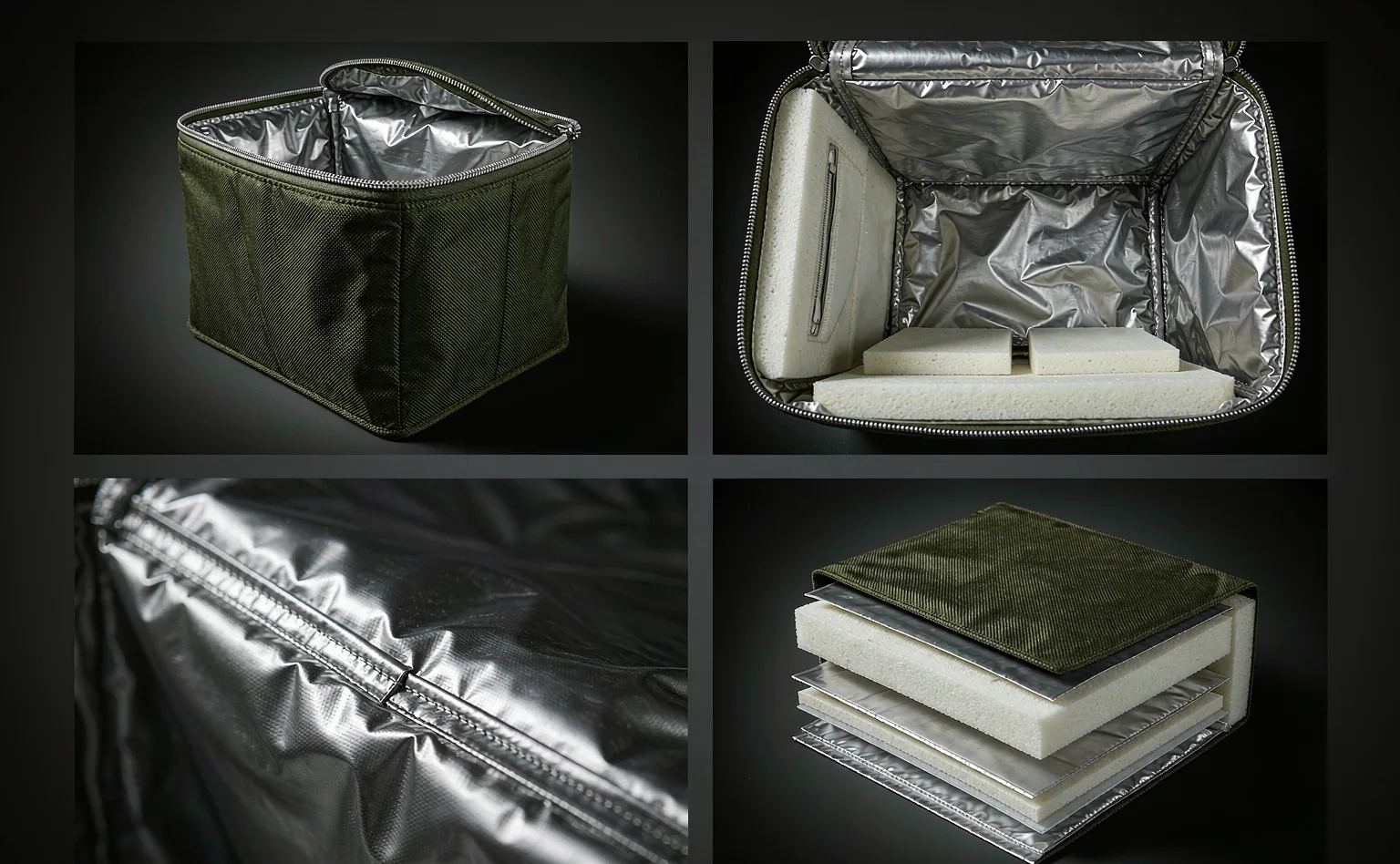
Closed-cell foam is the right answer for almost every soft insulated bag, because it insulates, it survives compression and it does not absorb water. Fibre wadding insulates well per gram when lofted and badly when compressed or wet, which rules it out of any bag that is packed tightly or washed. Vacuum insulated panels give five to ten times the resistance per millimetre but they are rigid, uncuttable and vulnerable to puncture, and they belong in a moulded shipper rather than a bag.
The insulation choice is the first structural decision in an insulated bag programme and the one that is most often made by copying the incumbent. Three technologies are available — closed-cell polymer foam, fibre wadding, and vacuum insulated panels — and they differ on five axes at once: resistance per millimetre, weight, compressibility, water behaviour and cost. This piece puts the three side by side and gives the decision rule for each duty.
How Do the Three Technologies Actually Insulate?
All three do the same thing, which is stop heat moving by conduction, convection and radiation. Closed-cell foam does it with gas trapped in sealed cells: the cells are small enough that convection is suppressed and the polymer path is long and thin. Fibre wadding does it by trapping air in a tangle of filaments, and it relies on the loft — the thickness of the trapped layer — for its resistance. A vacuum insulated panel removes the gas entirely: an evacuated core in a sealed barrier film, with conduction suppressed because there is almost no gas left to conduct.
The differences follow from those mechanisms. Foam resists compression because the cells are closed and pressurised. Fibre loses its loft under load, and with it most of its resistance. A vacuum panel has the highest resistance per millimetre of the three, but only while the vacuum holds, and a puncture or a barrier failure turns a high-performance panel into a poor one.
| Property | Closed-cell foam | Fibre wadding | Vacuum insulated panel |
|---|---|---|---|
| Resistance per 10 mm, relative | 1.0 | 0.7-0.9 lofted, 0.3 compressed | 5-10 |
| Density, kg per cubic metre | 25-40 | 8-20 lofted | 180-220 |
| Behaviour under compression | Recovers; loses some thickness | Loses loft and most resistance | Rigid; does not compress |
| Water behaviour | Closed cells do not absorb | Absorbs and loses resistance when wet | Barrier film protects the core |
| Can it be cut and sewn | Yes | Yes | No — cut or punctured, the panel fails |
| Typical use in bags | The default for every soft format | Decorative or low-duty linings | Moulded shippers and rigid panels |
Why Does Closed-Cell Foam Dominate Soft Bags?
Because a soft bag is folded, packed, sat on and washed, and foam survives all four while the other two do not. A bag is compressed in a carton, in a vehicle and under its own load; foam recovers from that, fibre does not. A bag gets wet inside; closed cells do not take water up, and a wet fibre loses most of what it had. And a bag has corners; foam can be mitred or welded at a corner, where a vacuum panel cannot go at all.
Foam also laminates and welds, which matters more than it sounds. A liner welded to a foam-backed panel is one article rather than three layers that can move against each other, and that is what keeps a bag feeling solid after a season. Fibre has to be quilted or bagged to stay in place, and every quilt line is a stitched path through the insulation.
When Is Fibre Wadding the Right Choice?
Three situations, none of them thermal-performance-led. Where the bag has to compress flat for storage or for the return leg, and the insulation is allowed to recover — a fibre layer recovers from folding better than a thick foam does. Where the insulation layer is required to be a soft, quiet, textile hand rather than a springy board. And where the thermal duty is genuinely light and the brief is a short window from a cold start.
The failure mode is water, and it is worth stating bluntly: fibre that has been wetted and then compressed does not recover its loft, and the bag that tested well on day one performs badly after the first wash. Where a fibre insulation is specified, specify a hydrophobic fibre and a bagging film, and test after a wash cycle rather than before one.
Is a Vacuum Insulated Panel Ever Right for a Bag?
Rarely, and only in a rigid or semi-rigid article. A vacuum panel gives five to ten times the resistance of foam per millimetre, which is transformative in a moulded shipper where wall thickness is expensive and where the panel can be protected by a rigid shell. In a soft bag the same panel is a liability: it cannot be cut, it cannot be folded, it cannot be sewn through, and a puncture from a strap rivet or a dropped tool destroys it silently, because the panel looks the same after it fails.
There is a partial answer for semi-rigid bags: a vacuum panel in the base only, protected by a moulded tray, with foam in the walls and the lid. That captures most of the benefit where the bag sits on a warm surface, which is where the loss is, without putting the panel where it gets flexed. It adds cost and it adds a component with a service life, so it has to be justified by the duty.
There is a fourth technology worth knowing about and worth usually declining: reflective and metallised film systems. A reflective facing laminated to foam reduces radiant gain and is worth an hour or so on a small format, and it weighs almost nothing, but it is an addition to an insulation rather than an insulation. A bag built with facing and no foam is a bag that performs well in a shade test and badly in any real duty.
What Does Each Option Cost, and Where Does the Cost Land?
Foam is priced by volume, so the cost follows the thickness and the density, and it is the lowest of the three per bag at any given performance level. Fibre is priced by weight and is low in cost per kilogram but needs more thickness and a bagging operation, so the assembled cost is comparable to foam at a lower performance. Vacuum panels are priced per panel and are several times the cost of the foam they replace, plus the tooling for the tray that protects them.
The cost that rarely gets counted is the freight. A vacuum panel allows a thinner wall, which allows a smaller bag, which allows more units per container; where the duty justifies the panel, that cube saving partly pays for it. The same arithmetic works against fibre, which needs more thickness for the same result and therefore more cube. Run the landed cost, not the unit cost.
How Does Each Option Affect the Way the Bag Is Built?
Foam is laminated to the shell and welded or sewn at the seams, which is the standard construction and the reason the trade is organised around it. Fibre has to be contained: quilted between two fabrics, or bagged in a film, and each containment method adds a sewing operation and a leak path. A vacuum panel has to be located and protected, which means a moulded tray or a rigid frame, and the bag stops being a bag in the conventional sense.
There is a quality consequence too. Foam thickness is measurable with a gauge at incoming inspection and at a cut-build check, so it is controllable; fibre loft is hard to measure consistently and is usually controlled by weight per unit area instead. A vacuum panel can only be verified by a thermal check on the panel or the finished article, which is a slower and more expensive control.
Choosing the insulation technology
- Closed-cell foam is the default: it compresses and recovers, and it does not take water up.
- Fibre is for light duty and for bags that must fold flat, and it must be bagged and hydrophobic.
- Vacuum panels belong in a moulded shipper, or in a protected base, not in a flexible wall.
- Judge on landed cost: thickness drives cube, and cube drives freight.
- Choose the technology you can measure at incoming inspection.

The second effect of the choice is on the end of the product life, which more brands now have to answer for. A foam-lined bag is a mixed-material article that is difficult to separate; a fibre-filled one is easier to separate and easier to recycle where the streams exist; a vacuum panel has to be removed before anything else can be processed. Where a brand has published a packaging commitment, the insulation choice is inside its scope and should be flagged at specification rather than at review.
There is a related question on recycled content. A foam or a fibre can carry recycled content with a transaction certificate behind it, and that documentation is a separate discipline from the thermal specification. Where a brand wants both a recycled claim and a thermal claim, plan both files at the same time, because a material substitution made to satisfy one can invalidate the other.
How Should the Choice Be Verified Before Bulk?
With a thermal test on the assembled bag, not with a material datasheet. Measure the conductivity of the candidate insulation by ASTM C518 at the service mean temperature, then build the bag and run the agreed protocol. The two numbers will not agree, because the bag is decided by the lid, the closure and the openings; the value of the material test is that it makes the second build comparable with the first.
Then add the durability tests that a datasheet does not carry: a compression-recovery check on the insulation after a stated load and dwell, a wet-flex or wash cycle followed by a re-test, and a cut-build check on a production unit. Those three are what separate an insulation that performs on day one from one that performs in month six.
| Duty | Insulation that fits | Why | What to avoid |
|---|---|---|---|
| 12-hour beverage cooler | Closed-cell foam, 8 mm | Compression recovery and water behaviour | Fibre; it loses loft where the bag folds |
| Lunch format, short window | Closed-cell foam, 6 mm, or a hydrophobic fibre | Thin walls and a folding lid | Thick foam in the lid; the bag will not close |
| Grocery delivery, daily service | Closed-cell foam, 6-8 mm | Washable and repeatable | Fibre; the first wash is where it fails |
| Pharmaceutical shipper | Vacuum panel in a moulded tray | Resistance per millimetre where cube is dear | A panel in a flexible wall; it will puncture |
| Event catering, single use | Closed-cell foam, 5 mm | Cost per unit and adequate window | Over-specifying; the duty is two hours |
A third verification is worth adding where the duty is harsh: an accelerated ageing check. Hold a production unit at an elevated temperature for a stated period, or cycle it between cold and ambient, then re-run the thermal protocol. Both foam and fibre change over time, and the change is slow enough to be invisible in a six-week development cycle and fast enough to matter in a two-year service life.
There is also a service question that belongs in the specification rather than in the warranty: what happens when the insulation is damaged. A foam panel that has been crushed can sometimes be recovered by lofting; a fibre that has matted cannot; a vacuum panel that has been punctured cannot be repaired at all and takes the whole article with it. Where a fleet maintains its own bags, the repairability of the insulation is a cost line, and foam wins it.
Finally, decide who owns the thermal number after launch. A programme that tests the first run and never tests again will not notice a slow drift until a customer complains, and by then the evidence is two years old. Put a re-test on the calendar — annually, or every third tranche — and the number stays current against a modest cost.
A fourth consideration is noise and hand-feel, which sounds cosmetic until a premium positioning is involved. Foam is springy and quiet; fibre is soft and quiet when new and becomes lumpy after washing; a vacuum panel is hard and sounds hollow when tapped. Where the product is positioned on touch, that is a specification line rather than a remark, and it is one of the few places where fibre genuinely wins.
Where Do the Programme Numbers Sit?
The technology choice does not change the commercial frame: MOQ 500 pcs per style and colourway, sampling 6-10 working days, bulk production 35-50 days from sample approval, inspection at AQL 2.5 under ISO 2859-1 General Inspection Level II, T/T 30/70, FOB Xiamen. What it changes is the sampling window, because a vacuum panel or a moulded tray is a sourced component with its own lead time, and that moves the build toward the 12-15 working day end.
It also changes the reorder risk. A foam specification can be controlled at incoming inspection on every run; a vacuum panel specification depends on a component supplier and a barrier integrity that is difficult to verify without a thermal test. Where a programme is going to repeat, that difference is worth more than the performance gain.
Match the insulation to the duty
Send the duty, the window, the ambient and the quantity. You get an insulation recommendation with the verification plan behind it, within one business day.

Frequently Asked Questions
Which insulation is best for an insulated bag?
Closed-cell polymer foam for almost every soft bag, because it recovers from compression and does not absorb water. Fibre suits light duty and folding lids; vacuum panels suit rigid shippers.
Why not use fibre wadding in a cooler bag?
Fibre loses loft under compression and loses most of its resistance when wet. A bag is compressed in use and washed in service, which is exactly the condition fibre fails in.
Are vacuum insulated panels used in bags?
Rarely, and only in rigid or semi-rigid articles. A panel cannot be cut, folded or sewn through, and a puncture destroys it without any visible change.
How much better is a vacuum panel than foam?
Roughly five to ten times the resistance per millimetre. That benefit only holds while the vacuum holds, and it requires a moulded tray to protect the panel.
Does foam thickness or insulation type matter more?
Type sets the ceiling and thickness moves within it. A foam that recovers and stays dry beats a higher-conductivity material that does not.
Which insulation survives washing?
Closed-cell foam. A hydrophobic fibre can be specified with a bagging film, but it should be re-tested after a wash cycle rather than before one.
How is insulation performance measured?
ASTM C518 on the material at the service mean temperature, then a thermal protocol on the assembled bag. The two numbers will not agree, and that is expected.
Which insulation is lightest?
Fibre, by weight per unit of thickness, but it needs more thickness for the same result. Vacuum panels are the heaviest per unit volume and the thinnest for the performance.
Does the choice change the freight cost?
Yes. Thickness drives carton cube, so a thinner high-performance wall can partly pay for itself in units per container.
Can a vacuum panel go in the base only?
Yes, in a semi-rigid bag with a moulded tray. It captures the benefit where the bag sits on a warm surface without putting the panel where it flexes.
What is the MOQ for a bag with a vacuum panel?
500 pcs per style and colourway, and the panel and tray usually move sampling toward 12-15 working days because they are sourced components.
How do I control insulation quality run to run?
Gauge the foam sheet at incoming inspection, cut-check the build-up per inspection lot, and re-run the thermal protocol after any material change.
Is aerogel used in bags?
It appears in some specialist cold-chain articles as a flexible blanket, at a cost that is hard to justify for a general insulated bag programme.
What inspection applies regardless of insulation?
AQL 2.5 for major defects to ISO 2859-1 at General Inspection Level II, with a defect class list written for the duty.
People Also Ask
What is the best insulation for cooler bags?
Closed-cell PE or EVA foam: it recovers from compression and does not absorb water, which fibre does not manage.
Is fibre insulation any good in a bag?
Only for light duty and folding lids, and only when hydrophobic and bagged, because it loses loft when wet.
Are vacuum insulated panels used in soft bags?
No. They cannot be cut, folded or sewn through, and a puncture destroys them invisibly.
How much insulation do I need in a delivery bag?
Six to eight millimetres of closed-cell foam, with the opening count mattering more than the wall.
Which insulation lasts longest in service?
Closed-cell foam at 30-35 kg per cubic metre, because it is the one that can be verified at incoming inspection on every run.
Sources and further reading
Every figure on this page is either our own programme data or attributed below. Open the originals before you write them into a specification.
- ASTM C518 — Steady-state thermal transmission properties by heat flow meterASTM International
- ISO 2859-1:1999 Sampling procedures for inspection by attributesInternational Organization for Standardization
- ISTA 7 Series — Thermal transport packaging performance testsInternational Safe Transit Association