How Do You Keep Whites and Sparkling Wine Cold in a Wine Bag?
Keeping a white or a sparkling wine cold in a bag is a refrigerant and condensation problem rather than a wall-thickness problem. Six to eight millimetres of closed cell, a welded lining and about 300 g of gel per bottle for a two to four hour window.
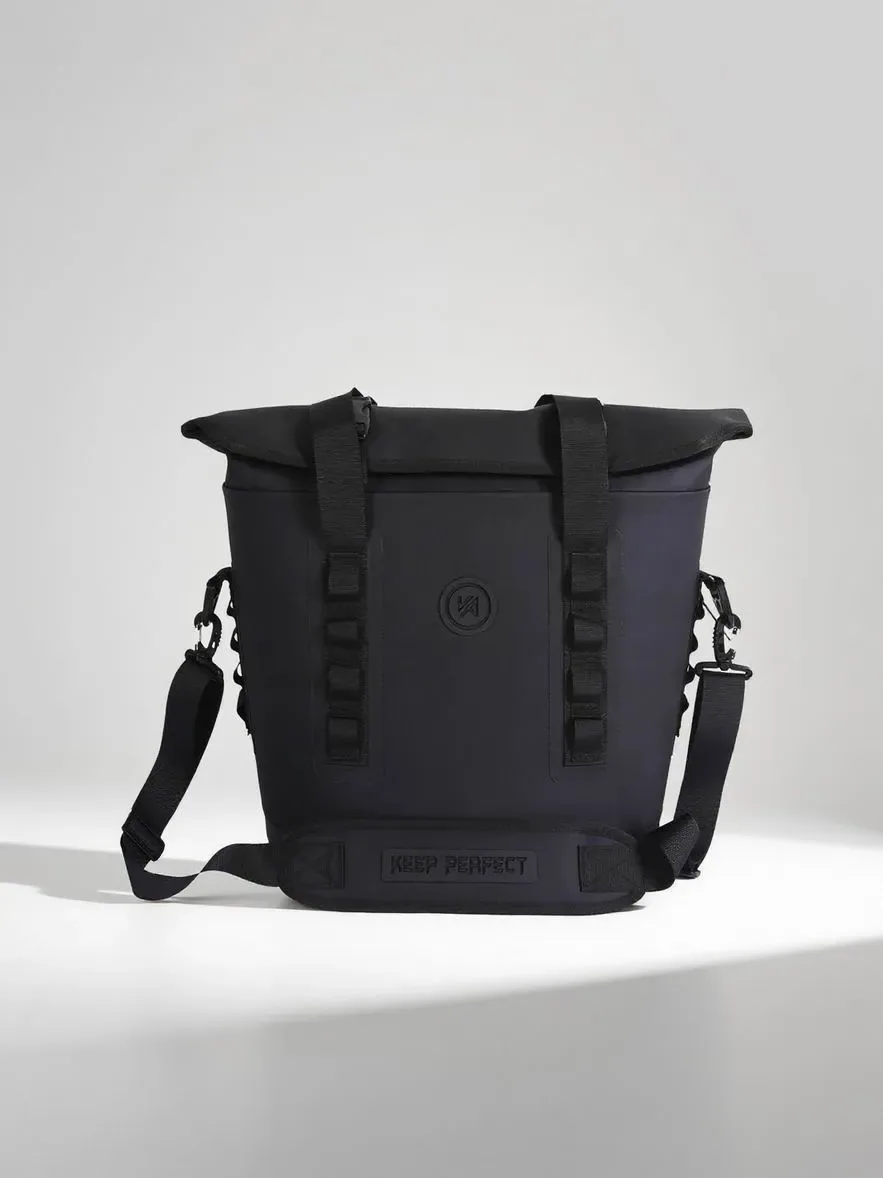
Keeping a white or a sparkling wine cold in a bag is a refrigerant and condensation problem rather than a wall-thickness problem. The working answer is 6-8 mm of closed-cell foam, a welded lining, a covered closure, a gel pack of about 300 g per bottle for a two to four hour window at 25 degrees, and a closed-cell divider, because an insulated bag is cold and damp inside by design.
A chilled white is the hardest load a wine bag carries. It has to be cold when it arrives, it produces condensation for the whole journey, and the thing that keeps it cold is the same thing that produces the water. Programmes specify the foam and forget the refrigerant, or specify both and put a paperboard divider into a bag that is permanently wet inside.
The courier-route version of this is in Insulated Wine Totes for Couriers, and the wider insulation material position sits in the cooler bag programme hub. This piece takes the chilled bottle itself.
What Temperature Do Whites and Sparkling Wines Travel At?
Around eight to twelve degrees for a white and a sparkling wine, and the band matters more than the midpoint. A wine that arrives at fourteen is not spoiled and it is not right; a wine that arrives at four is dulled. Write the band and the duration on the specification and the bag can be built to hold it, which is a different exercise from holding a maximum.
The starting condition is the part programmes leave out. A bottle loaded at eight degrees from a cellar and a bottle loaded at twelve from a shop fridge are two different problems, and the second one needs more refrigerant for the same window. Where the load starts warm, the refrigerant is doing the cooling as well as the holding, and the mass roughly doubles.
The third number is the ambient. A bag specified for a 20 degree European spring and used in a 32 degree summer is a bag that fails, and it fails in the month the programme is busiest. Name the ambient range on the tech pack and size the refrigerant for the top of it.
| Load | Start temperature | Target band | Ambient | Refrigerant per bottle | Insulation |
|---|---|---|---|---|---|
| Still white, cellar cold | 8 degrees | 8-12 degrees | 25 degrees | about 200 g | 6 mm closed cell |
| Still white, shop fridge | 12 degrees | 8-12 degrees | 25 degrees | about 300 g | 6-8 mm closed cell |
| Sparkling, cellar cold | 8 degrees | 8-12 degrees | 30 degrees | about 350 g | 8 mm closed cell |
| Sparkling, shop fridge | 12 degrees | 8-12 degrees | 30 degrees | about 450 g | 8 mm plus a reflective layer |
| Red, ambient protection | 18 degrees | 16-20 degrees | 35 degrees | about 150 g, or none | 6 mm closed cell |
| Rosé, long route | 8 degrees | 8-12 degrees | 30 degrees | about 400 g | 8 mm, compartmented |
How Long Does a Two-Bottle Insulated Bag Hold a Chilled Load?
Two to four hours with about 300 g of gel per bottle at 25 degrees ambient, and four to six hours with about 400 g, on the assumption that the bag is closed. Every opening costs air exchange and most of the margin, so a route with six stops is closer to the two-hour case than to the four-hour one however long the window is.
The reason the number is not higher is that a wine bag is a small cavity with a large surface-to-volume ratio. A cooler box holding twelve litres has a slow temperature rise; a two-bottle wine bag holding one and a half litres has a fast one, because there is more wall per litre of payload. Insulation thickness helps and it does not change the geometry, which is why the refrigerant matters more than the foam.
Where a programme genuinely needs six hours or more, the honest answer is a different article: a shipper with a phase-change pack sized to the window, and a bag that is a carrying case rather than a thermal device. Trying to stretch a soft two-bottle bag to eight hours produces a heavy bag that still misses.
Does a Gel Pack Belong in a Wine Bag?
Yes, and in a pouch rather than against the glass. A pack frozen to minus eighteen degrees held directly on a bottle is a thermal shock to the wine and it will mark or lift a label, and both are returns. A pouch on the inner wall, sized to the pack so the pack cannot migrate, gives the cooling without the contact.
The second question is the pack specification, and it is worth being precise because it is the difference between a two-hour and a four-hour window. A gel pack is specified by mass, by freeze point and by how long it takes to freeze. A pack that has been in a freezer for two hours is not at its freeze point and it will not give its full capacity; that is a pack-out instruction rather than a design question, and it belongs on the card in the carton.
The third is what happens when the pack melts. Meltwater has to go somewhere, and in a bag with a sewn lining it goes into the foam through the needle holes. That is the next question and it is the one that decides the lining.
How Much Insulation Holds a White at Serving Temperature?
Six to eight millimetres of closed-cell foam in every panel including the base, and the base is the panel that gets left out. The base is where the bottle sits and where the board is, and a board conducts. Six millimetres minimum under the base, eight where the route is long.
Thickness has diminishing returns and the reason is conduction through the cell structure rather than the number on the drawing. Going from 6 mm to 8 mm buys a meaningful extension of the window; going from 8 mm to 12 mm buys less than the weight and the cube it costs. Where more performance is needed, the refrigerant is the lower-cost lever.
A reflective layer inside the lining adds a little and it is worth including on a long route, but it is not a substitute for thickness. Three millimetres of foam behind a reflective layer is a marketing specification and it will be found out on the first hot day.
What Does Condensation Do Inside an Insulated Wine Bag?
It collects at the bottom of the cell, and the bottom of the cell is where the divider sits. That is the whole problem in one sentence and it is the reason a chilled wine bag is a different specification from a dry one. A paperboard divider in a chilled bag will soften from its own condensation over a season, and the softening is progressive and invisible until the cells start to rattle.
The second effect is on the lining. Condensation and meltwater sit in the bottom of the cavity, and a sewn lining is perforated at every needle hole. Water reaches the foam, and wet foam of any kind loses most of its insulating value, so the bag that was specified at 8 mm performs at 3 mm by the end of a season.
The third effect is on the bottle itself. A wet label lifts, a wet capsule rusts and a wet case marks. Where a programme is shipping a labelled bottle to a recipient, a divider that separates the label from the condensation — a closed-cell cell with a small drainage path at the base — is worth specifying.
Keeping a white cold in a wine bag
- Write the target as a band and a duration, and name the ambient range it has to hold in.
- About 300 g of gel per bottle for two to four hours at 25 degrees, in a pouch rather than on the glass.
- Six to eight millimetres of closed cell in every panel, including the base, which is the one that is missed.
- A welded lining: a sewn seam perforates the liner and lets water into the foam.
- A closed-cell divider, because the bottom of the cell is where the condensation collects.
Which Liner Handles Meltwater and Condensation?
A welded thermoplastic lining, and the reason is the seam rather than the polymer. A welded seam is continuous; a sewn seam is a line of holes, and in a chilled bag those holes are a route for water into the insulation. That is the single specification that decides whether the bag performs in month three as it did in week one.
The polymer choice is between a thermoplastic polyurethane film and a coated polyester, and it is decided by cold-flex and abrasion rather than by temperature range. A film that stiffens and cracks in a cold vehicle has failed by the end of winter, whatever its nominal range says. Ask for the cold-flex figure and for a weld strength figure, and test both on the liner material.
One point that is specific to wine rather than to food: a bag carrying a sealed bottle is generally not a food-contact article, because the bag never touches the contents. Where the same bag is used for food as well, the position changes and a declaration under Regulation (EC) No 1935/2004 belongs in the file. Confirm which case applies before the material is ordered.
| Element | Dry lane | Chilled lane | Why it changes |
|---|---|---|---|
| Lining seam | sewn is acceptable | welded | A sewn seam is a line of holes into the foam |
| Divider | paperboard is acceptable | closed cell, 3-5 mm | Condensation collects at the bottom of the cell |
| Refrigerant | none | about 300 g per bottle in a pouch | The refrigerant is what holds the band |
| Base panel | 2 mm board | 2 mm board plus 6-8 mm foam | The base is where the bottle sits and a board conducts |
| Closure | a flap is enough | a covered zip | An uncovered closure is the fastest thermal loss |
| Pack-out card | optional | required: freeze time and pouch | A pack that is not fully frozen gives less capacity |
How Is a Chilled Wine Bag Tested?
With a temperature logger against the bottle, on the real route, at the top of the ambient range, with the real number of openings. That is the only test that produces the number the specification was written in — a band over a duration with a stated opening count — and no chamber result substitutes for it. Loggers are inexpensive and the run costs an afternoon.
The mechanical test is separate and it is the one a network recognises: ASTM D5276, free fall of the filled bag, one fresh production sample per orientation, pass on no breakage, no opened seam and no glass exposed. Where the programme travels as a parcel, ask whether the network enforces a thermal procedure of its own; the ISTA 7 series covers thermal transport packaging.
The third test is the one that catches the failure nobody plans for: a wet soak. Fill the bag, add the refrigerant, leave it for the length of the route, tip it out and measure what is in the lining and in the foam. If the foam is wet, the lining seam is wrong, and it will be found by a customer in month three rather than by the test in week one.
What Does the Insulated Build Add to the Programme Cost?
About 300 to 500 g and meaningful volume per bag, and both are charged for. The bag does not fold, so it ships erected, and freight is charged on whichever is greater, the weight or the volume — and an insulated wine bag is mostly air. On a programme buying thousands, the freight line is often larger than the difference between an insulated and an uninsulated unit.
The comparison to run is the landed one: units per carton and cartons per container for the erected bag, and the same figures for a version designed to nest or knock down. the landed cost calculator exists for this, and the answer usually changes the decision rather than confirming it.
There is a second recurring cost that belongs in the same table. A heavier bag moves a consignment into a higher weight band in a parcel network, and that band is paid on every delivery for the life of the programme. On a direct-to-consumer wine programme, that recurring number dwarfs the one-off difference in bag cost.
- Target band
- A temperature band and a duration, in degrees and hours
- Ambient
- The top of the range the bag has to hold in
- Start condition
- The temperature the bottle is loaded at
- Refrigerant
- Type, mass per bottle, freeze point, freeze time and the pouch
- Insulation
- Material, thickness and density, in every panel including the base
- Lining
- Polymer, gauge, weld method, cold-flex figure and weld strength
- Divider
- Closed cell, thickness, density and the cell dimension
- Closure
- A covered zip, with the cover drawn
- Tests
- A logged route run, ASTM D5276, and a wet soak of the lining
- Pack-out card
- Freeze time, pouch position, and close at every stop
When Is Insulation Not Worth Specifying?
On a handover at a counter, on a short urban route from a cold vehicle, and on any programme where the bottle is inside its window for the whole journey anyway. Insulation adds weight, volume and cost, and where it is not doing a job it is all three for nothing. The test is simple: if the bottle arrives inside the band without it, do not specify it.
The second case is a presentation bag that is given rather than shipped. A chilled bottle handed over at a cellar door in a padded bag with no insulation arrives cold, because the journey is thirty seconds. Specifying a thermal build there is paying for a window nobody uses.
The third case is the one worth arguing about: a long route where the load starts warm. Insulation without refrigerant does almost nothing, and refrigerant without insulation does a little. Either specify both or specify neither and manage the route instead — a shorter route, a later dispatch, a cold vehicle.
On the programme side the frame is unchanged: MOQ 500 pcs per style and colourway, sampling 6-10 working days from a signed-off tech pack with the physical bottles and the gel pack in hand, bulk production 35-50 days from written sample approval, inspection at AQL 2.5 under ISO 2859-1 General Inspection Level II, T/T 30/70, FOB Xiamen. The one addition for a chilled build is a foam thickness and density check on the drawn sample, because both are invisible in a photograph and both decide whether the bag performs.
Size the refrigerant and the lining together
Send the bottle shapes, the start temperature, the window and the ambient range. You get an insulation build, a refrigerant load and the test that holds them, within one business day.
Frequently Asked Questions
What temperature should a white wine travel at?
Around eight to twelve degrees, written as a band and a duration rather than as a single maximum.
How long will an insulated wine bag keep a white cold?
Two to four hours with about 300 g of gel per bottle at 25 degrees ambient, and four to six hours with about 400 g, with the bag closed.
How thick should the insulation be for a chilled wine bag?
Six to eight millimetres of closed-cell foam in every panel, including the base. Going past 8 mm buys less than the weight and the cube cost.
Should a gel pack touch the bottle?
No. Put it in a pouch on the inner wall. A pack frozen to minus eighteen degrees held on glass is a thermal shock and it will lift a label.
Why does my insulated wine bag stop working after a season?
Water in the foam. A sewn lining is perforated at every needle hole, and condensation and meltwater reach the insulation through it. Specify a welded lining.
Can a paperboard divider be used in a chilled wine bag?
No. Condensation collects at the bottom of the cell, which is where the divider sits. Use a closed cell at 3 to 5 mm.
Does the starting temperature of the bottle matter?
Yes, and by more than the ambient. A bottle loaded at twelve degrees needs roughly twice the refrigerant of one loaded at eight, because the pack is cooling as well as holding.
How is a chilled wine bag tested?
A temperature logger against the bottle on the real route at the top of the ambient range with the real opening count, plus ASTM D5276 and a wet soak of the lining.
Does a wine bag need a food contact declaration?
A bag holding a sealed bottle generally does not, because the bag never touches the contents. Where the same bag carries food, a declaration under Regulation (EC) No 1935/2004 belongs in the file.
What does insulation add to the freight cost?
About 300 to 500 g and meaningful volume per bag, and the bag ships erected. Compare landed numbers for the erected bag and a nested version.
When is insulation not needed for wine?
At a counter handover, on a short route from a cold vehicle, and anywhere the bottle is inside its band for the whole journey anyway.
What is the MOQ for an insulated wine bag for whites?
MOQ is 500 pcs per style and colourway, and 300 pcs can be discussed on a repeat. Sampling is 6-10 working days with the bottles and the gel pack in hand.
How do I stop the foam drifting on a reorder?
Put the thickness and the density on the tech pack with a tolerance and hold a sealed sample. A lower-density sheet looks identical and performs differently.
What inspection applies to a chilled wine bag order?
ISO 2859-1 at General Inspection Level II with AQL 2.5, plus a stated foam thickness and density check on the drawn sample.
People Also Ask
How do you keep white wine cold in a bag?
Six to eight millimetres of closed cell, a welded lining, a covered closure and about 300 g of gel per bottle in a pouch, for a two to four hour window at 25 degrees.
How long does an insulated wine bag keep wine cold?
Two to four hours with 300 g of gel per bottle and four to six hours with 400 g, closed, at 25 degrees ambient.
Can I use an ice pack in a wine bag?
Yes, in a pouch on the inner wall rather than against the glass, and frozen to its stated freeze point rather than for two hours.
Why does my insulated wine bag get wet inside?
Condensation from a chilled bottle collects at the bottom of the cell. A closed-cell divider and a welded lining handle it; paperboard and a sewn seam do not.
Do I need insulation to carry red wine?
Usually not for a short journey. Insulation on a red is about avoiding heat at the top of the range rather than about holding a cold load.
Sources and further reading
Every figure on this page is either our own programme data or attributed below. Open the originals before you write them into a specification.
- ISTA 7 Series — thermal transport packaging performance testsInternational Safe Transit Association
- Regulation (EC) No 1935/2004 on materials and articles intended to come into contact with foodEuropean Union, EUR-Lex
- ASTM D5276 — drop test of loaded containers by free fallASTM International