What Should an Insulated Wine Bag for Couriers Actually Hold?
An insulated wine bag on a courier route is a refrigerant and opening question rather than a wall-thickness question. Six to eight millimetres of closed cell, a welded lining, and a refrigerant load sized to the window and to the number of stops.
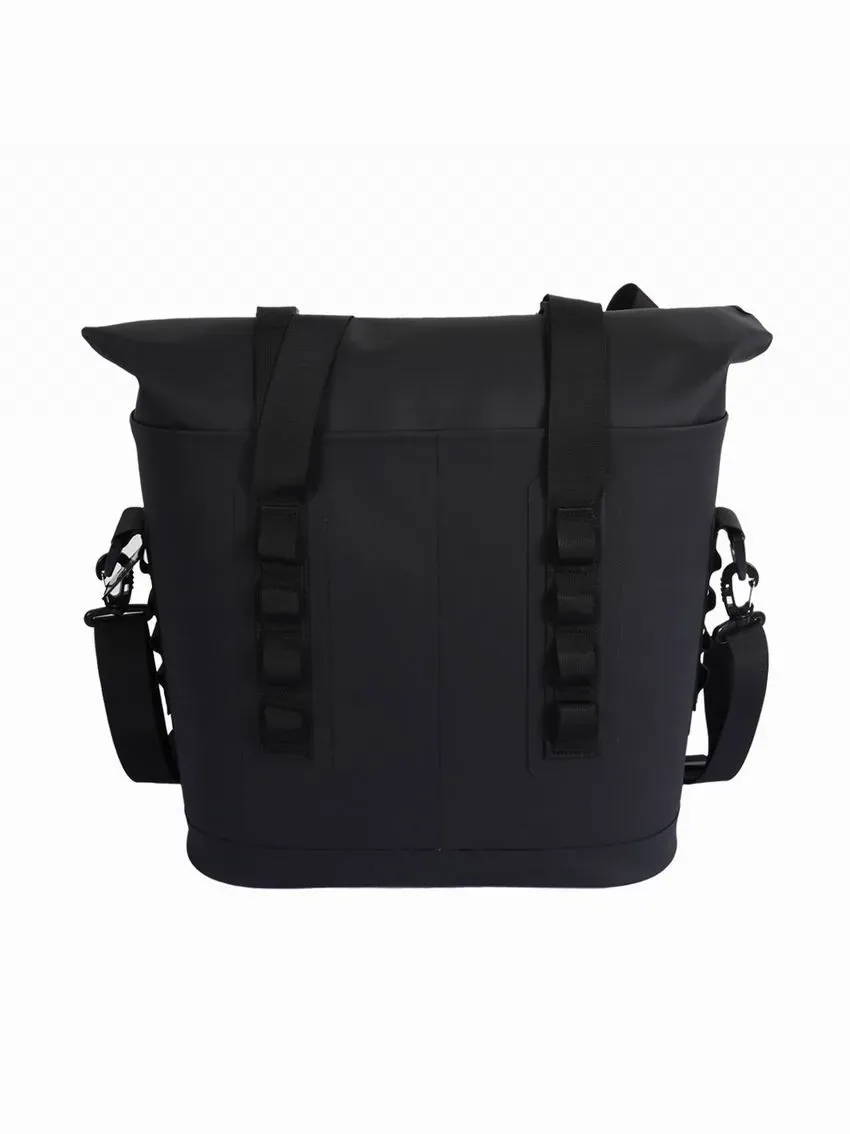
An insulated wine bag for a courier route is a refrigerant and opening question, not a wall-thickness question. The working build is 6-8 mm of closed-cell foam, a welded lining, a covered closure, a divider that is closed cell because the bag is cold inside, and a documented refrigerant load for the route window. The bag is opened at every stop, and every opening is the whole thermal problem.
Wine delivery is the case where an insulated bag earns its cost and the case where it is most often specified wrongly. The specification arrives as a foam thickness and the failure arrives as a warm bottle, because the two things that decide the temperature are the refrigerant mass and the number of times the bag is opened, neither of which is on the drawing.
The bottle dimensions and the drop test sit in the wine bag programme hub, and the wider insulation material position is in the cooler bag programme hub. This piece takes the courier route itself.
Does Wine Need Insulation in Transit?
It needs protection from a temperature excursion rather than from warmth alone, and the distinction matters. A red wine travelling at 30 degrees for four hours is not damaged in the way a chilled white at 20 degrees is, but both are damaged by a fast change and by heat at the top of the range. The failure customers actually report is a bottle that arrived warm and a cork that has moved, and the second is a heat problem.
The second reason to insulate is mechanical rather than thermal. A padded insulated bag with a closed-cell divider and a welded lining survives a courier network better than an unpadded one, because the same materials that slow a temperature change also absorb a knock. On a two-bottle delivery bag the insulation is doing two jobs and it is worth specifying it for both.
The case where insulation is the wrong answer is a short urban route with a single drop and a chilled load held in a cold vehicle, where the bottle is inside the window anyway and the bag is only carrying it from the door to the table. That is a presentation question and not a thermal one, and it is covered by the reusable build in Reusable Wine Bags for Retail.
What Temperature Window Should a Wine Delivery Bag Hold?
The window is set by what the wine is and by how long the route is, and it should be written as a band rather than as a maximum. A still red is generally carried within a band around cellar temperature, a white and a sparkling wine around eight to twelve degrees, and the difference between the two is a different bag for many programmes. Write the band and the duration on the specification, not a single number.
The duration is the part that decides the build. A two-hour window is achievable with modest insulation and a small refrigerant load. A six-hour window needs more of both, and the marginal cost of the second four hours is larger than the first two. Programmes that specify an eight-hour window for a route that averages ninety minutes are paying for refrigerant they will never need and carrying weight they do not have to.
Where the route crosses a climate boundary — out of a refrigerated vehicle into a summer street, repeatedly — the number that matters is the number of openings rather than the total time, and that is the next question.
| Route window | Refrigerant load, per bottle | Insulation | Closure | Divider | Verdict |
|---|---|---|---|---|---|
| up to 2 hours | one small gel pack, about 200 g | 6 mm closed cell | a covered flap | closed cell | a padded bag with a small pack |
| 2 to 4 hours | about 300 g per bottle | 6-8 mm closed cell | a covered zip | closed cell | the working courier build |
| 4 to 6 hours | about 400 g per bottle, split | 8 mm closed cell | a covered zip and a pouch | closed cell | specify the refrigerant and log the run |
| over 6 hours | a phase-change pack sized to the window | 8 mm plus a reflective layer | a covered zip, sealed | closed cell | a shipper, not a carrying bag |
| chilled with no timing | not specified | insulation only | a covered flap | closed cell | an unmanaged result |
How Much Insulation Does a Two-Bottle Delivery Bag Need?
Six to eight millimetres of closed-cell foam in every panel, including the base, and the base is the panel that gets left out. A two-bottle insulated bag with foam in the walls and none in the base loses most of its advantage through the bottom, because the bottom is where the bottle sits and where the board is, and a board is a conductor. Six millimetres minimum in the base, eight where the route is long.
The second requirement is that the insulation be continuous rather than pieced. A bag with foam panels that stop short of a seam has a thermal bridge at every join, and the bridge is where the temperature moves. On a welded-liner construction the liner does most of this work; on a sewn one, ask where the bridge is and what closes it.
A reflective layer inside the lining adds a little and it is worth including on a long route, but it is not a substitute for thickness. The physics that matters is conduction through the foam, and thickness and cell structure are the two levers. A reflective layer with 3 mm of foam is a marketing bag.
How Many Openings Does a Delivery Route Make?
One per stop, and each one costs the bag its cold air and most of its refrigerant margin. A route with twelve stops and a two-hour window is a harder thermal problem than a route with one stop and a four-hour window, because the air in the bag is exchanged twelve times and the refrigerant is sized for conduction rather than for exchange. This is the single most under-specified number in wine delivery.
Two design answers work. A compartment layout that lets an operator open one cell rather than the whole bag, which is a divider question and also a handling question. And a refrigerant load sized to the number of openings as well as to the window, which is a specification question and the one that gets skipped.
The operational answer matters as much and it belongs in the pack-out instruction: pre-chill the load, load the bag in the order the drops will be made, and close the bag at every stop even when the next one is thirty seconds away. A bag left open at a doorstep for a signature has lost the run.
Which Liner Suits a Delivery Wine Bag?
A welded thermoplastic lining, and the reason is the seam. A sewn lining is perforated by every needle hole, and in an insulated bag that means meltwater and condensation reach the foam, which is the one thing that destroys closed-cell performance over a season. A welded seam is continuous at the join and it keeps the water out of the insulation.
The polymer choice is between a thermoplastic polyurethane film and a coated polyester, and the decision is about abrasion and cold-flex rather than about temperature range. A film that stiffens and cracks in a cold vehicle is a film that has failed by the end of winter. Ask for the cold-flex figure and for a weld strength, and test both on the liner material rather than on the finished bag.
One point that is specific to wine rather than to food delivery: a bag carrying a sealed bottle is generally not a food-contact article, because nothing in the bag touches the contents. Where a programme also delivers food in the same bag, the position changes and a declaration under Regulation (EC) No 1935/2004 belongs in the file. Confirm which case applies before the material is ordered.
Does the Divider Work in an Insulated Bag?
It works better than in an uninsulated one, provided it is closed cell. An insulated bag is cold and damp inside by design, so the divider is permanently in the wet — which is the condition that rules paperboard out entirely. EVA or closed-cell foam at 3 to 5 mm, slotted into the base board, and the cell dimension stays the same as it is in an uninsulated bag.
The second point is that a divider in an insulated bag is a thermal bridge if it is built wrong. A full-height divider that touches the top and the bottom of the cavity connects the warm outer face to the cold inner one, and it carries heat in. It is a small effect compared with an open closure and it is worth one line of attention: the divider can stop short of the top face, and the neck block can do the restraining.
The third point is the refrigerant pouch. Where a gel pack is carried, it belongs in a pocket that keeps it off the glass — a frozen pack held directly against a bottle at minus eighteen degrees is a thermal shock, and it can also mark a label. A pouch on the inner wall, sized to the pack, is the specification.
Building an insulated wine bag for a courier route
- Write the window as a band and a duration, and size the refrigerant to both.
- Six to eight millimetres of closed cell in every panel, including the base.
- A welded lining: a sewn seam perforates the liner and lets water into the foam.
- Count the openings. Every stop costs the bag its cold air and most of its margin.
- A closed-cell divider, because an insulated bag is cold and damp inside by design.
How Is an Insulated Wine Bag Tested?
With a logged run on the actual route, and no laboratory result substitutes for it. Instrument the bag with a temperature logger against the bottle, load it the way the operator will load it, run the real route with the real stop count, and read the curve. The result is a band over a stated duration with a stated number of openings, which is exactly the form the specification should have been written in.
The laboratory test that is worth paying for is the mechanical one, because it is the one a network will recognise: ASTM D5276, free fall of the filled bag, one fresh production sample per orientation, pass on no breakage, no opened seam and no glass exposed. Where the bag travels as a parcel, ask whether the network enforces a thermal procedure of its own — the ISTA 7 series covers thermal transport packaging — and run what the network recognises.
Two conditions are worth adding to the logged run, because they are the conditions in which field failures happen. Run it in summer ambient rather than in a mild week. And run it with the vehicle at the temperature it will actually be at, because a bag that starts warm needs more refrigerant than the specification allowed for.
| Test | What it measures | How to run it | What it decides |
|---|---|---|---|
| Logged route run | The temperature band over the real route | A logger against the bottle, the real stop count, summer ambient | The refrigerant load and the insulation thickness |
| Drop test, ASTM D5276 | Whether the bag contains the bottle | One fresh production bag per orientation, filled with bottles | Whether the build survives the network |
| Cold soak of the liner | Whether the film cracks in a cold vehicle | A stated soak at a stated temperature, then a flex | The liner polymer |
| Weld strength | Whether the lining seam holds | A stated peel or burst figure on the liner material | The weld parameters |
| Opening count test | The cost of each stop | The route run with the bag opened at every stop | Whether a compartment layout is needed |
What Does an Insulated Build Add to Cube and Weight?
About 300 to 500 g per bag and a meaningful amount of volume, and both are charged for. An insulated two-bottle bag does not fold, so it ships erected, and erected volume is what a forwarder charges on when it exceeds the weight. On a delivery programme that is buying thousands of bags, the freight line on the erected bag is often larger than the difference in unit price between an insulated and an uninsulated build.
The mitigation is the same one the whole category uses: ask for units per carton and cartons per container for the erected bag, and for a version designed to nest or knock down, and compare the two landed numbers rather than the two unit prices. the landed cost calculator exists for exactly this comparison, and it is the reason an insulated programme should be quoted as a landed number.
There is a second and smaller effect: a heavier bag moves the consignment into a higher weight band in the parcel network, and that recurring charge is paid on every delivery for the life of the programme. On a direct-to-consumer wine programme that recurring number dwarfs the one-off difference in bag cost.

How Do Courier Programmes Order and Reorder?
The commercial frame is the same as it is everywhere in the category: MOQ 500 pcs per style and colourway, sampling 6-10 working days from a signed-off tech pack with the physical bottles and the gel pack in hand, bulk production 35-50 days from written sample approval, inspection at AQL 2.5 under ISO 2859-1 General Inspection Level II, T/T 30/70, FOB Xiamen. The Incoterm question is the one worth deciding early, and the Incoterm decision tool walks through it.
The specification drift on a reorder is thermal rather than visual, and it is the reason an insulated wine bag programme needs a tighter reference than an uninsulated one. Foam thickness is invisible in a photograph and it is the whole performance. A closed-cell sheet substituted at a lower density looks identical and performs differently at the end of the second hour. Put the thickness and the density on the tech pack with a tolerance and hold a sealed sample.
The last piece is the operating instruction, and it is the lowest-cost thing on the whole programme. Pre-chill the load, load in drop order, keep the pack in its pouch, close the bag at every stop. A printed card in every carton costs almost nothing and it is the difference between the bag performing to its test and performing to a complaint.
- Window
- A temperature band and a duration, stated in degrees and hours
- Refrigerant
- Type, mass per bottle, the frozen temperature and the pouch
- Insulation
- Material, thickness and density, in every panel including the base
- Lining
- Polymer, gauge, weld method and the cold-flex figure
- Divider
- Closed cell, thickness, density and the cell dimension
- Closure
- Covered zip, with the cover drawn
- Stop count
- The number of openings the bag is sized for
- Tests
- A logged route run, plus ASTM D5276 on the filled bag
- Pack-out
- Units per carton for the erected bag and for a nested version
- Instruction
- A printed card: pre-chill, load in drop order, close at every stop
Size the refrigerant before the foam
Send the route window, the stop count, the bottle shapes and the ambient range. You get an insulation build, a refrigerant load and the test that holds them, within one business day.
Frequently Asked Questions
Do wine bags need insulation for delivery?
For a route of more than about two hours, or any route crossing a hot ambient, yes. The insulation also protects the bottle mechanically, which on a courier network is half the value.
What temperature should a wine delivery bag hold?
Write it as a band and a duration: a red around cellar temperature, a white and a sparkling wine around eight to twelve degrees, over the actual route window.
How thick should the insulation be?
Six to eight millimetres of closed-cell foam in every panel, including the base. The base is the panel that gets left out and it is where the bottle sits.
How much refrigerant does a wine bag need?
About 300 g of gel per bottle for a two to four hour window at 25 degrees, and about 400 g for four to six hours. Confirm against a logged run on the actual route.
Does the number of delivery stops matter?
It matters more than the total time. Every stop exchanges the air in the bag and costs most of the refrigerant margin, so a twelve-stop route is harder than a four-hour single drop.
Should the lining be welded or sewn?
Welded. A sewn lining is perforated by every needle hole, and in an insulated bag that lets meltwater and condensation into the foam, which destroys closed-cell performance over a season.
Can paperboard dividers be used in an insulated wine bag?
No. An insulated bag is cold and damp inside by design, so the divider is permanently in the wet. Use EVA or closed-cell foam at 3 to 5 mm.
Where does the gel pack go?
In a pouch on the inner wall. A pack frozen to minus eighteen degrees held against glass is a thermal shock and it will mark a label.
How is an insulated wine bag tested?
With a logged run on the real route with the real stop count and summer ambient, plus ASTM D5276 on the filled bag for the mechanical question.
Does an insulated wine bag need a food-contact declaration?
A bag carrying a sealed bottle generally does not, because nothing in the bag touches the contents. Where the same bag delivers food, a declaration under Regulation (EC) No 1935/2004 belongs in the file.
What does insulation add to freight?
About 300 to 500 g and meaningful volume, and the bag does not fold, so it ships erected. Compare landed numbers for the erected and a nested version rather than unit prices.
What is the MOQ for an insulated wine bag?
MOQ is 500 pcs per style and colourway, and 300 pcs can be discussed on a repeat. Sampling is 6-10 working days with the bottles and the gel pack in hand.
How do I stop the foam drifting on a reorder?
Put the thickness and the density on the tech pack with a tolerance and hold a sealed sample. A lower-density sheet looks identical and performs differently at the end of the second hour.
What inspection applies to an insulated wine bag order?
ISO 2859-1 at General Inspection Level II with AQL 2.5, plus a stated foam thickness and density check on the drawn sample because those two are invisible in a photograph.
People Also Ask
Do I need an insulated bag to deliver wine?
For a route over about two hours or any hot ambient, yes. Insulation also cushions the bottle, which is half the value on a courier network.
How long will an insulated wine bag keep a bottle cold?
Two to four hours with about 300 g of gel per bottle, and four to six hours with about 400 g, at 25 degrees ambient with the bag closed.
How thick should wine bag insulation be?
Six to eight millimetres of closed-cell foam in every panel, including the base, and welded rather than sewn.
Can I put an ice pack in a wine bag?
Yes, in a pouch on the inner wall rather than against the glass. A pack frozen to minus eighteen degrees held on a bottle is a thermal shock.
How do I test an insulated wine bag?
A temperature logger against the bottle on the real route with the real stop count in summer ambient, plus ASTM D5276 on the filled bag.
Sources and further reading
Every figure on this page is either our own programme data or attributed below. Open the originals before you write them into a specification.
- ISTA 7 Series — thermal transport packaging performance testsInternational Safe Transit Association
- ASTM D5276 — drop test of loaded containers by free fallASTM International
- Regulation (EC) No 1935/2004 on materials and articles intended to come into contact with foodEuropean Union, EUR-Lex