Custom Cooler Bag Materials: TPU, PVC, Oxford and 840D Compared
TPU is a weldable, abrasion-resistant polymer; PVC welds beautifully and is progressively restricted on plasticiser grounds; Oxford is a weave rather than a material; and 840D is a yarn weight. Specify polymer, weave and finish as three separate lines, each with the test that verifies it.
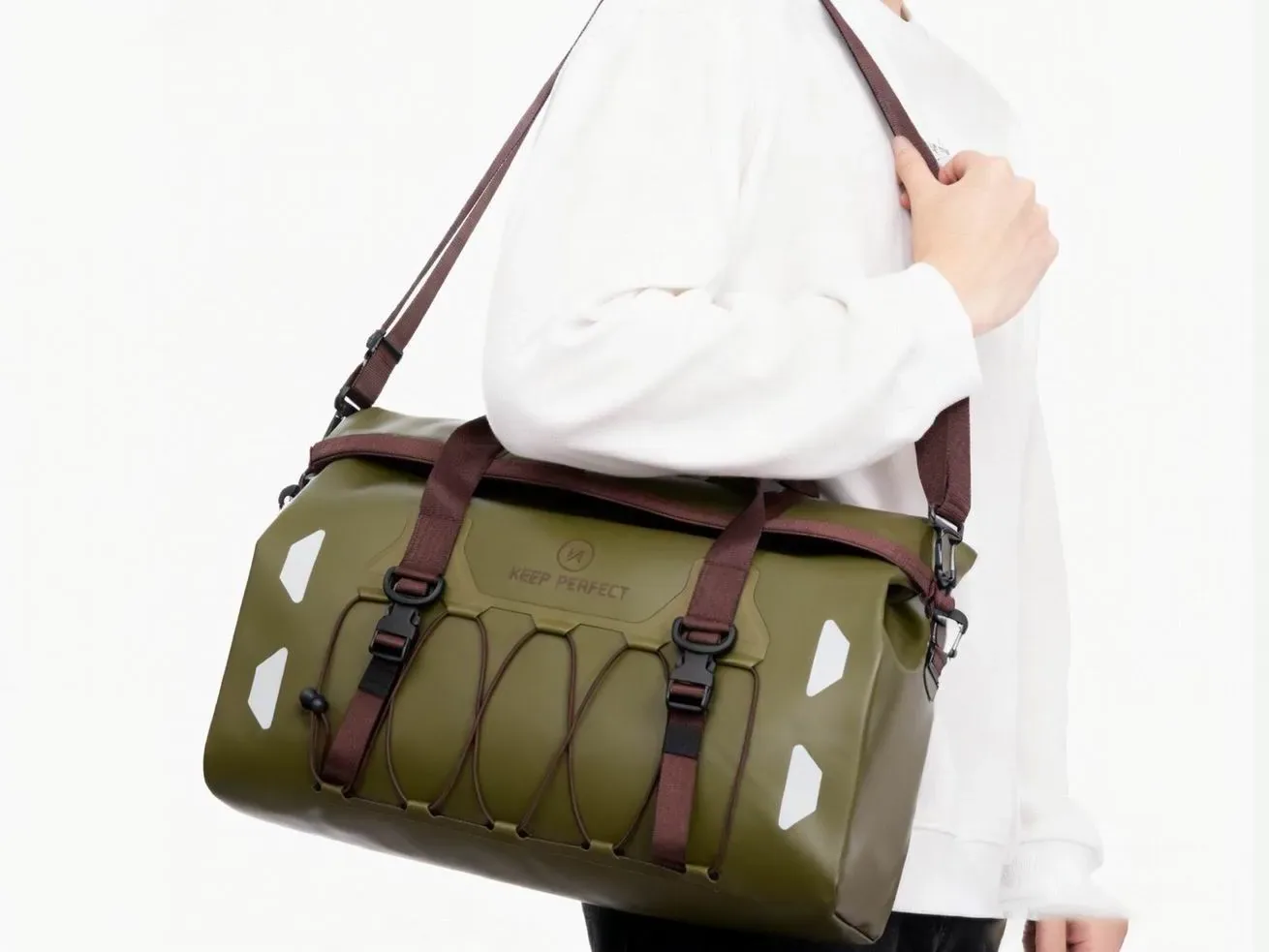
Four materials carry most cooler bag specifications. TPU is a weldable, abrasion-resistant film or coating for liners and for hard-wearing shells. PVC backs and films weld beautifully and are progressively restricted on plasticiser grounds. Oxford is the weave, not the material: 420D, 600D and 840D are yarn weights in the same polyester or nylon family. Choose the shell by abrasion and coating, and the liner by compliance and weld.
Material lists on cooler bag quotations are often a mixture of chemistry, weave and marketing, and the three get compared as if they were the same kind of thing. TPU is a polymer; PVC is a polymer with a plasticiser problem; Oxford is a weave available in several polymers; 840D is a yarn weight. This piece separates the four, explains what each one actually decides in a specification, and gives the test methods that make the choice verifiable.
What Is Oxford, and Is It a Material or a Weave?
Oxford is a weave, not a fibre. It is a basket-weave construction in which two fine warp yarns weave against one heavier weft yarn, which gives a fabric with a visible texture, good dimensional stability and a flat surface that takes a coating well. It is made in polyester and in nylon, and it is sold by denier: 210D, 420D, 600D and 840D are the common steps, where the denier number is the mass in grams of 9,000 metres of the yarn. Higher denier means thicker yarn, a heavier fabric and better abrasion.
So "840D Oxford" is a specification of yarn weight and weave, and it still leaves the polymer and the coating open. An 840D polyester Oxford with a PU coating and an 840D nylon Oxford with a TPU coating are different fabrics with different abrasion, different hand and different cost. Specify all three: polymer, weave and finish.
| Fabric | What the number means | Typical weight | Where it appears on a cooler bag |
|---|---|---|---|
| 210D Oxford | Light yarn, fine texture | About 90 g/m² | Lining fabrics, light-duty shells |
| 420D Oxford | Mid-weight, the volume choice | About 160 g/m² | Mainstream cooler and lunch shells |
| 600D Oxford | Heavier, better abrasion | About 220 g/m² | Delivery bags, fleet service |
| 840D Oxford | Heavy yarn, high abrasion | About 300 g/m² | Base panels, high-wear zones |
| 840D ballistic weave | Two-ply yarn in a basket weave | About 320 g/m² | Base and corner reinforcement |
When Is TPU the Right Choice?
TPU, thermoplastic polyurethane, appears in cooler bags in three forms: as a liner film, as a coating on a woven shell, and as a clear or coloured film panel. As a liner it welds well, it resists abrasion and puncture, it stays flexible at low temperature and it tolerates repeated washing, which is why it is specified where a bag is washed at temperature. As a coating it gives a shell water resistance and abrasion without the plasticiser question that PVC carries.
The two things to check on a TPU grade are hydrolysis resistance and yellowing. Polyester-based TPU grades resist abrasion and are the common choice; polyether-based grades resist hydrolysis and microbial attack better and are the choice for a wet, warm service. Some aromatic grades yellow under ultraviolet exposure, which matters on a light-coloured panel; an aliphatic grade does not, at a higher price. Specify the grade, not the acronym.
Why Is PVC Being Specified Out?
PVC is an excellent processing material: it welds beautifully by radio frequency, it is tough, and it is inexpensive. Its problem is not the polymer but the package that makes it flexible. Phthalate plasticisers, and the stabiliser systems that used to accompany them, appear on restricted-substance lists — on the REACH candidate list in the European Union and on the Proposition 65 list in California — and a growing number of retailers restrict them outright rather than testing for them.
The second pressure is end of life. PVC is difficult to recycle in the streams most brands now commit to, and chlorine content is a problem in several take-back schemes. The consequence is that PVC persists where the duty is harsh and the brand has no restriction, and disappears where a retailer list applies. Where a programme sells into more than one market, the strictest list sets the material, and PEVA or TPU usually wins by default.
How Do the Four Compare on the Tests That Matter?
Four tests decide a shell specification. Abrasion: the fabric is rubbed against a standard abradant to a stated end point, and a coating usually improves the result more than a heavier yarn does. Tear: a tongue-tear or an Elmendorf method measures resistance to a propagating tear, and this is where a high-denier woven fabric earns its weight. Tensile: ISO 13934-1 gives the breaking force and elongation of the fabric. Colourfastness to light: AATCC 16 gives a grade after a stated exposure, and it is the test that decides whether a brand colour survives a season in a shop window.
None of those four is a water test. Water resistance is a separate measurement — a spray test for repellency and a hydrostatic head test for penetration — and it belongs on the specification separately, because a fabric can be highly repellent and still leak under pressure at a seam. Where a bag is described as water-resistant, ask which of the two was measured and at what value.
Which Material Should Go Where on a Cooler Bag?
A rational allocation is a coated 600D or 840D Oxford for the base and the lower side panels where abrasion and set-down damage happen; a 420D or 600D shell for the upper panels where weight and hand matter more; a welded TPU or PEVA liner for the cavity; and a TPU coating rather than a PVC backing wherever a restricted-substance list applies. That mix costs less than specifying the heaviest fabric everywhere and performs better.
The corners and the strap attachments are worth calling out separately. Those are the points where a bag fails, and a reinforced patch in a heavier fabric or a TPU panel at the corner costs a few grams and removes the most common warranty claim. Put the reinforcement on the drawing rather than asking for it in a note, because a note is what gets dropped on the reorder.
| Position on the bag | Material that fits | Why | Test to specify |
|---|---|---|---|
| Base panel | 840D Oxford with a PU or TPU coating | Abrasion and set-down damage | Abrasion to a stated cycle count |
| Lower side panels | 600D Oxford, coated | Wear without the weight penalty | Abrasion and tear |
| Upper panels and lid | 420D or 600D Oxford | Hand and weight | Tensile to ISO 13934-1 |
| Cavity liner | Welded PEVA or TPU film | Food contact and cleanability | Leak and peel |
| Corners and strap anchors | Reinforcement patch or TPU panel | The point where bags fail | Strap pull to a stated load |
| Brand panel | Print-compatible face fabric | Print quality and light fastness | AATCC 16 colourfastness to light |
How Does the Shell Interact With the Foam and the Liner?
The shell is laminated to the foam in most builds, and the lamination method decides how the bag behaves in the hand and how it survives a container. A flame lamination bonds a foam sheet to a fabric with a flame-passed surface and gives a soft, full hand; an adhesive lamination gives a flatter, stiffer panel and a better bond on a coated fabric. Where the shell has a coating, adhesive is usually the answer, because a flame process can damage the coating and because the bond to a coated face is poor.
The liner is a separate decision and the interface between the two is where most constructions fail. A welded liner is attached to the shell at the mouth and floats inside otherwise; a laminated liner is bonded across the whole panel and is stiffer, warmer-feeling and more expensive. Floating liners move and can crease; bonded liners cannot be replaced and telegraph any wrinkle in the film through the shell. Choose deliberately, because the choice is visible in a showroom and invisible in a quotation.
The third interaction is dimensional. Every layer adds thickness at the fold, so a bag with a heavy shell, thick foam and a bonded liner will not close to the dimension on the drawing unless the pattern allows for it. Ask for the build-up to be drawn at the fold and for the sample to be made on production tooling, because a sample-room unit is usually assembled with more tolerance than a production one has.
A fourth interaction is on the print. A brand panel printed on a coated fabric behaves differently from one printed on a film, and a water-resistant coating that improves the bag can reduce the adhesion of a print. Where a brand panel is critical, specify the print method and the coating together and approve a printed production swatch rather than a printed sample-room offcut.
What Do the Materials Cost Relative to Each Other?
Polyester Oxford is the volume material and sets the baseline; nylon Oxford costs more for the same denier and buys abrasion and a better hand; a TPU coating costs more than a PU coating and buys hydrolysis and abrasion; a TPU film costs several times a PEVA film of the same gauge and buys washing and puncture resistance. The step from 420D to 840D in the shell is a smaller cost than any of those, which is why the weave is usually the wrong place to economise and the right place to spend.
The cost that matters is cost per bag rather than cost per metre, because yield and gauge differ. A TPU film at 0.12 mm can cost less per bag than a PEVA at 0.18 mm, and a heavier fabric can cost less per bag if it allows a simpler reinforcement. Ask for the material cost as a line in the bag costing and the comparison becomes arithmetic.
Choosing among TPU, PVC, Oxford and 840D
- Oxford is a weave; the denier is a yarn weight, and the polymer and coating are separate.
- TPU is the answer where the bag is washed, abraded or sold into a restricted market.
- PVC welds beautifully and is progressively restricted on plasticiser and end-of-life grounds.
- Allocate materials by position: the base wants abrasion, the lid wants hand.
- Specify abrasion, tear, tensile and light fastness separately; none substitutes for another.
There is one more material decision that belongs in the same conversation: the thread. A polyester thread in a bag that is washed and dried repeatedly is fine; a nylon thread has more stretch and a better recovery under shock load; a bonded nylon is the choice for a strap attachment. Thread is a small line item and a large share of seam failures, and it should be named alongside the fabric rather than left to the line.
Where the bag meets water, ask whether the thread has been treated. An untreated thread wicks water along the stitch line into the foam, and a wicking thread is the quiet reason a bag that passed a leak test at sampling becomes damp in service. A water-repellent finish on the thread is a small cost and closes a path that no panel specification addresses.
How Should Materials Be Controlled Across Runs?
By naming the supplier and the grade, and by requiring a certificate with the lot. Fabric is bought in lots and dye lots vary; a shade that was approved on one lot can be outside the band on the next. Specify a shade band with a tolerance and a reference swatch held by both sides, and the colour argument becomes a measurement. Where a brand colour is critical, approve a lab dip before the bulk lot is dyed.
Then specify the coating by weight rather than by description. A "PU coating" can be 15 or 40 grams per square metre, and the difference is visible in water resistance and in hand. Give the coating weight with a tolerance and the fabric specification becomes repeatable.
Where the bag is sold with a warranty, the cycle rating and the field-serviceability belong in the warranty wording as well as in the specification, because a closure that cannot be repaired in the field is a closure that generates a whole-bag return. Agreeing that at specification changes both the closure design and the spare-parts decision.
A fourth detail is the length tolerance. A chain cut long can be shortened; a chain cut short cannot be lengthened, and the failure appears at final assembly when the panel has already been cut. Specify the chain length with a tolerance on the drawing and check it on the first production unit rather than on the sample.
Two practical details belong on the drawing and are usually left to the line. The first is the garage: the pocket or flap at the closed end that hides the slider when the bag is shut, which keeps the puller from catching on other goods and reduces the lateral load on the stop. The second is the direction of pull and the handedness, because a left-hand and a right-hand chain are different parts and a bag assembled with the wrong one cannot be corrected after the fact.
The third detail is the spare. Fleet operators ask for a replacement puller or a repair kit, and a closure design that allows the slider to be replaced without unpicking the seam turns a scrapped bag into a five-minute repair. Where the duty is fleet service, specify whether the closure is field-serviceable and what the spare part is.
Where Do the Programme Numbers Sit?
Unchanged: MOQ 500 pcs per style and colourway, sampling 6-10 working days from a signed-off tech pack, bulk production 35-50 days from sample approval, inspection at AQL 2.5 under ISO 2859-1 General Inspection Level II, T/T 30/70, FOB Xiamen. What material choice does move is the sampling window, because a non-stock fabric or a dyed-to-order shade has its own lead time, and that is the usual reason a standard build moves toward 12-15 working days.
It also moves the compliance file. A PVC-backed fabric or film brings a restricted-substance question that PEVA and TPU do not, and a recycled-content claim on any of the four brings a transaction certificate requirement. Decide both at specification, because a substitution made for supply reasons after approval reopens both files.
Allocate the material by position
Send the duty, the market and the quantity. You get a material map with the test methods behind it, within one business day.
Frequently Asked Questions
What is Oxford fabric?
A basket weave in which two fine warp yarns cross one heavier weft yarn, made in polyester or nylon and sold by denier. It is a weave, not a polymer.
What does 840D mean?
Denier: the mass in grams of 9,000 metres of the yarn. Higher denier means thicker yarn and a heavier, more abrasion-resistant fabric.
Is TPU better than PVC for cooler bags?
For compliance and end of life, yes. TPU carries no chlorine and needs no phthalate plasticiser, which is where the PVC restriction sits.
Which is better, nylon or polyester Oxford?
Nylon buys abrasion and a softer hand at a higher price for the same denier. Polyester is the volume choice and holds colour well.
What denier should a cooler bag shell use?
420D to 600D for the upper panels and 600D to 840D for the base and lower panels, with the coating specified alongside.
Does a coating matter more than the denier?
Usually yes for abrasion and water resistance. A coated 600D can outperform an uncoated 840D on abrasion and weigh less.
Which tests verify a shell fabric?
Abrasion to a stated cycle count, tear, tensile to ISO 13934-1, and colourfastness to light under AATCC 16.
Is water resistance the same as abrasion resistance?
No, and neither predicts the other. Water resistance needs a spray test for repellency and a hydrostatic head test for penetration.
Does TPU yellow?
Some aromatic grades do under ultraviolet exposure. An aliphatic grade resists yellowing at a higher price; specify the grade, not the acronym.
What is the difference between a TPU coating and a TPU film?
A coating is applied to a woven fabric to give it water resistance and abrasion; a film is a standalone sheet used as a liner or a panel.
How is fabric colour controlled between runs?
With a reference swatch, a shade band with a tolerance, and a lab dip approval before the bulk lot is dyed.
What is the MOQ for a custom material build?
500 pcs per style and colourway, with repeat programmes open to discussion at 300 pcs.
Does a non-stock fabric change the sampling window?
Yes. A dyed-to-order shade or a non-stock fabric has its own lead time and moves the build toward 12-15 working days.
What inspection applies regardless of material?
AQL 2.5 for major defects to ISO 2859-1 at General Inspection Level II, with a defect class list written for the duty.
People Also Ask
What is 840D fabric?
An Oxford weave using 840-denier yarn: heavy, abrasion-resistant, and usually coated for cooler bag base panels.
Is TPU or PVC better for cooler bags?
TPU, for most programmes: no chlorine, no phthalate plasticiser, and better washing and abrasion behaviour.
What is Oxford material?
A basket weave available in polyester or nylon, sold by denier and usually coated for bag use.
Which fabric is most durable for a cooler bag?
A coated 840D Oxford in the base and high-wear zones, with 600D elsewhere to keep the weight down.
How do I test fabric durability?
Abrasion to a stated cycle count, tear, tensile to ISO 13934-1, and light fastness under AATCC 16.
Sources and further reading
Every figure on this page is either our own programme data or attributed below. Open the originals before you write them into a specification.
- AATCC 16 — Colorfastness to LightAmerican Association of Textile Chemists and Colorists
- ISO 13934-1 — Textiles: tensile properties of fabricsInternational Organization for Standardization
- REACH — Registration, Evaluation, Authorisation and Restriction of ChemicalsEuropean Chemicals Agency