Custom Cooler Bags with Logo: Embroidery vs Heat Transfer vs Silicone Print
Three methods, and the insulated build constrains all three: silicone print lasts longest and resists washing, heat transfer has the lowest setup and suits multi-colour marks, and embroidery has to be a patch applied to an outer panel rather than stitch-through.
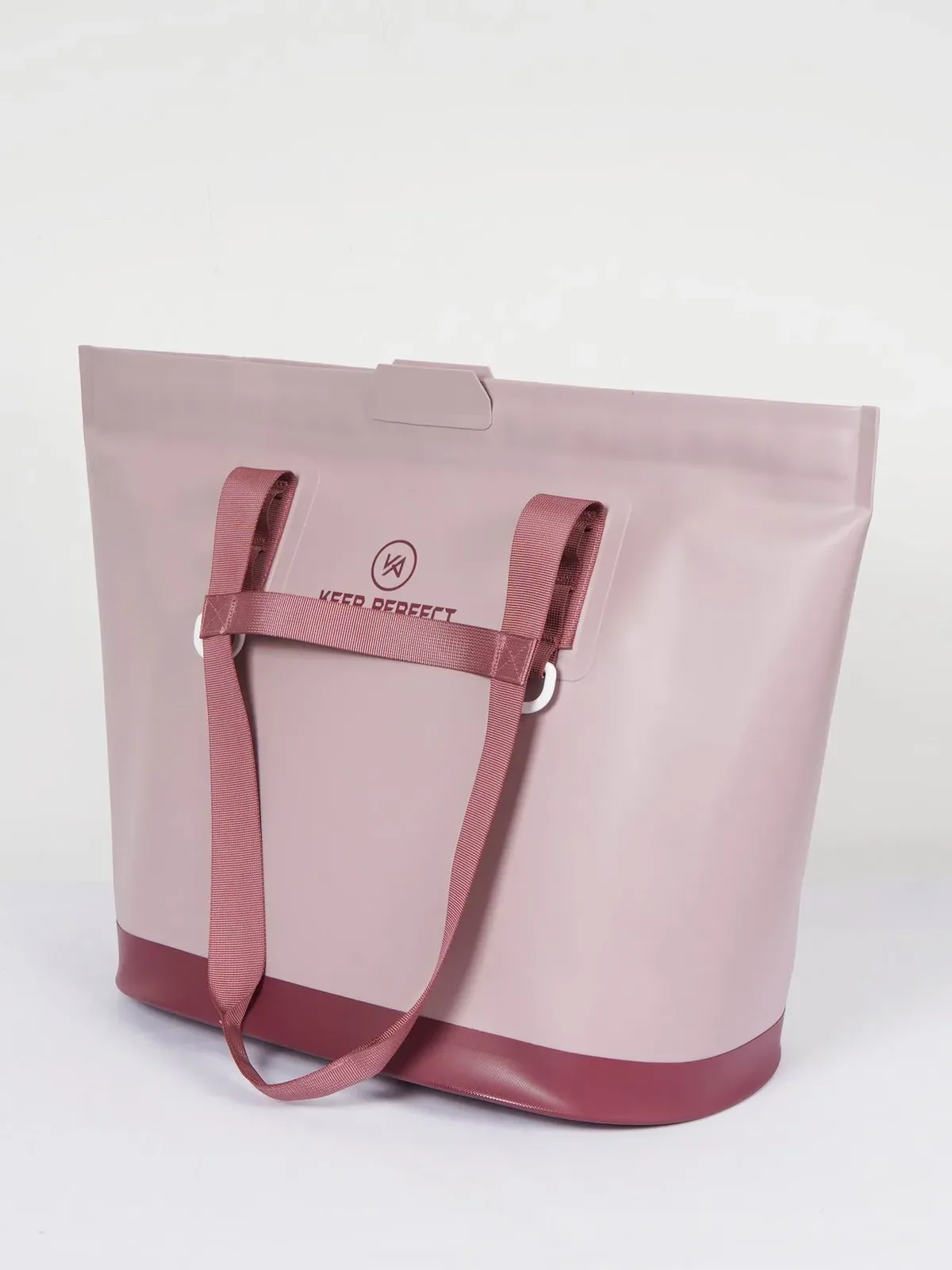
Three branding methods cover most cooler bag programmes. Heat transfer suits a photographic or multi-colour mark on a flat panel and has the lowest setup. Silicone print is the most durable, resists washing and gives a raised hand, at a higher unit cost and a cure step. Embroidery reads as quality and lasts, but on an insulated bag it must be a patch applied to an outer panel, never stitch-through the liner.
Branding an insulated bag is more constrained than branding a plain one, because the panel is often coated, the wall behind it contains foam, and every needle hole through the liner is a leak. That rules out some methods that work elsewhere and it changes how the others should be applied. This piece compares the three principal methods on durability, substrate, cost and lead time, and sets out the two constraints that are specific to a thermal build.
Why Is Branding an Insulated Bag Different?
Two constraints. The first is the substrate: most cooler bag shells are coated woven fabrics or films, and a coating that gives water resistance also reduces the adhesion of a print, so the ink system and the coating have to be chosen together. The second is the wall: behind the face panel there is foam and a liner, and any stitch that penetrates all the way through is a hole in the thermal envelope and a path for water into the foam.
The second constraint is the one that catches programmes out. Direct embroidery through a finished insulated panel is a leak, and it is also a thermal path. Where a brand wants the look of embroidery, the answer is an embroidered patch applied to an outer panel only, with the stitching confined to the shell.
How Does Heat Transfer Behave on an Insulated Shell?
A heat transfer is a printed film applied under heat and pressure, and it suits multi-colour and photographic marks on a flat panel. On a coated shell the two variables are temperature and dwell: too little and the film lifts at the edge after washing, too much and the coating under it is damaged or the panel shrinks. The third variable is pressure, and it matters more on an insulated panel than on a flat fabric, because the foam behind it compresses and springs back.
The test is a wash or wipe cycle followed by an edge inspection and a peel check. Ask for the result on the actual panel build-up rather than on a flat swatch, because a transfer that passes on a swatch can lift on a foam-backed panel where the pressure was uneven.
| Method | Where it works | Durability | Unit cost index | Setup and lead time |
|---|---|---|---|---|
| Heat transfer | A flat panel, multi-colour or photographic marks | Good, if applied at the stated temperature and pressure | 100 | A film per colour; no tooling |
| Screen print | A flat coated panel, solid marks | Very good on a coated fabric | 105 | A screen per colour; a setup step |
| Silicone print | A panel that needs grip and a raised hand | Excellent, resists washing and abrasion | 160-210 | A cure step; a longer cycle |
| Embroidered patch | An outer panel, or a curved or structured panel | Excellent | 190-260 | A sourced component with its own lead time |
| Woven label | A seam or a small flat panel | Excellent | 85 | Woven to order; a sourced component |
| Debossed or moulded badge | A structured base or a rigid panel | Excellent | High unit plus tooling | Tooling; moves the sampling window |
When Is Silicone Print Worth the Extra Cost?
Where the bag is washed, abraded or handled with wet hands, and where the brand mark is also functional — a grip panel, a pull tab, a non-slip base. Silicone bonds well to coated fabrics and films, retains its colour and does not crack at the fold, which are exactly the properties a print on a cooler bag needs. It costs more per unit and it needs a cure step, which adds a little to the cycle.
There is a second reason to specify it: a raised, tactile mark reads as quality on a product that is otherwise a soft, quiet object. Where the bag is positioned as a premium item and the mark is small, the incremental cost per unit is small in absolute terms even though the index looks high.
What Does Embroidery Cost and What Are Its Limits on This Format?
As a patch applied to an outer panel, embroidery is durable and reads well; the limits are the sourced-component lead time and the fact that a patch is stiff, so it does not suit a panel that has to fold. Direct embroidery through the wall is the limit that matters: it perforates the liner and the foam, and the result is a bag that leaks and holds less cold at that point.
Where a brand wants a stitched look without a patch, the answer is a decorative stitch line confined to the shell, sewn before the panel is assembled into the bag. That is a construction decision rather than a branding one, and it has to be on the drawing at the cutting stage.
How Should the Print Position and Colour Be Specified?
Position by dimension: distance from the top edge, distance from the side seam, and the print area, each with a tolerance. A mark placed by eye on a sample and approved that way will be placed differently in bulk, because bulk uses a jig or a screen. Then specify the colour by a physical standard — a Pantone reference or a retained swatch — with a tolerance and a stated light source, because a screen proof is a picture of a colour rather than a colour.
Then specify the fastness: a light-fastness grade under AATCC 16 for a bag that will sit in a window, and a rub or wash expectation for one that will be handled. Both are low in cost and both prevent the argument that follows a faded mark on a premium product.
Branding an insulated bag
- Never stitch through the liner: an embroidered patch goes on an outer panel only.
- On a coated shell, the ink system and the coating have to be chosen together.
- Silicone print is the durable answer where the bag is washed or handled wet.
- Dimension the position and specify the colour by a physical standard with a tolerance.
- Test light fastness under AATCC 16 and, for a handled bag, rub or wash fastness.
| Panel and substrate | Method that holds | Method to avoid | Why |
|---|---|---|---|
| Coated woven shell, flat | Heat transfer or screen print with a matched ink | A transfer applied without a pressure check | The coating reduces adhesion; the foam behind springs back |
| Coated shell, curved or folding | Silicone print or a woven label | A stiff patch | A patch does not follow a fold |
| Film panel, TPU or PEVA | Silicone print | Most solvent-based systems | Adhesion and cracking at the fold |
| Structured base or rigid panel | A debossed or moulded badge | Anything stitched through | The panel is the anchor point |
| Inside the food-contact zone | A low-migration system, or nothing | A standard plastisol | Migration and compliance |
| High-wear zone | Silicone print or a patch | A thin transfer at a corner | Abrasion at the corner lifts the edge |
What Compliance Applies to the Branding Itself?
The print is an article in its own right. Where it sits inside the food-contact zone it needs a low-migration ink system and a position in the compliance file; where it sits outside, the file is shorter. Either way the position has to be stated, because silence is read as inside. A restricted-substance declaration covering the ink, plus a REACH position and, for California, a Proposition 65 statement, closes it.
Where the bag is a children product, the print and any patch are in scope for CPSIA and for EN 71-3 migration testing on accessible components, and a small patch or a raised silicone mark can become a small-parts question. Ask which parts have been tested rather than assuming the fabric declaration covers the decoration.
There is a fourth method worth knowing and worth being careful with: a digital or sublimation print on a light polyester panel. It gives photographic detail with no setup at all, which makes it attractive for short runs and for multi-design programmes. It needs a polyester face, it is less durable than silicone under abrasion, and it does not suit a coated panel, so the substrate has to be chosen for the method.
Where a programme runs several designs across one bag body — a common pattern for events and for regional branding — the method choice changes the whole production plan. A transfer or a digital print allows the body to be made in one run and decorated later; a patch or a badge has to be ordered per design, with a separate minimum and lead time for each. That is a planning decision rather than a branding one, and it belongs in the first conversation.
How Does the Method Affect the Programme Calendar?
Heat transfer and screen print fit the standard 6-10 working day sampling window, because the setup is a film or a screen. Silicone adds a cure step. A woven label, an embroidered patch or a moulded badge is a sourced component with its own lead time and its own minimum, and that is the usual reason a build moves toward 12-15 working days.
The commercial frame does not change: MOQ 500 pcs per style and colourway, bulk production 35-50 days from written sample approval, inspection at AQL 2.5 under ISO 2859-1 General Inspection Level II, T/T 30/70, FOB Xiamen. What changes is the reorder: a patch or a badge that runs out holds the whole order, so where the programme will repeat, a printed mark on a standard panel is the more robust choice.
What Should Be Approved Before Bulk?
A printed or decorated production swatch on the actual panel build-up, not a sample-room offcut, and a wash or wipe test result on that swatch. Then a placement check on a production unit against the dimensioned position, because the jig is what decides the placement in bulk. Those two approvals take an hour and they prevent the two most common branding complaints.
Finally, keep a reference. A retained decorated panel, held with the approved sample, is what the reorder is matched against — and a brand mark that shifts shade or position between runs is noticed by the customer before it is noticed by the inspector.
What Artwork Does Each Method Need?
Silicone print needs a vector file with a minimum stroke of roughly 0.8 mm, because a finer line does not hold on the screen and breaks at the edge of the deposit. Heat transfer accepts finer detail, down to about 0.3 mm, but a large solid field is where it fails: a solid block wider than about 120 mm tends to trap air under the film and lift at the edge. Embroidery is the most constrained method of the three — type below about 5 mm cap height becomes unreadable, and a gradient cannot be reproduced in thread at all.
Colour is the second artwork question. A print or a transfer can hold a Pantone reference within a stated tolerance, typically two to three units of delta E on a coated panel, and the tolerance has to be written into the approval so that a later shade argument has something to be measured against. Embroidery cannot: thread is supplied in a fixed range, so the reference is the nearest thread number and the approval is against a stitched swatch. Ask for the thread numbers in writing before the sample is made.
Placement is the third, and it is the one that causes the most rework. A dimensioned drawing with the mark referenced to two edges of the panel, not to a seam, survives a pattern change; a mark referenced to a seam moves when the seam allowance changes. Where the panel folds, state the position on the flat rather than on the made-up bag, because the flat is what the jig is set against.
How Is Branding Quality Judged on the Line?
Three checks, and all three cost little. A tape test on a production panel separates a print that has cured from one that has not. A defined number of wash or wipe cycles on a decorated swatch gives the durability number. And a placement measurement taken on five units drawn from the top, the middle and the bottom of the run tells you whether the jig is holding, which a single measurement never will.
The failure modes are specific enough to be worth naming, because naming them is what gets them fixed. A silicone mark that has not cured comes away in a wipe and leaves a tacky surface. A transfer applied below temperature lifts at a corner first and then along an edge. A patch sewn through the liner leaks, and the leak does not show at the seam but fails the water test. Recording which of these was seen, and on how many units in a sample of 50, is more useful to a supplier than a photograph.
Which Method Survives a Reorder?
This is the question that is usually asked after the second order rather than before the first. A printed mark is reproducible from a stored file and a stored screen or film, so run two matches run one within the stated shade tolerance. A patch or a badge is a purchased component: it is made by a different supplier, in a different minimum, and the second batch is matched to a sample rather than to a specification. Two supplies of the same patch can differ visibly, and where the brand mark is the visible part of the product, that difference is the complaint.
Where the programme will repeat, that argues for a printed or transferred mark on a standard panel, with the artwork file, the screen or film reference and a retained decorated swatch held together. It also argues against a decoration whose supply is a single small shop, however good the first sample looked: the risk is not the first run, it is the one two years later when the shop has closed.
Choose the method against the panel
Send the artwork, the panel material, the duty and the quantity. You get a method recommendation with the fastness tests behind it, within one business day.
Frequently Asked Questions
Can an insulated cooler bag be embroidered?
Yes, as a patch applied to an outer panel. Direct embroidery through the wall perforates the liner and the foam and produces a leak and a thermal path.
Which branding method lasts longest on a cooler bag?
Silicone print, followed by an embroidered patch. Both resist washing and abrasion; a heat transfer lasts well if it is applied at the stated temperature, dwell and pressure.
Does a coating affect print adhesion?
Yes. A coating that gives water resistance reduces the adhesion of a print, so the ink system and the coating have to be chosen together and tested on the actual panel.
How should the logo position be specified?
Dimensioned: distance from the top edge, from the side seam, and the print area, each with a tolerance. Bulk uses a jig and the sample was placed by hand.
How should the brand colour be specified?
By a physical standard, a Pantone reference or a retained swatch, with a tolerance and a stated light source. A screen proof is a picture of a colour.
What fastness test applies to a printed mark?
A light-fastness grade under AATCC 16 for a bag that will sit in a window, and a rub or wash expectation for one that will be handled.
Does the print need compliance documents?
Where it sits inside the food-contact zone, yes: a low-migration ink system plus a REACH declaration and a Proposition 65 position. State the position either way.
Is silicone print worth the cost?
Where the bag is washed, abraded or handled wet, yes. It also gives a raised, tactile mark that reads as quality.
Does branding change the sampling window?
A patch, a woven label or a moulded badge is a sourced component with its own lead time and moves the build toward 12-15 working days.
What is the MOQ?
500 pcs per style and colourway, with repeat programmes open to discussion at 300 pcs.
What should be approved before bulk?
A decorated production swatch on the actual panel build-up with a wash or wipe result, and a placement check on a production unit.
Can a patch run out and hold the order?
Yes. Where the programme will repeat, a printed mark on a standard panel is the more robust choice.
Are patches a safety issue?
On a children product, a small patch or a raised mark can become a small-parts question under CPSIA and EN 71.
What inspection applies to branding?
AQL 2.5 for major defects to ISO 2859-1 at General Inspection Level II, with an illegible or misplaced print counted as major.
People Also Ask
Can you embroider a cooler bag?
Yes, as a patch on an outer panel; stitch-through embroidery perforates the liner and leaks.
Which logo method lasts longest on an insulated bag?
Silicone print, then an embroidered patch; heat transfer lasts well when applied to specification.
Does the coating affect printing?
Yes: a water-resistant coating reduces print adhesion, so ink and coating must be chosen together.
How do I stop the logo shifting position in bulk?
Dimension the position with a tolerance and check placement on a production unit.
What is the MOQ for branded cooler bags?
500 pcs per style and colourway, with repeat programmes open to discussion at 300 pcs.
Sources and further reading
Every figure on this page is either our own programme data or attributed below. Open the originals before you write them into a specification.
- AATCC 16 — Colorfastness to LightAmerican Association of Textile Chemists and Colorists
- REACH — Registration, Evaluation, Authorisation and Restriction of ChemicalsEuropean Chemicals Agency
- ISO 2859-1:1999 Sampling procedures for inspection by attributesInternational Organization for Standardization