How to Create a Tech Pack for a Cooler Bag: Insulation and Welds
A cooler bag pack is built around four things a general bag pack does not have: the liner material and its food-contact position, the insulation thickness and density, the weld method and weld width, and the leak and thermal test method. Everything else is ordinary.
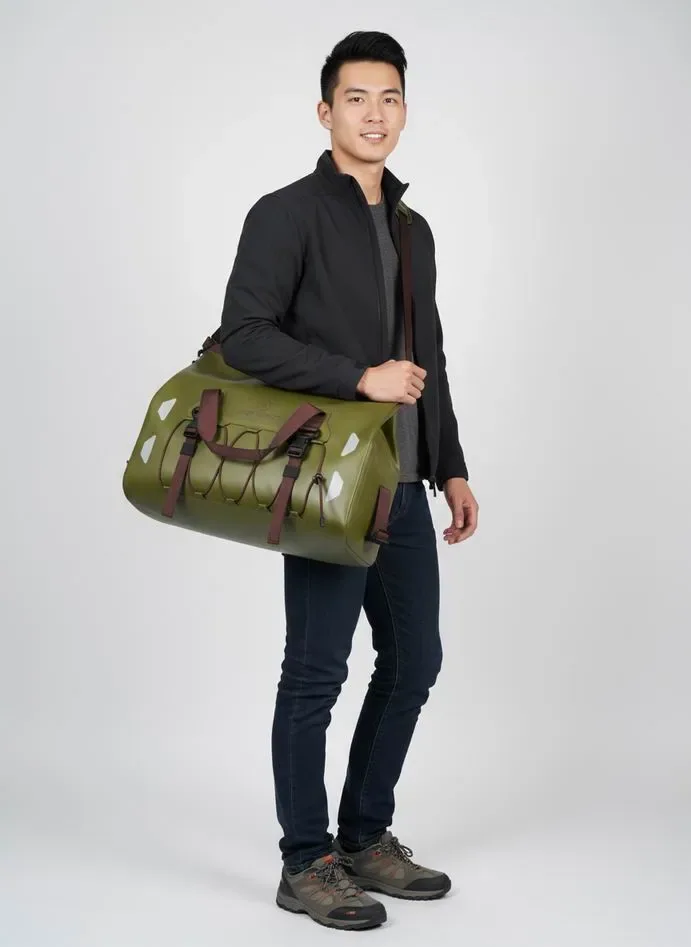
A cooler bag tech pack carries four fields an ordinary bag pack does not: the liner with its food-contact statement, the insulation with thickness and density, the weld method with the weld width in millimetres, and the test method for leak and thermal performance. Add the ordinary twelve sections on top. Sampling runs 6-10 working days, bulk 35-50 days, inspection at AQL 2.5 under ISO 2859-1.
The reason a cooler bag needs its own pack is that the failure modes are different. A general bag fails at a seam or a strap. A cooler bag fails at a weld, at a corner where the liner has been folded twice, or at the point where the closure lets cold air out. None of those is visible on a drawing, and all of them are decisions that belong in writing.
The second reason is that the four extra fields are the ones that decide the price. Insulation thickness and liner material are the two largest material lines in the bag, and the weld method decides whether the assembly is a fast single operation or a slow one with a fixture. A pack that leaves them open produces a price that will move.
How Do You Specify the Liner and Its Food-Contact Position?
Name the material, the thickness, the construction and the compliance position. PEVA, TPU film and PU-coated polyester are three different liners with three different price points and three different weld behaviours, and "food-grade liner" is not a specification of any of them.
The compliance position is a document, not an adjective. For the European Union the liner needs a statement against the framework regulation on materials intended to come into contact with food, backed by migration testing on the actual liner; for California a Proposition 65 position; for the United States a CPSIA statement where the product is a children's product. Name the document and the test report number in the pack.
What Does the Insulation Section Have to State?
Thickness in millimetres, density in kilograms per cubic metre, cell structure, and how the insulation is held in place. Five millimetres of closed-cell polyethylene foam at one density and five millimetres at another are not the same part, and a pack that states only the thickness has specified half of it.
How it is held in place is the field most often missed. Insulation that is loose between the shell and the liner migrates to the bottom of the bag within a season, and the bag then has no insulation where it matters. State whether the foam is laminated to the liner, tacked at named points, or captured in a closed pocket, and name the method.
| Field | What to write | Why | If it is wrong |
|---|---|---|---|
| Liner material | PEVA, TPU film or PU-coated polyester, with thickness in mm | The three weld differently and cost differently | The wrong weld method is chosen for the liner |
| Food-contact position | The named document and test report number | An adjective cannot be produced at an audit | A customer asks for the report and there is none |
| Insulation thickness | mm, with a tolerance | It is the largest material line in the bag | The bag underperforms and the price was for a thicker bag |
| Insulation density | kg per cubic metre | Thickness alone does not set performance | The bag feels right and performs wrong |
| Cell structure | Closed-cell or open-cell | Closed-cell resists water uptake | The foam holds water and the bag gets heavier each use |
| Retention method | Laminated, tacked at named points, or captured | Loose foam migrates | The insulation ends up at the bottom of the bag |
| Weld method | Radio-frequency, hot air or hot wedge | It follows from the liner, not from preference | The weld peels or the liner burns |
| Weld width | mm, with a tolerance | It sets both strength and appearance | The seam is strong and ugly, or neat and weak |
Which Weld Method Belongs in the Pack and Why?
The method follows from the liner, and stating it wrongly is the most common error in a cooler bag pack. Radio-frequency welding works on materials with a polar molecule — PVC and PU among them — and produces a strong, narrow, repeatable seam. Hot-air and hot-wedge welding work on polyolefin films such as PEVA, which radio-frequency will not weld without a suscepting layer.
This is a physical constraint, not a preference. A pack that specifies radio-frequency welding on a PEVA liner has specified a seam that will not form, and the first place anybody finds out is the sampling bench, several days into the 6-10 working day window. Where there is doubt about which the liner is, ask the mill to confirm the polymer before the pack is signed.
Four weld decisions to write down
- The method: radio-frequency, hot air or hot wedge, chosen from the liner polymer.
- The weld width in millimetres, with a tolerance of plus or minus 1.5 mm.
- The peel requirement, stated as a minimum force per unit width with the test method named.
- What happens at a corner: whether the weld runs round it or the liner is folded and welded twice.
How Do You Write the Leak and Thermal Test Into the Pack?
Leak testing is written as a method, a duration and an acceptance criterion. The simplest defensible version is a water-fill test: fill the bag to a stated level, stand it on an absorbent surface for a stated number of minutes, and accept zero penetration at the welds and the corners. State the level, the minutes and what counts as a failure.
Thermal performance is harder, because a single number is meaningless without the conditions behind it. State the start temperature of the contents, the ambient temperature, the load, whether a gel pack was used, and the number of hours to the stated end temperature. A claim that the bag holds cold for six hours is not testable; the same claim with the conditions attached is.
How Does a Cooler Bag Pack Differ on Closure and Structure?
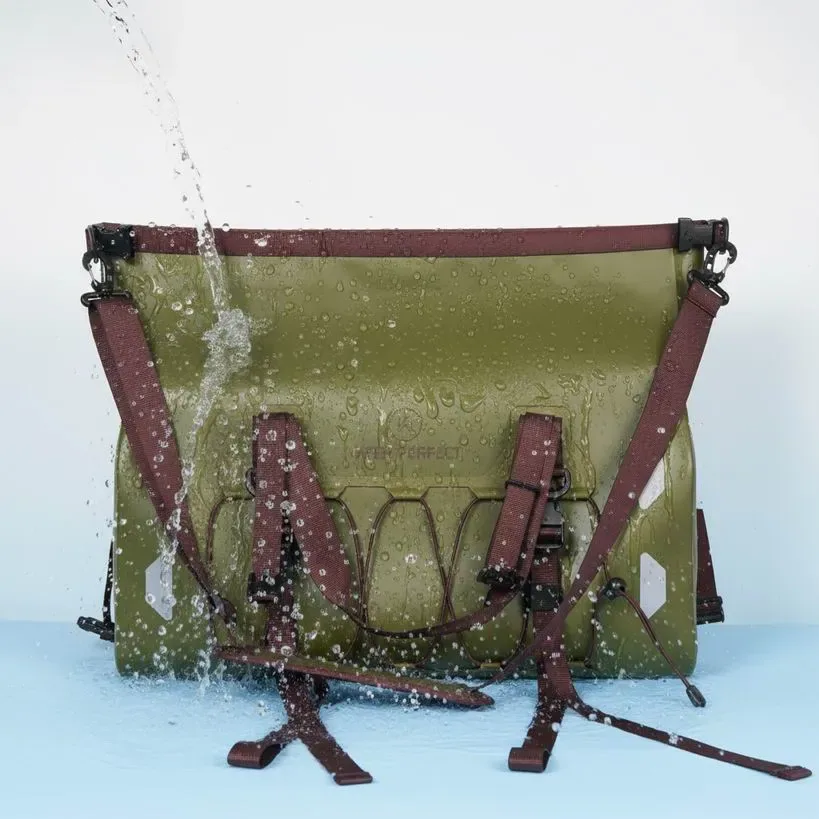
On the closure. A cooler bag that closes with a conventional sewn zip loses cold through the tape, and the pack has to say whether the zip is a sewn coil, a welded track, or a fold-top with a buckle. Each has a different thermal consequence and a different cost, and each produces a different leak risk at the point the tape meets the liner.
On the structure, the difference is that the liner is a sealed volume. Every penetration through it — a drain grommet, a strap anchor that goes through the wall, a pocket stitched into the side — is a potential leak path. The pack should list every penetration and state how each is sealed, because a drain that is fitted but not sealed is worse than no drain at all.
| Penetration through the liner | How it is sealed | What to write in the pack | Failure if unstated |
|---|---|---|---|
| Drain grommet | Welded flange, or a grommet on a welded patch | Grommet type, flange diameter, weld width around it | A drip from the drain that is worse than no drain |
| Strap anchor through the wall | Captured in the weld, not stitched through | Anchor method and the reinforcement patch size | A wicking path along the webbing into the cavity |
| External pocket | Stitched to the shell, outside the liner | Whether the pocket is on the shell or through the liner | A stitch line through the sealed volume |
| Zip insertion | Welded track or a sewn tape with a sealed backing | Zip type and how the tape is sealed to the liner | Cold loss and a leak at the tape |
| Label or care tab | Captured in a seam outside the liner | Where the tab sits relative to the weld | A pinhole in the sealed volume |
How Do You Specify the Closure and the Cold Loss Path?
Name the closure type, then name the path cold takes out of the bag and say how that path is closed. On a sewn coil zip the path is the tape; on a welded track it is the track; on a fold-top it is the fold itself. Each one has a different consequence, and the pack should state which is used and what seals it.
A fold-top closure is the one buyers underestimate. Three folds is a common minimum and four is better, and the pack should state the number of folds and the width of each, because a two-fold top on a delivery bag loses more cold than a moderate zip does. Where the top also carries a buckle, state the buckle position and the pull figure.
| Closure type | Cold loss path | What the pack states | Consequence if unstated |
|---|---|---|---|
| Sewn coil zip | Through the tape and the stitch line | Zip size, coil type, whether the tape is sealed to the liner | A leak at the tape and steady cold loss |
| Welded track | Through the track profile | Track type, weld width to the liner, slider type | A track that peels away from the liner |
| Fold-top with buckle | Through the fold | Number of folds, fold width, buckle size and pull figure | A top that opens in transit and vents the cavity |
| Hook-and-loop flap | Around the flap edge | Width, cycle life, overlap in mm | A closure that stops gripping after a season |
| Magnetic snap | Around the flap edge | Diameter, breakaway force in kgf, cycle count | A closure that opens in a vehicle |
What Does the Rest of the Pack Cover?
Ordinary. The other twelve sections — cover, drawing, materials, colourways, construction, stitch schedule, hardware, artwork, labels, packing, testing and approval — are filled exactly as they would be for any soft bag. The cooler bag adds a subsection to materials and a subsection to testing; it does not replace the template.
Two sections do get heavier. The packing section has to state whether the bag is shipped flat or assembled, because a welded liner creased in transit can fail at the crease, and the carton has to be specified with that in mind. The testing section carries the leak and thermal methods on top of the ordinary dimensional and colourfastness checks.
How Do the Weld Parameters Get Recorded?
As three numbers on the pack, not as a setting on a machine. Weld temperature, dwell time and pressure are recorded for each seam type, together with the date they were set and the sample they were set against. Without them, a welded bag that passes on the first run and fails on the second has no documented difference to investigate.
This matters more on a cooler bag than on most soft goods because the weld is the structure. A stitched seam can be inspected by eye and by pull; a weld can look perfect and be cold, and the only way to know is to test it and to have written down what was different when it was right. Where a programme repeats, the parameter record is the thing that makes the second run the same as the first.
How Do the Four Extra Fields Change the Calendar?
They add fixture time rather than days. A welded style needs the weld parameters — temperature, dwell and pressure — set and recorded before the first acceptable part comes off the bench, and those parameters belong in the pack as a record. Once they are set, the sampling window is the ordinary 6-10 working days.
Where the window widens to 12-15 working days is a cooler bag with a moulded base, a drain assembly, or a multi-layer insulation build where the layers have to be cut and assembled in sequence. Bulk then runs 35-50 days from written sample approval, and the leak test belongs in the inspection as a defined check at AQL 2.5 under ISO 2859-1. More on insulated programmes sits on the cooler bag page.
Get the weld and insulation fields checked
Send the liner, the insulation build and the closure you have in mind. You get the weld method that follows from it and the test method to hold it to.
Frequently Asked Questions
What makes a cooler bag tech pack different?
Four extra fields: the liner with its food-contact document, the insulation with thickness and density, the weld method and weld width, and the leak and thermal test methods. The other twelve sections are ordinary.
Which weld method should I specify?
The one that follows from the liner polymer. Radio-frequency welding works on polar materials such as PVC and PU; hot-air and hot-wedge welding work on polyolefin films such as PEVA.
Can I specify radio-frequency welding on a PEVA liner?
Not without a suscepting layer. It is a physical constraint rather than a preference, and the first place it shows up is the sampling bench.
How do I write a leak test into the pack?
State the fill level, the duration, the surface the bag stands on and the acceptance criterion — zero penetration at welds and corners. A test without a duration and a criterion cannot be failed.
Why is a thermal claim not testable on its own?
Because it depends on the start temperature, the ambient temperature, the load, whether a gel pack was used and the end temperature. State all five and the claim becomes testable.
Should insulation be specified by thickness alone?
No. Thickness in millimetres and density in kilograms per cubic metre together, plus the cell structure. Two foams of the same thickness perform differently.
How do I stop insulation migrating to the bottom?
State the retention method: laminated to the liner, tacked at named points, or captured in a closed pocket. Loose foam between shell and liner moves within a season.
Does a sewn zip let cold out of a cooler bag?
Through the tape, yes. The pack has to say whether the closure is a sewn coil, a welded track or a fold-top with a buckle, because each has a different thermal consequence.
What is a penetration in a cooler bag pack?
Any hole through the sealed liner: a drain grommet, a strap anchor, a pocket stitched through the wall, a zip tape, a care tab. Each needs its sealing method written down.
What compliance documents does the liner need?
A food-contact statement against the framework regulation for the European Union, backed by migration testing on the actual liner; a Proposition 65 position for California; and a CPSIA statement where the product is a children's product.
Should a welded cooler bag ship flat or assembled?
State it in the packing section. A welded liner creased in transit can fail at the crease, so the carton is specified around the fold method.
How long does sampling take on a welded cooler bag?
6-10 working days once the weld parameters are set and recorded, widening to 12-15 working days where the style has a moulded base, a drain assembly or a multi-layer insulation build.
How many folds should a fold-top closure have?
Three as a common minimum and four where the bag runs a delivery duty. State the number of folds and the width of each in the pack, because a two-fold top vents more cold than a moderate zip does.
Why do weld parameters belong in the pack?
Because the weld is the structure. A weld can look perfect and be cold, and without a recorded temperature, dwell and pressure there is nothing to investigate when the second run differs from the first.
What does a cooler bag pack say about the closure?
The closure type and the path cold takes out of the bag: through the tape on a sewn coil zip, through the track on a welded track, or through the fold on a fold-top, with the number of folds stated.
People Also Ask
How do you write a tech pack for a cooler bag?
Take the ordinary twelve sections and add four fields: liner with its food-contact document, insulation thickness and density, weld method and weld width, and the leak and thermal test methods.
What is the best weld method for a cooler bag liner?
It depends on the polymer. Radio-frequency for PVC and PU, hot air or hot wedge for polyolefin films such as PEVA. The liner decides, not the preference.
How thick should cooler bag insulation be?
It follows from the duty: a lunch-size bag commonly carries 5 mm, a delivery bag 8 to 10 mm. State the thickness and the density together, because thickness alone does not set performance.
How do you test a cooler bag for leaks?
Fill to a stated level, stand it on an absorbent surface for a stated number of minutes, and accept zero penetration at the welds and corners.
Why does a cooler bag need its own tech pack section?
Because its failure modes are different: a weld, a folded corner, or a closure that lets cold air out. None of those appears on an ordinary bag pack.
Sources and further reading
Every figure on this page is either our own programme data or attributed below. Open the originals before you write them into a specification.
- ASTM D751 — Standard Test Methods for Coated FabricsASTM International
- REACH Regulation (EC) 1907/2006 — restricted substancesEuropean Chemicals Agency
- ISO 2859-1:1999 — Sampling procedures for inspection by attributesInternational Organization for Standardization