How to Match Team Bag Colours to Your Kit: Pantone, Thread and Fabric
A colour match fails at the trim, not at the shell. One Pantone reference has to be interpreted five times — woven shell, binding, webbing, zipper tape and embroidery thread — and each substrate takes it differently. Lock a coupon set and a shade band, not a single swatch.
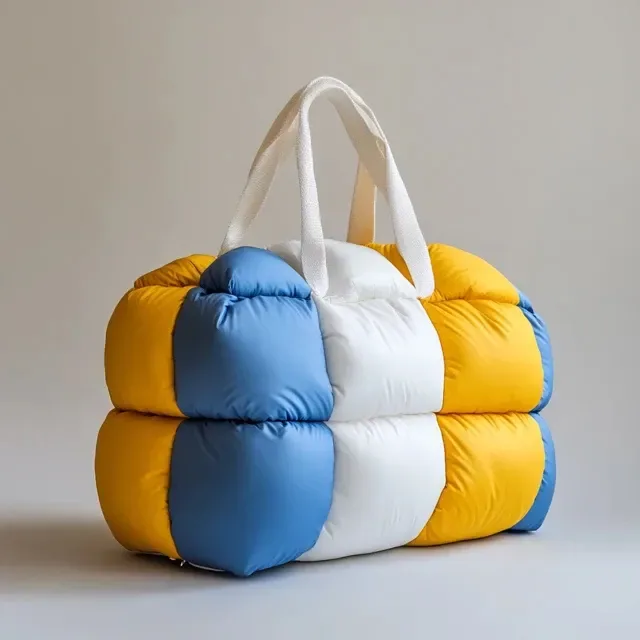
Name one Pantone reference for the club colour and then match it separately on every substrate that will be visible on the finished bag. Approve a physical coupon per substrate under one light source, agree an upper and a lower limit as physical coupons, record the dye-lot number, and hold all three against the next order.
Why Does One Pantone Number Produce Five Different Colours?
A Pantone reference describes a colour as ink on a specified stock under a specified viewing condition. It does not describe a colour as polyester yarn in a plain weave, or as a cotton-wrapped polyester thread laid in a satin stitch, or as a dyed nylon zipper tape. Fibre, construction, dye class and surface geometry all move the result, so the same reference read as a target on five substrates produces five colours that are close but not identical.
The club sees all five at once. The shell, the binding down the seam, the webbing on the strap, the tape behind the zipper teeth and the thread in the crest are within a few centimetres of each other on the finished bag, and the eye reads them as one field of colour. Any one of them that is out reads as a defect even though it matches the printed reference perfectly. This is why "we matched the Pantone" is not the answer a club needs.
Which Reference System Should the Club Specify?
The Pantone Matching System publishes several libraries, and the one that matters for a bag is not the one that matters for a business card. Textile programmes work from the textile libraries because those are dyed onto fabric rather than printed onto coated paper; the graphic libraries are printed references and behave differently under the same light. The practical rule is to state which library the reference came from, and to require that the physical standard used for approval is the same library.
| Reference type | What it is | Where it is used | What to watch for |
|---|---|---|---|
| Textile library reference | Dyed onto a textile standard | Shell, lining, webbing, binding | The standard itself ages; replace it on a cycle |
| Graphic library reference | Printed on coated stock | Crest artwork and printed panels | Do not use it to approve a dyed substrate |
| Physical club swatch | A piece of the actual jersey | Cross-checking the whole set | Metamerism — it can match under one light and not another |
| Instrumental reading | A measured value with a tolerance | Reorders and dispute resolution | Needs a stated geometry and a stated light source |
Yarn-Dyed, Piece-Dyed or Sublimated — Which Holds a Club Colour?
The route the colour takes into the fabric decides how stable it is. Yarn dyeing colours the yarn before it is woven, and it gives the deepest and most consistent result with the best fastness, at the cost of a longer lead time and a higher minimum per colour. Piece dyeing colours the finished cloth, which is faster and more flexible but more exposed to lot-to-lot variation. Sublimation puts the colour into a polyester surface as a print, which is excellent for multi-colour panels and gradients and poor for a flat club colour across a whole shell.
| Route | Typical use on a team bag | Colour stability | Lot-to-lot variation | Minimum exposure |
|---|---|---|---|---|
| Yarn-dyed woven | Main shell where the colour must be exact | Highest | Lowest | Colour is committed before weaving |
| Piece-dyed woven | Shell and lining in a single colour | Good | Moderate | One dye lot per order |
| Sublimation print | Panels, gradients and multi-colour artwork | Good on polyester | Low if the profile is held | Artwork-driven, low |
| Pigment or PU coating | Coated shells and trims | Moderate | Moderate | Coating batch matters as much as dye lot |
What Is a Dye Lot and Why Does It Decide the Reorder?
A dye lot — the industry also calls it a dye bath or a batch number — is the quantity of fabric coloured in one operation. Within one lot the colour is consistent. Between two lots there will be a difference, because the recipe is a formulation and not a formula: water quality, dye strength, temperature profile and dwell time all move slightly, and no two batches land on exactly the same point.
That is not a defect. It is physics, and every textile programme lives with it. What turns it into a problem is silence: if the lot number is not recorded on the order and on the approval sheet, then the reorder is a brand-new colour-matching exercise and the club gets a second shade. Record the lot, hold a retained coupon from it, and the next order has something to be measured against.
How Is a Shade Band Agreed and Judged?
A shade band is the accepted range around the standard. It exists because zero tolerance is not achievable in dyeing and pretending otherwise just moves the argument to the loading bay. The useful form of a shade band is physical: an upper-limit coupon and a lower-limit coupon, both signed, with the instruction that anything between them ships and anything outside them does not. A written description of a band — "close to standard" — is not a band, and it will be read differently by everybody who reads it.
Judgement is made in two ways and the programme should allow both. Visual judgement under a controlled light source, graded against the grey scale for change in colour, is what the club will actually do when the bag arrives. Instrumental measurement expresses the same difference as a number, and it is what settles a disagreement. Colour-difference computation is standardised, and the reading is meaningless unless the geometry, the light source and the observer are stated alongside it.
| Judgement route | Standard to cite | What it produces | When it settles the question |
|---|---|---|---|
| Visual, controlled light | ISO 105-A02 grey scale for change in colour | A fastness grade against the standard | Day-to-day approval at goods-in |
| Instrumental, measured | ASTM D2244 colour-difference computation | A numeric difference with a stated tolerance | Disputes and reorder comparison |
| Light fastness of the match | AATCC 16 colorfastness to light | A grade after a stated exposure | Bags that live on a touchline all summer |
| Wash and rub behaviour | AATCC 61 and AATCC 8 | A grade after laundering and rubbing | Bags that get washed, not wiped |
How Does the Trim Get Matched to the Shell?
Trim is where the match is lost. Webbing, binding, zipper tape and thread are bought in rather than dyed with the shell, they come from a different dye house on a different schedule, and they are usually matched visually against a shell coupon rather than against the original reference. The error compounds: the webbing is matched to a shell that was already slightly off, so the finished bag drifts twice in the same direction.
- Match every trim to the original reference, never to an approved shell coupon.
- Approve trim coupons in the same session as the shell, under the same light.
- Name the thread construction on the tech pack — a sewing thread behaves differently from a embroidery thread in the same shade.
- Ask for the trim dye-lot numbers alongside the shell lot number.
- Reject a trim approval that arrives as a photograph rather than as a physical coupon.
What Does Metamerism Do to a Club Colour?
Metamerism is the reason two panels can match in the showroom and not on the pitch. Two samples that reflect the same colour under one light source can reflect differently under another, because the dye formulations that produced them are not the same. A club colour built from a yarn-dyed shell and a sublimated panel is the classic case: they agree under the fluorescent light in the kit room and separate in daylight.
The defence is straightforward. Approve under the light the bag will actually be seen in, and if the club colour matters enough, approve under a second source as well. Specify a single dye route for every visible substrate wherever the quantity allows it, and accept that a mixed route — print next to dye — will always carry some metamerism risk.
How Is the Colour Locked Across an Annual Kit Cycle?
Locking a colour across a season is a records exercise, not a dyeing exercise. Four artefacts have to exist and have to survive the handover between people: the reference, the approved coupon set, the dye-lot record and the shade band. With all four in hand a reorder is a comparison. Without them it is a re-approval, and every re-approval is an opportunity to drift.
The four artefacts that hold a club colour across a season
- The reference: one named Pantone reference, with the library stated.
- The coupon set: a physical coupon for every visible substrate, signed and dated.
- The dye-lot record: lot numbers for shell, lining, webbing, binding, tape and thread.
- The shade band: an upper-limit and a lower-limit coupon, not a written description.
What Should the Tech Pack Say About Colour?
A tech pack that says "club navy" has not specified a colour, and a tech pack that gives a Pantone number with no substrate list has specified a quarter of one. The colour section has to name the reference, list every visible substrate, state the dye route for each, and state what evidence arrives with the approval. Anything less leaves the decision to whoever is standing at the dye vat that week.
| Tech pack field | What a complete entry contains | What a weak entry contains |
|---|---|---|
| Reference | Named reference with the library stated | A colour name |
| Substrate list | Shell, lining, binding, webbing, tape, thread | Shell only |
| Dye route | Yarn-dyed, piece-dyed or sublimated, per substrate | Not stated |
| Trim matching | Matched to the reference, coupon required | Matched to the shell |
| Tolerance | Upper and lower physical coupons | Close to standard |
| Evidence | Light fastness grade and instrumental reading | None requested |
| Lot record | Lot numbers required on the order and the approval | Not requested |
How Is a Colour Dispute Settled Without Re-Dyeing?
Disputes about shade are settled by reference to what was agreed, which is why the physical artefacts matter more than the words. If an upper and a lower coupon exist and the goods sit between them, there is no dispute to settle. If they do not exist, then the argument is about opinion and the outcome is usually a re-dye at somebody's cost and a slipped delivery date.
Where the goods sit outside the band, the first question is whether the whole lot is out or whether the lot contains more than one dye lot. A mixed lot inside one shipment is a packing and identification failure rather than a dyeing failure, and it is the more common of the two. Asking for the lot numbers per carton is a one-line clause that makes the difference visible before the bags reach the players.
How Does the Approval Sequence Work in Practice?
The sequence is short and it is worth following in order, because each step depends on the one before. Skipping the lab-dip stage in order to save time is the single most reliable way to lose more time later. Sampling runs 6-10 working days from a signed-off tech pack and extends to 12-15 working days where a new club colour has to be matched from scratch.
- Club supplies the reference with the library, plus a physical jersey swatch if one exists.
- Lab dips are produced on every substrate, not on the shell alone.
- Coupons are approved together under one light source, and the approved set is signed.
- The shade band is fixed as an upper and a lower coupon.
- Lot numbers are booked and recorded against the order.
- Bulk runs 35-50 days and is inspected at AQL 2.5 under ISO 2859-1 before release.
What Does All This Cost and Where Does It Save Money?
Colour control costs sampling time and it costs nothing else. The substrates are the same, the dye house is the same and the line is the same. What it saves is the cost of a rejected shipment, the cost of a club that does not reorder, and the cost of a second approval round that nobody planned for. A programme that holds four artefacts once will run the same colour for years.
The realistic risk is not that the first order is wrong — most first orders are approved carefully and come out right. The risk is the second order, placed eleven months later by a different person, with the reference still in a drawer and the coupon set long gone. Everything in this article exists to make the second order as easy as the first. The reorder mechanics are set out in Reorder colour consistency.
How Does a Printed Panel Behave Next to a Dyed Shell?
A sublimated panel and a dyed shell can measure the same and still look different, because the print sits on the surface of the fibre while a dye sits inside it. The surface print reflects slightly differently, it takes wear differently, and it ages differently under sunlight. Where a club colour spans both — a printed crest panel on a dyed shell, or a printed side panel beside a dyed one — the seam between them is where the eye goes first.
The workable rule is to separate the two rather than to blend them. Use print where print has a job to do — a gradient, a crest with fine detail, a sponsor mark — and use dye for every flat field of club colour. Where a printed panel must sit inside a dyed field, put a binding or a piping line between them so the join reads as a design decision rather than as a mismatch. It is a one-line instruction on the tech pack and it removes the most visible metamerism risk in the whole bag.
What Evidence Should Arrive With a Colour Approval?
An approval that arrives as a photograph has not been approved; it has been looked at. The evidence that belongs with a club colour is physical and it is specific: the coupon set, the shade band, the lot numbers, and a light-fastness result for the shell. Without the fastness result there is no way to know whether the colour that matches in February will still match in July after a season on a touchline.
Light fastness is the exposure that club kit actually sees, and AATCC 16 is the method that measures it. The grade is meaningless without the exposure stated alongside it, so the tech pack should name both. Where the bag will be washed rather than wiped, add a laundering result and a rubbing result, because a crest that bleeds into a light shell after the first wash is a colour problem reported as a print problem.
How Do You Match a Colour That Has No Reference?
Plenty of clubs have a colour and no reference for it — inherited from a shirt bought years ago, or specified once as a name and never measured. The route out is to instrument the physical article rather than to guess from a screen. A measured reading of the existing jersey gives a target, and a coupon set dyed to that target gives the club a reference it did not have before.
It is worth doing properly the first time, because the reference created here becomes the artefact that every later order is measured against. A club that creates a reference from an old shirt, approves a coupon set against it and records the lot numbers has done the work once and owns it permanently. A club that keeps matching to an ageing shirt is matching to an article that is itself fading, and the drift compounds year on year.
Approve the coupon set, not the swatch
Send the club reference and the substrate list, and we come back with a coupon set, a shade band and a sampling window you can plan around.
Frequently Asked Questions
Should a club give a Pantone reference or a physical swatch?
Both. The reference gives the dye house a target; the physical jersey swatch lets the finished set be cross-checked against what the players will actually wear.
Why does the same reference look different on thread and on fabric?
Different fibre, construction and dye class. A sewing thread and a woven shell in the same shade are never identical, which is why the trim is matched to the reference rather than to the shell.
What is a dye lot?
The quantity of fabric coloured in one dyeing operation. Within one lot the colour is consistent; between two lots there will be a difference.
What is a shade band?
The accepted range around a standard, held as an upper-limit and a lower-limit physical coupon rather than as a written description.
How is a shade difference judged?
Visually against the ISO 105-A02 grey scale under a controlled light, and instrumentally as a computed colour difference where the two sides disagree.
Which light fastness standard applies to a touchline bag?
AATCC 16, colorfastness to light, reported at a stated exposure. State the exposure on the tech pack or the grade means nothing.
Should the bag shell be yarn-dyed or piece-dyed?
Yarn-dyed where the club colour must be exact and the quantity supports the minimum; piece-dyed where speed and flexibility matter more.
What is metamerism and does it matter for a club colour?
Two samples that match under one light and not under another. It matters most when a printed panel sits next to a dyed shell in the same colour.
How long does a colour match add to sampling?
A new club colour matched from scratch moves sampling from 6-10 working days to 12-15 working days.
Can a reorder be guaranteed to match?
Not guaranteed — dyeing is a formulation. It can be held inside an agreed band if the reference, the coupon set and the lot record all survive the handover.
What should be recorded per carton?
The dye-lot number. It makes a mixed lot visible before the bags reach the players.
Does the trim need its own approval?
Yes. Webbing, binding, zipper tape and thread each get a coupon, approved in the same session as the shell under the same light.
People Also Ask
How do you match a team bag to a jersey?
One reference, a coupon per substrate, approval under one light, and a recorded dye lot.
What is a shade band?
Two physical coupons, an upper and a lower limit, that define what ships and what does not.
Why do two dye lots differ?
Dyeing is a formulation, not a formula — water, dye strength and temperature all move.
Which standard covers colour fastness to light?
AATCC 16, reported at a stated exposure.
Does sublimation match a dyed shell?
It can, but a printed panel beside a dyed shell always carries metamerism risk.
Sources and further reading
Every figure on this page is either our own programme data or attributed below. Open the originals before you write them into a specification.
- Pantone Matching System — colour reference standardsPantone
- AATCC 16 — Colorfastness to LightAmerican Association of Textile Chemists and Colorists
- ASTM D2244 — Calculation of Color Tolerances and Color DifferencesASTM International