When Is Neoprene Better Than Nylon or PU for a Bag Programme?
Neoprene is a foamed elastomeric laminate chosen for compression and insulation, nylon is a woven polyamide chosen for abrasion and tear at low weight, and PU is a polyurethane coating or face chosen for a non-fabric surface. Decide by failure behaviour, panel by panel.
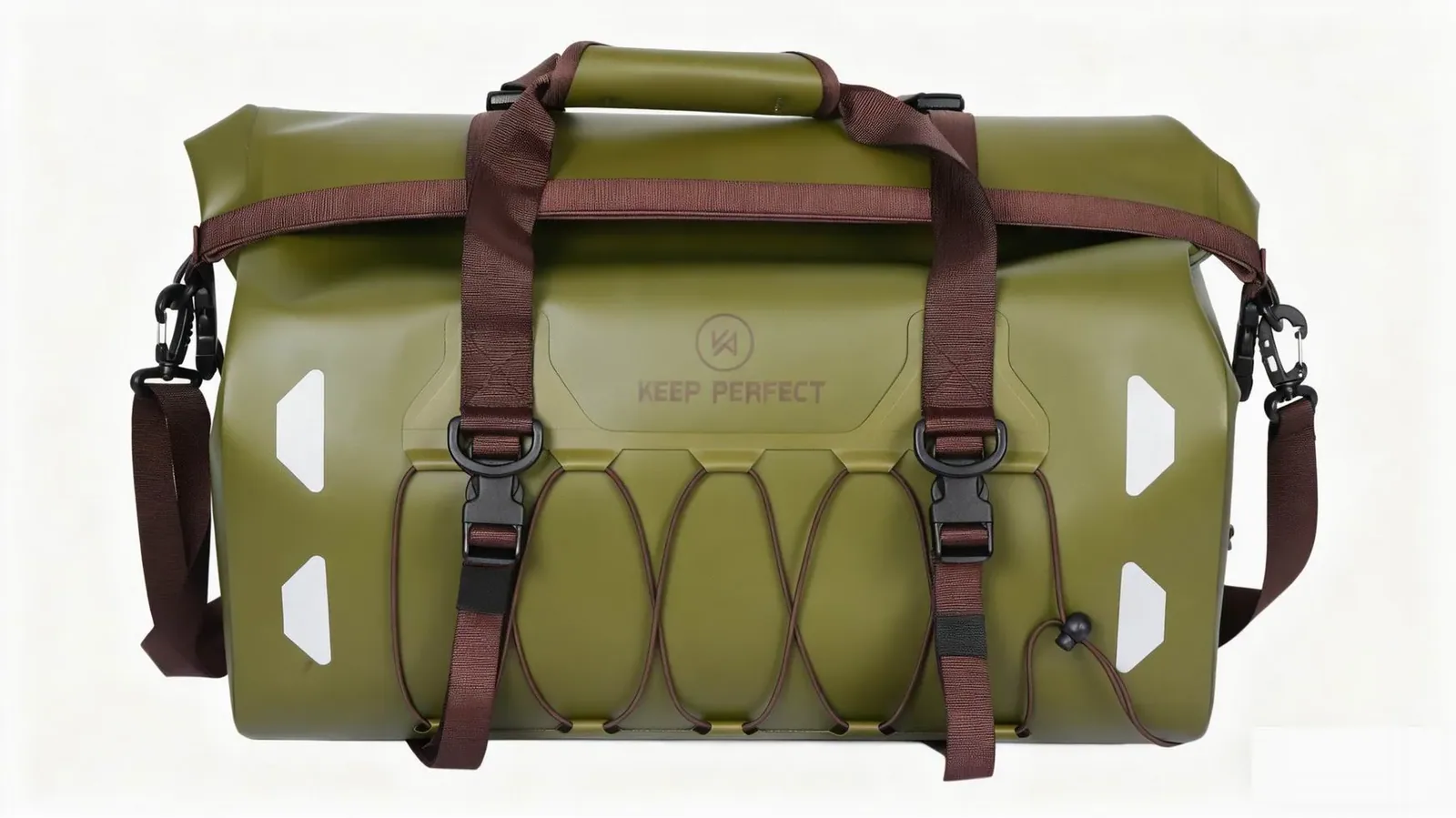
Neoprene, nylon and PU are not three grades of one thing. Neoprene is a closed-cell elastomeric sheet laminated to a face fabric, and it buys cushioning, insulation and stretch recovery. Nylon is a woven shell bought by denier and by coating, and it buys abrasion and tear strength at low weight. PU is either a film, a coating or a coagulated face, and it buys a non-fabric surface and a controlled hand.
The comparison appears on nearly every enquiry in this category, and it is usually framed wrongly. A buyer asks which of the three materials is "better" for a bag, when the real question is which one belongs on which panel. Most serious builds use two of the three: a neoprene body with a woven reinforcement at the base is common and sensible, and a neoprene body with a PU-coated panel at the wear point is common too. What matters is knowing what each family actually decides, and what each one will not do. the thickness and density clause
What Is Actually Being Compared When Three Materials Sit Side by Side?
Three fundamentally different structures. Neoprene is a foamed elastomer — either polychloroprene or a styrene-butadiene rubber compound — delivered as a sheet with a skin on each face and usually bonded to a textile face. Nylon is a woven polyamide built from filament yarn, sold by yarn weight and by weave, and finished with a coating if the duty requires it. PU, polyurethane, can be a coating applied to a woven textile, a standalone film, or a coagulated surface layer; a "PU bag" usually means a woven substrate carrying a polyurethane face.
Comparing them on one axis therefore produces nonsense. A denier number describes a yarn and says nothing about a foam. A millimetre describes a foam and means nothing to a weave. The useful comparison is by behaviour under load, by what each does with water, by how each takes a logo, and by what each costs per finished part at a defined duty. Those four questions produce a decision; "which is strongest" does not.
| Behaviour | Neoprene sheet | Woven nylon | PU-coated or PU-faced |
|---|---|---|---|
| Compression under load | Compresses and recovers; this is its purpose | Barely compresses; load goes into the seam | Depends on the substrate behind the face |
| Abrasion at the base | Moderate; the face fabric takes the wear | High, especially at 840 denier and above | Very high if the coating is a good grade |
| Tear propagation | Runs once started, especially along a cell plane | Resists propagation well in a plain weave | Resists well; the coating helps |
| Water behaviour | Closed cells do not absorb; the face fabric does get wet | Absorbs unless finished or coated | The face sheds water; seams decide the rest |
| Insulation | The reason to choose it | Negligible on its own | Negligible on its own |
| Stretch recovery | High in the face fabric direction | Low; the weave limits it | Low to moderate |
How Does Neoprene Behave Under Load, Water and Repeated Flexing?
Under load it compresses through perhaps thirty to fifty percent of its thickness before it bottoms out, and returns almost all of the way, which is what makes it a cushioning material rather than a covering. That behaviour is why it protects a bottle or a lens and why it feels forgiving against a shoulder. The failure mode is different from a woven fabric: rather than tearing, it creases permanently at a fold, splits along a cell plane if the fold is sharp enough, or takes a compression set if it is stacked for months.
With water the cellular core is on the buyer side: closed cells do not take water up, so the panel does not gain weight or lose insulation by becoming wet. The face fabric does wet out, and the seam line is where water gets through. Repeated flexing is the hard test, because the bond between the foam and the face is what eventually gives; delamination at a fold is the single most common end-of-life appearance problem on a neoprene part.
Where Does Yarn-Weight Nylon Outperform an Elastomeric Foam?
Anywhere the dominant failure is abrasion or tear rather than impact. A base panel set down on a pavement hundreds of times, a strap attachment that carries a full load, a corner that drags across a loading surface — in all three, a woven polyamide at a few hundred grams per square metre outperforms a foam of any practical thickness, because failure there is surface wear and thread breakage rather than cushioning.
The second advantage is weight and packability. A 210 denier nylon panel costs a fraction of the weight of even a 1.5 mm neoprene laminate for the same area, and it packs to nothing. Where the product has to fold into a pocket, or where the shipping cube is the binding constraint rather than the duty, the weave wins on its own. The hybrid answer — a neoprene body with a nylon reinforcement patch at the base — is so common because it puts each of the two where it works.
When Is PU the Right Answer Rather Than a Compromise?
PU earns its place on three counts. As a coating on a woven nylon or polyester it delivers water resistance and abrasion at low cost and reliably, and it is specified by coating weight in grams per square metre rather than by description. As a film it gives a weldable, food-contact-capable surface for a liner or a panel. And as a coagulated face it produces a leather-like appearance with excellent abrasion at a fraction of the weight of leather, which is why it appears on structured panels that have to look dressed rather than technical.
Its weakness is the same in all three forms: it ages. A polyester-based polyurethane resists abrasion and hydrolysis better; polyether-based grades resist hydrolysis and microbial attack better; aromatic grades yellow under ultraviolet exposure where aliphatic grades do not. The choice is a grade choice, not just a material choice, and specifying "PU" without the grade is how a program ends up with a panel that cracks at the fold after a season.
How Do the Three Compare on Abrasion, Tear and Water Behaviour?
Abrasion is measured by rubbing the material against a standard abradant to a stated end point, tear by measuring the force needed to propagate a cut, and tensile behaviour under ISO 13934-1 gives breaking force and elongation. Water behaviour is two separate measurements — a spray test for surface repellency and a hydrostatic head test for penetration under pressure — and neither predicts the other. A fabric can be highly repellent and still leak at a seam under load.
On those five measurements the picture is stable. Nylon leads on tear and on hydrostatic head once coated. PU leads on abrasion and on surface repellency. Neoprene leads on neither, and it should not be chosen for either: it is chosen for compression and insulation, which none of those five tests measures. A buyer comparing three materials only on abrasion will always conclude wrongly that neoprene is the weakest option, which is precisely the mistake this table has to prevent.
Two further behaviours separate them once the article is in service. Under sustained load a neoprene panel takes a small permanent set, which is why a part that ships flat-packed should be specified by density as well as gauge; a woven panel creeps far less but transmits load straight into its seams. And on repeated laundering the differences widen again, because a bonded laminate has three things that can move — foam, adhesive and face fabric — where a woven or coated panel has one.
Which Material Structure Handles Printing and Branding Best?
A woven nylon takes almost anything: screen print, heat transfer, sublimation where the polymer accepts disperse dye, embroidery, and a woven label. A PU face is narrower — screen print and heat transfer work, and the wrong plastisol will plasticise-migrate and go tacky — but it gives a clean, sharp edge that a textured neoprene face cannot. Neoprene is the most constrained of the three, because the surface is a stretch jersey bonded to a foam that moves underneath it.
On neoprene the two reliable routes are sublimation into a polyester face fabric, which puts the colour into the fibre and survives stretch, and a silicone badge or screen print formulated for high extension, which sits on top and must be able to stretch with the panel. Embroidery on neoprene perforates the sheet and needs stabiliser and a backing. Whichever route is chosen, print durability is verified by laundering and colourfastness methods from the AATCC manual rather than by looking at a sample.
| Branding method | Neoprene | Woven nylon | PU face |
|---|---|---|---|
| Dye-sublimation | Yes, into a polyester face | On polyester, on nylon with care | Usually not |
| Screen print | Silicone or high-stretch ink only | Standard plastisol or water-based | Yes, with a compatible ink |
| Embroidery | Possible, needs a backing and a lighter density | Excellent | Poor; the face splits |
| Heat transfer | Yes, with a stretch-grade film | Yes | Yes |
| Silicone badge | Best option on stretch faces | Possible but unnecessary | Rarely used |
| Failure to watch | Cracking as the panel stretches | Peeling at the edge | Plasticiser migration going tacky |
What Do the Three Cost Once Weight and Yield Are Counted?
Neoprene is priced by area and by gauge, so the cost driver is thickness times density; a 3 mm laminate is a different article from a 1.5 mm one even though both are "neoprene". Nylon is priced by weight and by construction, so the driver is denier plus coating plus finish. PU adds a coating step or a face layer on top of one of those two. Comparing them per metre is meaningless; comparing them per finished part at the duty is the only arithmetic that holds.
Two things distort the comparison in practice. Yield: neoprene cut from a sheet leaves skeleton waste that the panel nesting decides, so a badly nested pattern can waste a fifth of the material. And assembly: neoprene needs less lining and fewer internal stiffeners, because the panel itself provides structure, while a woven shell often needs interlining, foam or board to stand up. Counted at part level, neoprene frequently lands closer to a coated weave than the raw prices suggest.
Choosing between the three
- Neoprene is chosen for compression, insulation and stretch recovery, not for abrasion.
- Nylon is bought by denier plus coating, and it wins wherever wear and tear dominate.
- PU is a grade decision, not just a material decision; name the chemistry, not the acronym.
- Most good builds use two of the three: a foam body with a woven reinforcement at the wear point.
- Choose the branding method with the material, since each surface has a different print menu.
How Do the Three Behave in Compliance and in the Restricted-Substance File?
Differently enough to matter at specification rather than at shipment. A neoprene sheet brings a rubber-compound question — residual monomers, accelerators, and plasticisers in some blends — alongside the textile face, which brings its own dye and finishing chemistry. A woven nylon brings a dye and coating question, and polyamide has its own extraction considerations in some test regimes. A PU face brings an isocyanate and solvent question, plus the plasticiser question where a flexible PVC-like hand has been engineered.
All three are assessed the same way in Europe: against the REACH candidate list administered by the European Chemicals Agency, with a Proposition 65 position for goods sold into California, and OEKO-TEX certification as the common textile route to evidence. The point of asking early is that each family fails on different substances, so a substitution made for supply reasons reopens a different part of the file. Where the article is for children, CPSIA applies to the assembled product regardless of which of the three was chosen.
How Should a Mixed-Material Build Be Specified?
Panel by panel, with the panel list in the tech pack rather than in an email. The list names each position on the article, the material there, the basis on which it is bought — gauge and density, or denier and coating weight — and the test that verifies it. Then it names how the two materials meet, because the interface is where a mixed build fails: a woven patch sewn to a foam body concentrates load at the stitch line and can tear the foam before it tears the weave.
Two interface details decide most of these failures. The reinforcement has to be generous enough in area that the load spreads beyond the stitch line, and the thread and needle have to suit the foam rather than the patch, because it is the foam that will give. Where a heavy patch meets a light panel, a box stitch with bar-tacks at the corners and a slightly longer stitch length outperform a dense straight stitch every time.
A third decision in a mixed build is how the two materials move as one article. A woven patch does not stretch, so wherever it lands it arrests the extension of the foam around it and concentrates stress at its own perimeter. Keep the patch inside the low-stretch zones of the panel rather than across a fold or a corner that has to flex, or the article will tear around the reinforcement rather than at a seam.
Finally, sequence matters more on a mixed build than on a single-material one. Where a woven reinforcement has to be sewn on before the panel is closed, and the neoprene has to be bonded or laminated before it is cut, the two operations sit either side of each other on the line and either can hold the other up. Map the sequence at the tech-pack stage, because a sequence discovered on the line is the most expensive kind of process change.
Programme numbers are unchanged by the material choice: MOQ 500 pcs per style and colourway, sampling 6-10 working days from a signed-off tech pack, bulk production 35-50 days from sample approval, inspection at AQL 2.5 under ISO 2859-1 General Inspection Level II, T/T 30/70, FOB Xiamen. What a mixed build does add is a sourcing step, because two material families usually mean two lead times, and the longer of the two sets the sampling window.
Get the material map before the drawing is frozen
Send the duty, the market and the quantity. You get a panel-by-panel material map with the verification test behind each line, within one business day.
Frequently Asked Questions
Is neoprene better than nylon for bags?
Neither is better in the abstract. Neoprene wins on cushioning, insulation and stretch recovery; nylon wins on abrasion, tear strength, weight and packability. Most builds use both.
What is the difference between nylon and PU?
Nylon is a woven polyamide bought by yarn weight and weave; PU is a polyurethane applied as a coating, a film or a coagulated face. PU describes a finish or a layer, not a substitute for a weave.
When should I choose neoprene over a woven shell?
When the contents need cushioning or temperature buffering, when the article rests against the body, or when a single layer can serve as structure, lining and padding at once.
Is PU-coated fabric durable?
A good PU coating resists abrasion and sheds water well. Grade matters: polyester-based grades resist abrasion, polyether-based grades resist hydrolysis, and aliphatic grades resist yellowing.
Which material is best for printing a logo?
A woven nylon accepts nearly every method; neoprene needs a stretch-capable route such as sublimation into the face or a silicone badge; a PU face takes screen print and heat transfer.
Does neoprene absorb water?
The closed-cell core does not take water up, so insulation survives wetting. The bonded face fabric does wet out, and the seam line is where water enters.
Can one bag combine neoprene and woven nylon?
Yes, and it usually should. Reinforce the wear points with a woven patch and keep neoprene where cushioning matters, with a generous patch area so the load spreads past the stitch line.
How do I compare material costs fairly?
Per finished part at the defined duty, counting yield waste on sheet material and counting the lining and stiffener a woven shell needs to stand up.
Do the three differ on compliance?
Yes. Each fails on different substances, so a substitution for supply reasons reopens a different part of the restricted-substance file under REACH.
What is MOQ on a mixed-material build?
MOQ 500 pcs per style and colourway. Sampling runs 6-10 working days, moving toward 12-15 working days when the second material has its own lead time.
Which tests verify each material family?
Abrasion to a stated cycle count, tear, tensile to ISO 13934-1, spray and hydrostatic head for water behaviour, and AATCC colourfastness methods for appearance after laundering.
Is neoprene heavier than nylon?
Yes per unit area, substantially. A 3 mm neoprene laminate weighs several times a 210 denier nylon panel of the same area, which is why the weigh point for any part is a design decision.
People Also Ask
Is neoprene better than nylon?
Neoprene is better at cushioning and insulation; nylon is better at abrasion, tear and low weight. Choose by duty, then mix them by panel.
What is the difference between neoprene and PU?
Neoprene is a foamed rubber sheet; PU is a polyurethane coating, film or face applied to another substrate.
Which bag material lasts longest?
A coated high-denier weave lasts longest against abrasion; neoprene lasts longest where the failure would be impact or repeated compression.
Can neoprene and fabric be combined?
Yes, most serious builds combine them, with woven patches at the wear points and a generous attachment area.
How do I choose between three materials?
Decide which behaviour the failure would be — wear, tear, impact or heat transfer — and let that choose the material panel by panel.
Sources and further reading
Every figure on this page is either our own programme data or attributed below. Open the originals before you write them into a specification.
- ISO 13934-1 — Textiles: tensile properties of fabricsInternational Organization for Standardization
- AATCC technical manual — colourfastness and appearance test methodsAmerican Association of Textile Chemists and Colorists
- REACH — Registration, Evaluation, Authorisation and Restriction of ChemicalsEuropean Chemicals Agency