How Many Bags Fit in a 20-Foot and 40-Foot Container?
A 60 x 40 x 40 cm carton is 0.096 cubic metres and stacks 9 x 5 x 5 in a 20-foot container — 225 at the ceiling, 200 to 215 loaded. The same carton stacks 20 x 5 x 5 in a 40-foot container. Loaded counts run 10-15% below the ceiling. MOQ 500 pcs per style.
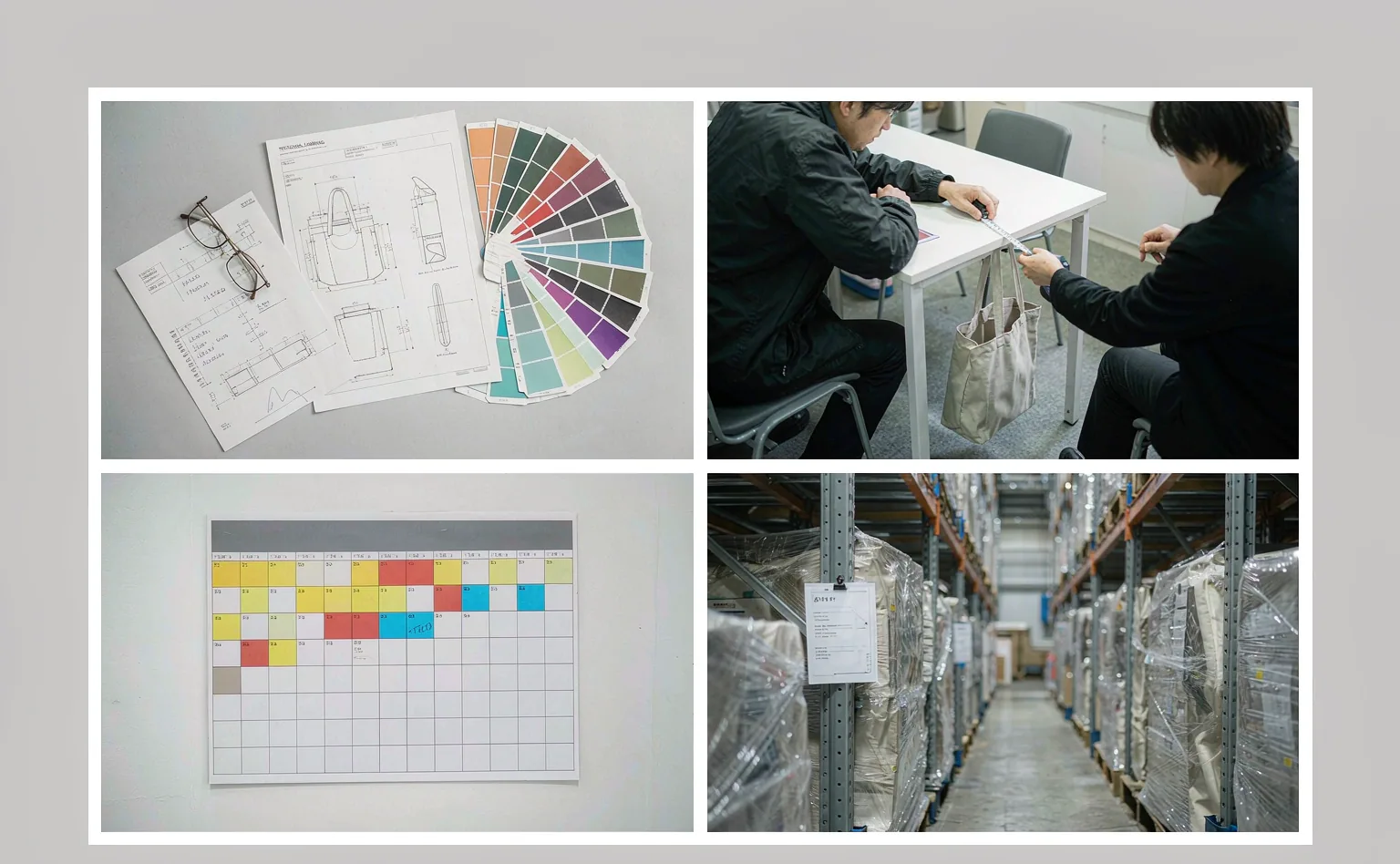
Take the standard export carton at 60 x 40 x 40 cm, which is 0.096 cubic metres. A 20-foot container has an internal volume of about 33 cubic metres and stacks that carton 9 along the length, 5 across the width and 5 high — a 225-carton ceiling. Loaded quantities run 10-15% below the ceiling, so plan 200-215 cartons, which at 12 bags per carton is 2,400 to 2,580 bags. A 40-foot container stacks 20 x 5 x 5 for a 500-carton ceiling and loads 450 to 480 cartons.
What Are the Internal Dimensions of a 20-Foot and 40-Foot Container?
The dimensions are standardised. ISO 668 classifies Series 1 freight containers and gives the external dimensions and ratings; ISO 1496-1 covers the specification and testing of general cargo containers. A 20-foot container has an internal length of roughly 5.9 metres, an internal width of roughly 2.35 metres and an internal height of roughly 2.39 metres, which is an internal volume of about 33 cubic metres. A 40-foot container is roughly 12.03 metres internally, giving about 67 to 68 cubic metres.
Those are the numbers to work from, and the first thing to note is that neither is a figure you can fill. The internal volume includes the space above the door line, the taper at the corners, the space lost to the floor and the walls, and the gap you cannot close at the door. A container is a rectangular box with rounded corners and a door that has to shut, and every one of those features takes volume out of the calculation.
| Container | Internal length | Internal width | Internal height | Internal volume |
|---|---|---|---|---|
| 20-foot general cargo | about 5.90 m | about 2.35 m | about 2.39 m | about 33 cubic metres |
| 40-foot general cargo | about 12.03 m | about 2.35 m | about 2.39 m | about 67-68 cubic metres |
| 40-foot high cube | about 12.03 m | about 2.35 m | about 2.70 m | about 76 cubic metres |
How Do You Get From Carton Dimensions to Cartons per Container?
Divide, then round down, then multiply — and the rounding is not a rounding, it is the whole calculation. A carton that fits 9.8 times along the length fits 9 times. Divide the internal length by the carton dimension pointing along it, take the integer, and do the same for the width and the height. Multiply the three integers and you have the stacking ceiling.
Then test each orientation, because the carton can lie three ways and the answers differ sharply. With a 60 x 40 x 40 cm carton in a 20-foot container, putting the 60 cm dimension along the length gives 9 x 5 x 5 = 225. Putting the 40 cm dimension along the length gives 14 x 3 x 5 = 210, or 14 x 5 x 3 = 210. The difference between 225 and 210 cartons is 180 bags at 12 per carton, and it costs nothing to get right.
- Carton volume
- 0.6 x 0.4 x 0.4 = 0.096 cubic metres
- 20-foot, best orientation
- 9 along x 5 across x 5 high = 225 cartons
- 20-foot, second orientation
- 14 along x 3 across x 5 high = 210 cartons
- 40-foot, best orientation
- 20 along x 5 across x 5 high = 500 cartons
- 40-foot, second orientation
- 30 along x 3 across x 5 high = 450 cartons
- 40-foot high cube, best orientation
- 20 along x 5 across x 6 high = 600 cartons
Why Does the Loaded Quantity Fall 10-15% Below the Arithmetic?
Because the stacking ceiling assumes perfect rectangular cartons in a perfect rectangular box, loaded by a machine, with nothing else in the container. Five things break that assumption and between them they take 10-15% off the count. The first is carton bulge: a carton of soft goods is not a rigid rectangular solid, and the nominal dimensions are measured on an empty carton. Filled and stacked, the faces bow.
The second is the last-row gap, which is the space left at the door where a full row will not fit and has to be made up with a partial row, dunnage or air bags. The third is dunnage and protection: edge board, corner posts, strapping and the air bags themselves all occupy volume. The fourth is mixed cartons — a container carrying three colourways rarely splits into three perfect blocks.
The fifth is the loading sequence. Where one container serves two delivery addresses, the load is planned so that the goods for the second stop are behind the goods for the first, and that constraint costs volume because you can no longer choose the tightest arrangement. Put all five together and a 225-carton ceiling becomes a 200 to 215 carton plan.
| Cause of loss | What it does to the plan | Typical effect |
|---|---|---|
| Carton bulge on soft goods | Cartons bow, so rows do not close up | A few percent |
| Last-row gap at the door | A partial row or dunnage fills the end | A few percent |
| Dunnage and protection | Edge board, strapping, air bags take space | A few percent |
| Mixed colourways or styles | Blocks do not divide evenly | Up to several percent |
| Multi-drop loading sequence | Blocks must be ordered by stop | Up to several percent |
| Combined | Ceiling minus the above | 10-15% off the stacking ceiling |
How Many Bags Per Carton by Bag Type?
The units per carton is the number that turns cartons into bags, and it varies by a factor of five across the six product families on this programme. A flat-packed drawstring bag nests almost flat, so a carton holds dozens. A cooler bag with foam insulation holds far fewer because the insulation does not compress. A camera bag with padded dividers holds fewer still, and it is the one family where weight rather than volume can become the limit.
These are planning figures for the standard 60 x 40 x 40 cm carton, and the right way to use them is to ask for the actual packed count on the packing list rather than to assume. The packed count is measured, and it is the number the freight is allocated against.
| Bag type | Units per 60 x 40 x 40 cm carton | Approximate carton weight | Comment |
|---|---|---|---|
| Drawstring bags, flat packed | 30-40 | about 7 kg | Nests almost flat |
| Neoprene sleeves and small cases | 20-25 | about 9 kg | Compressible, springs back |
| Insulated cooler bags | 8-12 | about 11 kg | Foam does not compress |
| Wine and bottle bags | 12-16 | about 13 kg | Glass protection adds bulk |
| Team kit bags | 10-14 | about 12 kg | Depends on whether it is packed flat |
| Camera bags with dividers | 6-8 | about 18 kg | The one family where weight can bind |
What Is the Worked Answer for a 20-Foot Container?
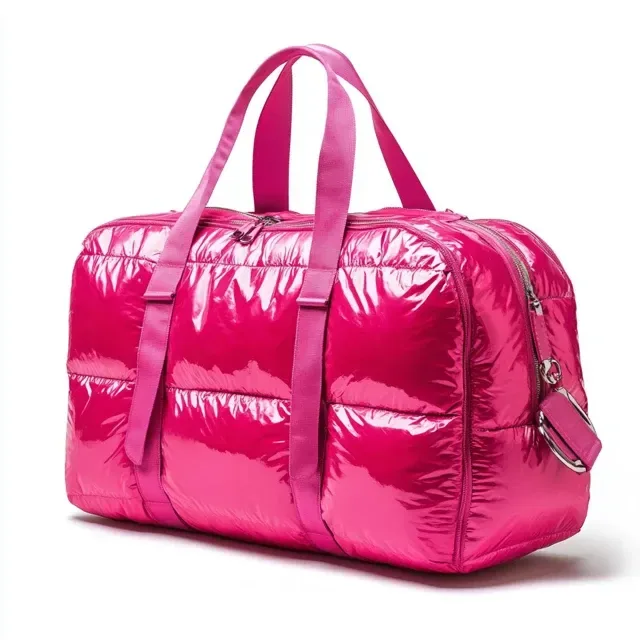
Work it in four steps. Step one: the carton is 0.096 cubic metres. Step two: the stacking ceiling is 9 x 5 x 5 = 225 cartons. Step three: apply the 10-15% packing loss, giving a plan of 200 to 215 cartons. Step four: multiply by the units per carton.
At 12 units per carton — the planning figure for an insulated cooler bag — that is 2,400 to 2,580 bags in a 20-foot container. At 30 units per carton for a flat-packed drawstring bag, the same container holds 6,000 to 6,450. The container has not changed; the packing has. That is the single most useful sentence in container planning, because it means the freight cost per bag is a specification decision made long before anyone books a vessel.
| Bag type in a 20-foot container | Cartons planned | Units per carton | Bags per container |
|---|---|---|---|
| Insulated cooler bags | 200-215 | 8-12 | about 1,600-2,580 |
| Drawstring bags, flat packed | 200-215 | 30-40 | about 6,000-8,600 |
| Neoprene sleeves | 200-215 | 20-25 | about 4,000-5,375 |
| Wine and bottle bags | 200-215 | 12-16 | about 2,400-3,440 |
| Team kit bags | 200-215 | 10-14 | about 2,000-3,010 |
| Camera bags with dividers | 200-215 | 6-8 | about 1,200-1,720 |
What Is the Worked Answer for a 40-Foot and 40-Foot High-Cube Container?
The same four steps, with different integers. A 40-foot container stacks the standard carton 20 x 5 x 5 for a 500-carton ceiling; a 40-foot high cube stacks 20 x 5 x 6 for 600. Apply the same 10-15% packing loss and the plan is 450 to 480 cartons in a 40-foot container and 540 to 575 in a high cube.
At 12 units per carton that is roughly 5,400 to 5,760 bags in a 40-foot container and 6,480 to 6,900 in a high cube. Notice that the high cube is not 25% more expensive than the standard 40-foot container on most trades, but it carries roughly 20% more cartons — which is why a high cube is the first thing to ask for when the volume is close to a standard container.
- 20-foot container
- 200-215 cartons, about 2,400-2,580 bags
- 40-foot container
- 450-480 cartons, about 5,400-5,760 bags
- 40-foot high cube
- 540-575 cartons, about 6,480-6,900 bags
- Two 40-foot containers
- 900-960 cartons, about 10,800-11,520 bags
- Volume used, 20-foot
- about 19-21 cubic metres against 33 internal
- Volume used, 40-foot
- about 43-46 cubic metres against 67-68 internal
When Does Weight Rather Than Volume Limit the Load?
Almost never for soft bags, and that is worth stating because buyers who have only shipped dense goods assume the opposite. A 20-foot container has a payload rating in the region of 28 tonnes, and 2,500 soft bags at half a kilogram each is barely a tonne. Volume binds long before weight does.
The exceptions are the families with hardware. A camera bag with padded dividers, a metal frame or a dense hardware pack can reach a kilogram and a half, and at 12 to a carton in 215 cartons that is still under four tonnes — so even there, volume usually binds. Weight becomes the limit only when the bag is genuinely dense, or when the container is also carrying something else. The verified gross mass declaration required under SOLAS exists precisely because nobody should be guessing.
How Do Mixed Colourways and Mixed Styles Reduce the Count?
A container carrying one style in one colourway loads at the ceiling. A container carrying three colourways loads below it, because each colourway is a block that has to be complete and the blocks do not tile the container perfectly. The same applies to mixed styles with different carton sizes, and it applies most of all when the split is decided after the container has been planned.
The remedy is to declare the split at enquiry stage and let the packing plan be built around it. A packing plan drawn before the cartons exist can choose carton sizes that tile well; a split announced after production cannot, because the cartons are already packed and sealed. That is why the split belongs on the enquiry rather than on the shipping instruction.
What Does This Mean for Per-Bag Freight Cost?
It means the freight per bag is decided by the packing specification, not by the negotiation. If a 40-foot container costs a fixed amount and carries 5,400 bags at one packing specification and 6,900 at another, the per-bag freight differs by more than 20% with no change in the rate. Buyers spend hours negotiating the freight rate and minutes on the carton.
The arithmetic is worth doing once and keeping. Divide the freight by the planned carton count, then by the units per carton, and you have the freight per bag. Compare that figure across two packing options and the answer is usually obvious. The landed cost calculator holds the calculation, and the consolidation comparison sits in LCL against FCL for bag shipments.
Six numbers to ask for on every packing plan
- The carton dimensions, in centimetres, and the resulting carton volume.
- The units per carton, measured on a packed carton rather than estimated.
- The planned carton count for the container, not the stacking ceiling.
- The planned volume against the internal volume, as a percentage.
- The gross weight per carton and the total, for the verified gross mass declaration.
- The split by colourway and style, declared before the cartons are packed.
How Should You State the Packing Plan on the Enquiry?
State six things: carton dimensions, units per carton, planned carton count, total volume, total gross weight and the colourway split. Six numbers, one line each, and every freight quotation that follows is comparable. Without them a quotation is a guess with a rate card attached, and two such quotations cannot be compared even if they came from the same forwarder on the same day.
Ask for the packing list to be produced from the cartons actually loaded rather than from the order quantity, and check that the carton count times the carton volume equals the stated total volume. That one check catches most packing errors, and it is the same discipline that makes the entry go through without a query.
Freight bands and transit windows in this cluster are planning ranges drawn from quoted lots, not published tariff rates. They move with bunker cost, vessel rotation, port congestion and the week you book; ask for a live quotation against your sailing before you commit the order to a calendar.
Ask for a packing plan with the quotation
Send us the style, the quantity and the destination and we will quote with the carton dimensions, units per carton, planned carton count, total volume and gross weight on the same page.
Frequently Asked Questions
How many bags fit in a 20-foot container?
At the standard 60 x 40 x 40 cm carton the stacking ceiling is 225 cartons and the plan is 200-215. At 12 bags per carton that is roughly 2,400 to 2,580 bags; at 30 per carton for flat-packed drawstring bags it is 6,000 or more.
How many bags fit in a 40-foot container?
The stacking ceiling is 500 cartons and the plan is 450-480, which at 12 bags per carton is roughly 5,400 to 5,760 bags. A high cube takes the ceiling to 600 cartons.
Why is the loaded quantity lower than the arithmetic?
Because the ceiling assumes rigid cartons in a perfect box. Carton bulge, the last-row gap at the door, dunnage, mixed colourways and multi-drop loading sequence together take 10-15% off.
What is the cubic capacity of a 20-foot container?
About 33 cubic metres internal under ISO 668, and roughly 19 to 21 cubic metres of that is what a load of soft bags in standard cartons actually uses.
Does weight or volume limit a bag shipment?
Volume, almost always. A 20-foot container has a payload rating around 28 tonnes and 2,500 soft bags weigh barely a tonne. Weight binds only on dense hardware-heavy families.
How many bags fit in one export carton?
It depends on the family: 30-40 for flat-packed drawstring bags, 20-25 for neoprene, 8-12 for insulated cooler bags, 12-16 for wine bags, 10-14 for team kit and 6-8 for camera bags with dividers.
Should I use a 40-foot high cube instead of a standard 40-foot?
Usually yes when the volume is close, because the high cube carries materially more cartons for a rate that is not proportionally higher on most trades.
How do I convert the container rate into a freight cost per bag?
Divide the freight by the planned carton count and then by the units per carton. Use the planned count, not the stacking ceiling, or you will understate it.
Does a mixed colourway reduce the carton count?
Yes, because each colourway is a block and the blocks do not tile perfectly. Declare the split at enquiry stage so the packing plan can be built around it.
What is the standard export carton on this programme?
60 x 40 x 40 cm, which is 0.096 cubic metres. Other sizes are used where the product requires it, and the packed count is always stated on the packing list.
Why does my packing list not match the order quantity?
It should not. A packing list is produced from the cartons actually loaded, and the loaded count differs from the order count because of the packing loss and any short shipment.
What is verified gross mass and does it apply to bags?
It is the container weight declaration required under SOLAS before loading. It applies to every container including bag cargo, which is why the gross weight per carton belongs on the enquiry.
People Also Ask
How many bags fit in a 20-foot container?
At the standard 60 x 40 x 40 cm carton the ceiling is 225 cartons and the plan is 200-215 — roughly 2,400 to 2,580 bags at 12 per carton.
How many bags fit in a 40-foot container?
The ceiling is 500 cartons and the plan is 450-480, roughly 5,400 to 5,760 bags at 12 per carton.
Why is the loaded count lower than the arithmetic?
Carton bulge, the last-row gap, dunnage, mixed colourways and multi-drop sequence take 10-15% off the stacking ceiling.
What is the cubic capacity of a 20-foot container?
About 33 cubic metres internal, of which a load of soft bags in standard cartons uses roughly 19 to 21.
Does weight or volume limit a bag shipment?
Volume, almost always. Only dense hardware-heavy families approach the payload rating.
Sources and further reading
Every figure on this page is either our own programme data or attributed below. Open the originals before you write them into a specification.
- ISO 668 — Series 1 freight containers: classification, dimensions and ratingsInternational Organization for Standardization
- ISO 1496-1 — Series 1 freight containers: specification and testing, general cargoInternational Organization for Standardization
- ISTA test procedures — packaged-product performance testingInternational Safe Transit Association