What Is the Difference Between EXW and FOB for Bag Orders?
Under EXW the buyer collects at the sellers premises and owns the goods from that moment, unloaded and un-filed. Under FOB the seller delivers on board at Xiamen, export cleared. The gap between them is the pickup, the export declaration, the haulage and the loading. MOQ 500 pcs per style.
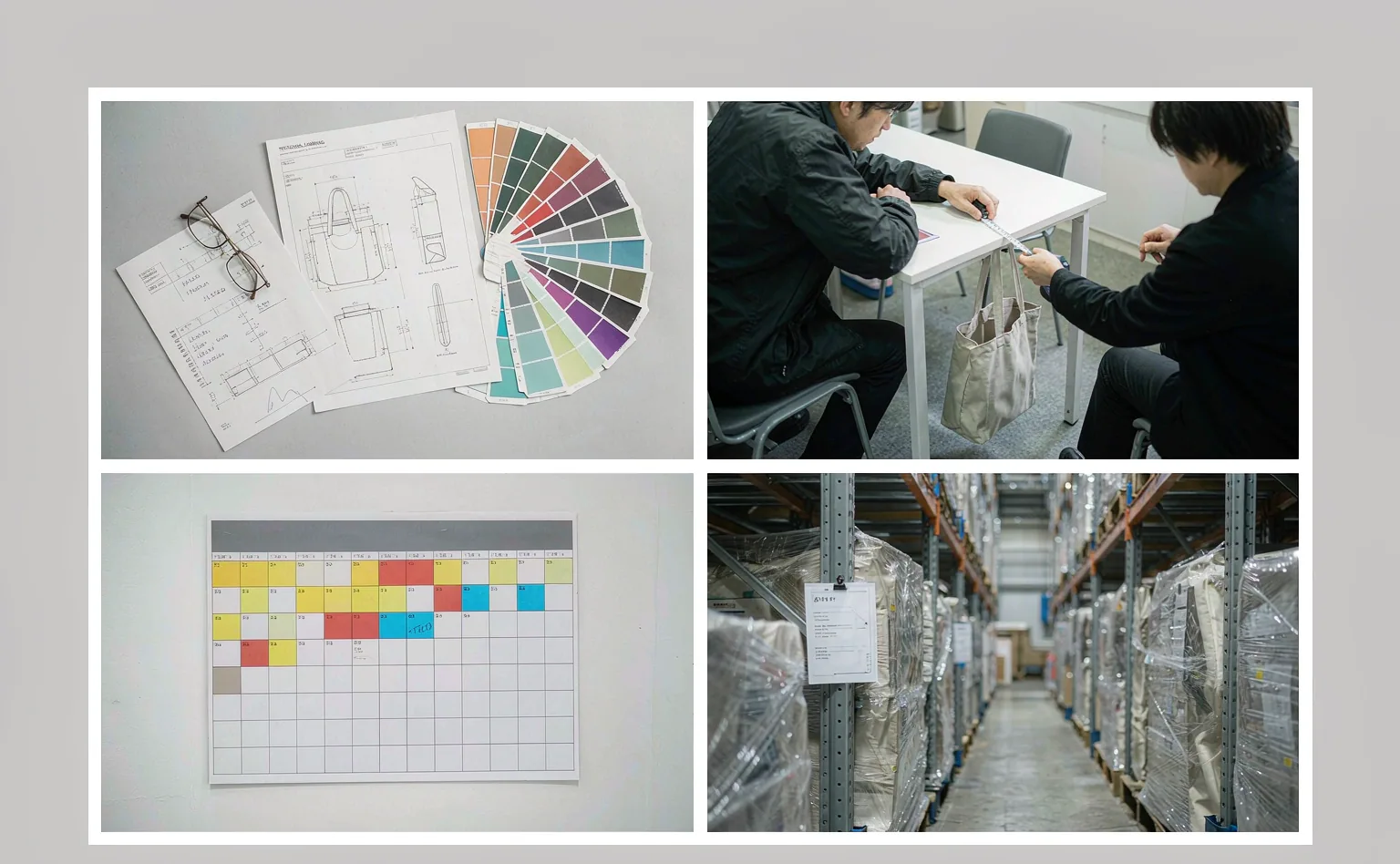
Under EXW the seller only makes the goods available at its premises or another named place; the buyer loads, hauls, files the export, books the vessel and bears every risk from the moment of collection. Under FOB Xiamen the seller does all of that up to loading on board. The price gap is the cost of those four activities; the risk gap is much larger, because under EXW the buyer owns the goods before they are even on a truck.
Where Does Delivery Happen Under Each Term?
Under EXW delivery happens when the goods are made available at the sellers premises or at another named place, not loaded on any collecting vehicle and not cleared for export. That is the minimum obligation in the whole Incoterms 2020 set. Under FOB delivery happens when the goods are on board the vessel at Xiamen, export cleared, with the seller having handled packing, marking, haulage, terminal handling and loading.
The practical difference is that under EXW the buyer has to be present, or represented, at a place it does not control. Collection has to be arranged within the sellers loading hours, with a vehicle suited to the carton dimensions, and somebody has to sign for the goods at that moment. Buyers who have never done this underestimate how much coordination a single collection involves.
What Does EXW Oblige the Buyer to Do at Origin?
Five things, in order: arrange the collection vehicle, load it, move the goods to the terminal, file the export declaration, and deliver the goods into the carriers hands at the port. Four of those five require a local presence or a local agent, and the fifth requires a booking the buyer has to make. None of them is difficult for a party that does this every week; all of them are difficult for a buyer doing it for the first time from another continent.
There is a sixth obligation buyers forget: providing evidence of delivery. Under EXW the buyer may need to give the seller proof that the goods were collected, because the sellers obligation ended at availability and the seller needs a record that its obligation was discharged. Where the sales contract and the payment terms are tied to shipment, that evidence becomes commercially important.
| Activity | EXW | FOB Xiamen | FCA Xiamen (named place) |
|---|---|---|---|
| Packing and marking for export | Seller | Seller | Seller |
| Loading the collecting vehicle | Buyer | Seller | Buyer or seller as agreed |
| Inland haulage to the terminal | Buyer | Seller | Seller to the named place |
| Export declaration | Buyer | Seller | Seller |
| Terminal handling at load port | Buyer | Seller | Buyer |
| Loading on board | Buyer | Seller | Buyer |
| Risk transfers | At availability, unloaded | On board | On delivery at the named place |
| Main carriage and insurance | Buyer | Buyer | Buyer |
| Cost line on one 40-foot container | Under EXW | Under FOB Xiamen | Note |
|---|---|---|---|
| Goods value | Buyer pays | Buyer pays | Identical on both terms |
| Collection vehicle and loading | Buyer pays and risks it | Included | The buyer also bears damage during loading under EXW |
| Inland haulage to Xiamen | Buyer pays | Included | Short in Fujian, so the gap is smaller than buyers expect |
| Export declaration | Buyer files, or cannot | Included | The decisive difference when the buyer has no local entity |
| Terminal handling | Buyer pays | Included | Published by the terminal |
| Loading on board | Buyer pays | Included | Default under FOB, per Incoterms 2020 |
| Coordination | Buyer arranges from abroad | Included | Not on any tariff, and the line buyers forget to price |
Can You File the Export Declaration Under EXW?
This is the question that decides whether EXW is usable at all, and the honest answer is that it depends on whether the buying entity can be the exporter of record in the country of export. Many jurisdictions require the exporter to be a registered entity with a local tax identification. A foreign buying entity with no local registration usually cannot file, and no amount of contractual drafting changes that.
Where the buyer cannot file, the work is done by somebody who can, and that somebody is usually the seller acting as a favour rather than as an obligation. That arrangement has two problems: it is not enforceable under the term, and it is priced at whatever the moment requires. Incoterms 2020 addresses this directly by recommending FCA where the buyer wants the seller to handle export formalities.
What Does Loading Actually Cost and Who Does It?
Loading sounds trivial and is not. Cartons of soft bags are volumous and light, so the cost of loading is labour and time rather than equipment — but the liability during loading is real, because under EXW the buyer already owns the goods while they are being handled by people the buyer has not instructed and cannot supervise. A carton dropped between the production site and the truck is the buyers loss.
The cost itself is modest in absolute terms and disproportionate in administrative terms. A buyer arranging loading from abroad is paying for a phone call, a confirmation, a delay and a correction. A seller doing it as part of a routine is paying for a few minutes of a team that is already there. That asymmetry — not the money — is the reason EXW rarely saves what the price difference suggests.
Which Documents Does the Buyer Have to Produce?
Under EXW the buyer produces the export declaration and, in most cases, has to obtain the documents the seller is not obliged to provide. Incoterms 2020 requires the seller to give the buyer the commercial invoice and whatever assistance is needed to obtain documents, but the buyer does the obtaining. In practice that means the buyer or its agent assembles the invoice, the packing list, the export filing and the transport document.
The risk in that arrangement is inconsistency. When the seller produces the set, the three documents agree because one party wrote them. When the buyer assembles the set from pieces provided by somebody else, a carton count or a description can drift between documents, and a drift between documents is a query at the border. If you must use EXW, ask for a draft document pack and check it before collection.
How Do the Two Prices Compare on the Same Bag?
Take one 40-foot container carrying 400 cartons at 12 bags per carton, which is 4,800 units. The EXW price excludes four things the FOB price includes: the haul to Xiamen, the export filing, the terminal handling and the loading. Add to those the administrative cost of arranging them from abroad, and the buyers own margin for the risk of getting one wrong.
In Fujian the haul is short, so the first of those four is small. The export filing is a fixed administrative cost, not a per-carton one. Terminal handling is published by the terminal. Loading is labour. What is left — the coordination — is the part that does not appear on any tariff and is the part buyers fail to price. A buyer with an agent in Xiamen already pays for that coordination; a buyer without one will.
- Cartons in the container
- 400 cartons at 60 x 40 x 40 cm
- Units in the container
- 4,800 bags at 12 per carton
- Haul to the terminal at Xiamen
- Short in Fujian; priced per container
- Export declaration
- Fixed administrative cost per shipment
- Terminal handling at load port
- Published by the terminal
- Loading on board
- Labour and equipment, priced per container
- Coordination and risk
- Not on any tariff, and the line buyers forget
When Is EXW Genuinely the Right Choice?
EXW is right when the buyer has a consolidation agent at origin that already collects from several vendors, because then the buyer is not arranging a collection — it is adding one stop to a route that already runs. It is also right when the buying entity has a local presence that can be the exporter of record, and when the goods are being consolidated with other purchases so that one party controls the whole export filing.
There is a fourth party in this picture who is easy to overlook: the consolidation agent at origin. If the buyer uses one, EXW stops being a problem and starts being convenient, because the agent collects from several vendors, consolidates at its own facility, files one export declaration for the consolidated lot and books one container. That is the structure under which EXW genuinely works, and it is also the structure under which a buyer shipping from a single vendor has no reason to use EXW at all.
It is also defensible when the buyer wants the goods to leave origin under its own control for chain-of-custody reasons — where the buyer is responsible for the goods from the moment they are finished and wants the record to say so. That is a real reason, and it is rare. For a single-vendor bag programme it is not usually the reason EXW is being requested.
What Is FCA and Why Is It Usually Better Than EXW?
FCA delivers the goods to the carrier or to another person nominated by the buyer at a named place, and — critically — requires the seller to clear the goods for export where applicable. It applies to any mode of transport, not just sea. That combination solves the two problems with EXW in one move: the seller handles the export filing it can actually do, and delivery happens at a place the buyer can name and control.
A second reason to prefer FCA concerns time rather than risk. Under FOB the seller has to get the goods on board, which means the seller is responsible through the whole terminal window — including any delay in that window. Under FCA at the terminal the sellers obligation ends at handover, and the buyers freight forwarder takes over from there. For a buyer whose forwarder is already managing the booking, that is the cleaner handover.
For containerised cargo many practitioners prefer FCA to FOB for a second reason as well: under FOB the risk passes on board, but the container is handed over at the terminal days before loading, so there is a period during which the buyer has lost practical control of the goods but not yet borne the risk, or vice versa depending on the drafting. Under FCA at the terminal the boundary and the handover happen at the same moment.

How Does the Term Affect the Inspection and Release Point?
Inspection at AQL 2.5 under ISO 2859-1 sits before shipment under all three terms, but what happens to a rejected batch changes. Under FOB the seller holds the goods and cannot ship a rejected batch, because delivery has not happened. Under EXW the goods are available, the buyer has the right to inspect, and if the buyer collects before inspecting it has taken delivery of a batch it may want to reject.
The clause that fixes this is simple: make inspection and written release a condition of collection under EXW. The buyer inspects, issues a release, and only then does the collection vehicle load. Without that clause the inspection right is theoretical, because the practical pressure to load a truck that has already arrived is considerable.
If you must use EXW, write these six clauses
- The named place in full: the site, the building and the loading point, not a city.
- Who loads the collecting vehicle, and who bears the risk while it is being loaded.
- Whether the seller will assist with the export filing, and on what terms.
- That inspection at AQL 2.5 and written release are a condition of collection.
- The loading window, in the sellers local time, and what happens if it is missed.
- The document set the seller will provide, and by when.
What Should You Write in the Contract if You Must Use EXW?
Name the place precisely enough that a stranger could find it. "EXW Xiamen" is not a place, it is a city; "EXW at the named site, Building 3, loading bay 2" is a place. The precision matters because the whole term turns on where the goods were made available, and a disagreement about that is a disagreement about who owned the goods when they were damaged.
Then write the loading obligation explicitly. Incoterms 2020 does not require the seller to load under EXW, which surprises buyers who assumed loading was included. If you want the seller to load, say so in the contract, because the default is the opposite and the default is what applies when the contract is silent.
Freight bands and transit windows in this cluster are planning ranges drawn from quoted lots, not published tariff rates. They move with bunker cost, vessel rotation, port congestion and the week you book; ask for a live quotation against your sailing before you commit the order to a calendar.
Compare EXW, FCA and FOB on the same carton count
Send us the quantity and the destination and we will quote EXW, FCA Xiamen and FOB Xiamen on the same specification so you can see what each boundary actually costs you.
Frequently Asked Questions
Does EXW include loading the truck?
No. Under EXW the seller is not obliged to load the collecting vehicle; the buyer loads. If you want the seller to load, it has to be written into the contract.
Can a foreign buyer file the export declaration under EXW?
Usually not, because many jurisdictions require the exporter of record to be a locally registered entity. Where the buyer cannot file, ask for FCA instead, which obliges the seller to handle export formalities.
Is EXW always the lowest price?
It is the smallest sellers price, because the seller does the least. Whether it is the lowest landed cost depends on whether you can execute the four activities you have just taken on at the same cost.
What is the difference between EXW and FCA?
FCA delivers to a named place with the seller handling export formalities; EXW delivers at the sellers premises with the buyer handling everything, including loading and export filing.
Why do practitioners prefer FCA over FOB for containers?
Because under FOB the container is handed over at the terminal days before loading, so the handover and the risk boundary are in different places. Under FCA at the terminal they happen together.
Who insures the goods under EXW?
The buyer, from the moment of collection. Neither party is obliged to insure under EXW, and the risk sits with the buyer earlier than under any other term.
Does inspection still happen before shipment under EXW?
It should, and the contract should make written release a condition of collection. Otherwise the practical pressure to load a truck that has arrived overrides the inspection right.
When is EXW genuinely the right choice?
When you have a consolidation agent at origin collecting from several vendors, when you have a local entity that can be the exporter of record, or when you need chain-of-custody control from the moment the goods are finished.
How much does the inland haul cost in Fujian?
The haul to Xiamen is short, which is why the EXW to FOB gap from a Fujian base is smaller than buyers expect from an inland province. Ask for both numbers rather than assuming.
What document does the buyer need to prove delivery under EXW?
Evidence of collection. The seller may require it to show its obligation was discharged, and where payment is tied to shipment the record becomes commercially important.
Can EXW be used for air freight?
Yes, EXW applies to any mode. But for air the same export-filing problem applies, and FCA at the carriers handling facility is usually the cleaner structure.
Should a first order use EXW?
Almost never. A first order has enough unknowns without adding pickup, export filing and main carriage to the list of things you have never done.
People Also Ask
Does EXW include loading?
No. The seller makes the goods available; the buyer loads. Loading has to be written into the contract if you want the seller to do it.
What is the difference between EXW and FCA?
FCA delivers to a named place with the seller handling export formalities; EXW delivers at the sellers premises with the buyer handling loading, haulage and export filing.
Can a foreign buyer file the export declaration?
Usually not, because the exporter of record must generally be a locally registered entity. FCA is the workable substitute.
When is EXW the right choice?
When you have a consolidation agent at origin, a local entity that can be the exporter of record, or a chain-of-custody requirement from the moment the goods are finished.
Is EXW the lowest total cost?
It is the smallest sellers price, not necessarily the lowest landed cost. The four activities you take on have to be priced before you know.
Sources and further reading
Every figure on this page is either our own programme data or attributed below. Open the originals before you write them into a specification.
- Incoterms 2020 — delivery, risk transfer and the A/B obligation tablesInternational Chamber of Commerce
- ISO 2859-1:1999 — Sampling procedures for inspection by attributesInternational Organization for Standardization
- Incoterms 2020 — ICC rules for the use of domestic and international trade termsInternational Chamber of Commerce