How Well Does a Neoprene Lunch Bag Actually Insulate?
It gives roughly a quarter to a third of the wall resistance of a conventional insulated build, holds a pre-chilled load below 8 °C for about two hours at 25 °C, and depends entirely on how cold the load started. Seams, lid and closure decide more than the gauge does.
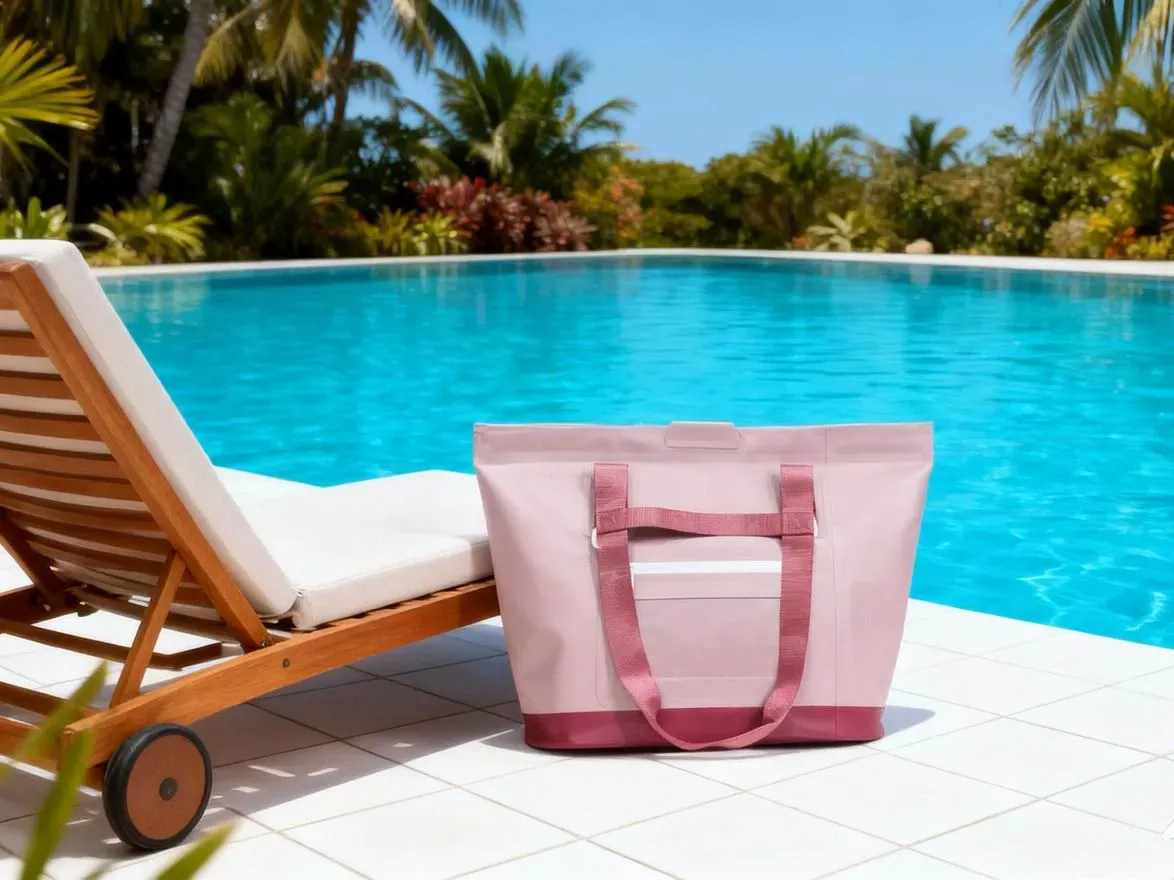
A neoprene lunch format insulates through the gas in its closed cells, and the resistance available is small: three millimetres delivers roughly a quarter of the wall resistance of a conventional 8 mm cooler build. It holds a pre-chilled load in the cold band for a short morning window and no longer. Anything beyond that needs a phase-change sheet, a thicker panel, or an honest statement on the label.
The buying question behind this article is almost always the same: can neoprene do the job of a conventional insulated lunch bag, and can we say something about hours on the label. The answer is a qualified yes to the first and a careful yes to the second, provided nobody expects the thermal performance of a thick foam build from a three-millimetre sheet. This page puts numbers on the resistance available, explains why the seam rather than the panel decides most lunch-format results, and sets out how to word a claim that can be defended.
What Insulation Does Neoprene Provide, and What Does It Not?
It provides modest, genuinely useful resistance to heat flow across a thin section, in a material that is at the same time flexible, light, forgiving in the hand and easy to wipe clean. Those properties together are the reason it is chosen; the insulation alone would not be. It does not provide stored cooling of any kind — there is no phase change in the panel — so everything the article achieves depends entirely on the temperature the load started at.
That distinction decides everything downstream. A neoprene lunch article does not cool anything; it slows the warming of something already cold. Remove the pre-chilled load and the performance disappears, however thick the panel is. Every credible claim therefore has to carry load starting temperature, load mass and ambient alongside the hours, and a claim without those three is a claim waiting to be challenged.
| Build | Wall resistance per unit area, indicative | Useful window at 25 °C with a 1.2 kg load | Where it belongs |
|---|---|---|---|
| 3 mm neoprene | About a quarter of an 8 mm cooler wall | Roughly 90 to 150 minutes to 8 °C | Commute, office and school morning |
| 4 mm neoprene | About a third of an 8 mm cooler wall | Roughly two to three hours to 8 °C | Long commute, site work |
| 3 mm with a 200 g phase-change sheet | Same panel, plus stored cooling | Four to five hours to 8 °C | Full workday without refrigeration |
| 8 mm closed-cell foam with a welded liner | The comparison baseline | Eight to twelve hours with refrigerant | Cooler duty rather than lunch duty |
| 3 mm with aluminised facing | Slightly better in radiant load | Adds roughly twenty percent in sun | Window-led duty and warm vehicles |
How Do You Convert Thickness Into a Thermal Number?
Thermal resistance is thickness divided by thermal conductivity, and the conductivity of a closed-cell elastomeric foam is commonly quoted in the region of 0.05 to 0.06 watts per metre kelvin. Take a mid-range figure and a 3 mm panel and the available resistance works out at around 0.05 kelvin metre squared per watt — the same order as a single thin layer of still air. Trebling the gauge triples that number, which is why 4 mm is meaningfully better and 5 mm better again.
The comparison that matters is against a resin-insulated cooler build, which typically uses eight or more millimetres of foam with a lower conductivity. On that comparison a neoprene lunch panel delivers somewhere near a quarter to a third of the wall resistance. That single sentence should be in every neoprene lunch specification, because it is the difference between an article sold honestly and an article sold as a cooler.
Why Is the Seam the Weak Point in a Neoprene Lunch Format?
Because it is where the insulation is missing, and on a small format the seam is a large share of the surface. A flatlock seam is laterally a dense line of perforation through the panel; a bound edge replaces perhaps eight millimetres of foam-plus-facing with tape and thread. On a boxy lunch shape there may be six edges and four corners, and each one is a strip of essentially uninsulated wall.
The practical mitigations are geometric. Move seams away from the base and the lid, which are the two surfaces facing the strongest temperature gradient in real use. Prefer a wrapped panel that reaches from the base up one side without a join, because it removes one edge entirely. And where a seam must sit at an edge, add a backing strip of the same sheet behind it, which costs a few grams and restores most of the resistance.
Can Neoprene Hold a Cold Load Without a Gel Pack?
Yes, for a short window, and the boundary is worth stating precisely because it is where marketing and engineering part company. With a load pre-chilled to 4 °C, at 25 °C ambient and in shade, a 3 mm neoprene lunch article typically holds the centre of a well-packed load below 8 °C for about two hours, and a 4 mm article for perhaps half again longer. At 32 °C in direct sun the same builds halve.
Three conditions decide whether even that holds, and all three belong on the product. The load must start cold — a warm load carries hundreds of kilojoules that the panel cannot remove. The load must fill the cavity, because a partial fill means internal air circulation rather than conduction through contact. And the article must not be opened during the window, since each opening exchanges most of the internal air.
Does Neoprene Insulate Better Wet or Dry?
Dry, decisively, and this is one of the few unconditional statements in this article. Water in the cell structure would replace trapped gas with a far better conductor and performance would collapse; happily, closed cells do not take water up, so the panel itself keeps working wet. What does degrade performance is water in the face fabric and, critically, water between the face and the foam.
That second failure mode — delamination letting water reach the interface — is why the bonding quality matters to the thermal result as well as to the appearance. Once moisture sits in the interface it is slow to leave, it supports microbial growth, and it shows as bubbles under the face. Specify the bonding likely to be tested after laundering rather than before, so the interface is proven rather than assumed.
How Does Neoprene Compare With a Foam-and-Fabric Cooler Build?
On performance the cooler build wins substantially and always will, because it has several times the wall resistance and — importantly — a cavity designed around refrigerant. Comparing the two on hours alone is unfair to both: the neoprene article is lighter, softer, washable, folds flat and looks nothing like a cooler, which for many programmes is the entire point. It solves a different job.
On cost the comparison is closer than it looks. The neoprene article needs fewer layers, no liner film in many constructions and no internal stiffener, because the panel is itself the structure. Set against a multi-layer resin-insulated build with a liner, a base board and bound seams, the part cost can land within reach even though the raw sheet costs more per square metre. the cooler bag programme hub covers what the heavier build buys.
There is also a difference in what each does with water, and it cuts both ways. A conventional build relies on a welded liner film to hold meltwater, and if that film is punctured the insulation loses most of its value. A neoprene article has no separate liner to puncture and its cells do not hold water, so it degrades more gracefully. Against that, its seams are sewn rather than welded in most constructions, and every needle hole is a small thermal leak that a liner-based build does not have.
| Loss path | Indicative share of heat gain | Why it dominates here | Fix that returns the most |
|---|---|---|---|
| Lid panel | Around a third | Largest surface facing the strongest gradient, least structure | A second layer in the lid before any other spend |
| Closure line | A quarter or more | A continuous gap across a panel already short of resistance | A covered flap with loft, or a roll-top |
| Corner and edge seams | Roughly a fifth | Perforation and tape replace the foam locally | Fewer seams, wrapped panels, backing strips |
| Flat walls | Around a fifth | The only path the gauge controls | Step to 4 mm once the other three are addressed |
| Radiant load through the face | Small in shade, large in sun | A dark face in sun runs well above ambient | A lighter colourway or a reflective facing |
- Endpoint
- Core temperature at 8 °C, or the bound the food safety file requires
- Load
- Mass and starting temperature, stated rather than assumed
- Ambient
- Worst service ambient, stated with a tolerance
- Conditioning
- Load conditioned overnight at the stated temperature
- Panel gauge
- By position: walls, base, lid
- Seam plan
- Seams named and positioned away from base and lid
- Refrigerant
- Phase-change sheet mass and melt point if the window needs it
- Instrument
- Calibrated probe at the load centre, logged at five-minute intervals
- Acceptance
- Three units, all three inside the bound at the stated hour
- Label wording
- Hours with the three conditions printed beside them
What Does the Lid and Closure Cost You Here?
On a small box format the lid is proportionately the largest surface facing the strongest gradient, because warm air rises against it and because it is usually the panel with the least structure. A lid that is a single thickness of laminate loses heat several times faster than a wall of the same gauge. A second layer in the lid is the most economical performance improvement available, ahead of increasing the whole article.
The closure is the same story in a smaller compass: a continuous gap in the insulation running across the panel that leaks most. A covered flap with a little loft in it, a roll-top that folds several thicknesses together, or a zipper tucked under a lip all help, and all three cost less than a gauge increase. Where the article has to hold toward the top of its window, spend there first.
How Is Insulation Measured Without Overclaiming?
With a defined protocol and a logged curve rather than a single reading. Place a calibrated probe in the geometric centre of a load simulant conditioned overnight at 4 °C, hold the article in still air at the stated ambient, do not open it, and log at five-minute intervals. Run three units. The curve tells you far more than the endpoint does: a steep early rise points at the closure or the lid, a steady decline points at the walls.
Then word the claim to match the protocol rather than the ambition. "Keeps a pre-chilled lunch cold for two hours at 25 °C, out of direct sun" is defensible and printable. "All-day cooling" is neither, because it implies an article with stored cooling that this construction does not have. A brand that prints the conditions is protected; a brand that prints only the time is exposed to the first customer who leaves the article on a dashboard.
Making a neoprene lunch claim honest
- Three millimetres gives roughly a quarter of an 8 mm cooler wall. Say so and the rest is credible.
- The load supplies the cooling; the panel only slows warming, so state its starting temperature.
- Seams and the lid decide more of the result than the gauge does on a small format.
- A dry interface performs and a delaminated one does not, which links bonding quality to thermal claims.
- Print hours together with load, ambient and shade, and back it with a logged curve from three units.
What Do Cost, Weight and Cube Look Like at 3 and 4 mm?
The step from 3 mm to 4 mm adds roughly a third more polymer by area, which on a lunch-sized article is a small absolute cost and perhaps eighty to a hundred grams of weight. Against that, it buys a real and measurable improvement in window and — worth as much commercially — a noticeably firmer article that photographs better and holds its shape on a shelf.
Cube behaves differently here than on most articles, because a well-designed neoprene lunch format nests well when empty. Nested packing can offset part of the extra gauge, which is why the honest answer always comes from units per carton rather than from a material price comparison. Ask for both figures before deciding, since the result depends on how much the shape collapses.
Programme numbers do not move with the thermal specification: MOQ 500 pcs per style and colourway, sampling 6-10 working days from a signed-off tech pack, bulk production 35-50 days from sample approval, inspection at AQL 2.5 under ISO 2859-1 General Inspection Level II, T/T 30/70, quoted FOB Xiamen. What does move is the sampling content: a thermal protocol takes days to run, sits inside the sampling window, and cannot be compressed into the production schedule afterwards.
One more question deserves its own answer, because it decides the compliance file rather than the panel: what touches the food. In many neoprene lunch constructions the load sits directly against the bonded face rather than against a separate liner film, which makes that face a food-contact surface. It needs the same declaration position any liner would need — Regulation (EC) No 1935/2004 in Europe and FDA 21 CFR 177 in the United States — and it needs to be raised before sampling rather than discovered at launch.
Specify the window you can defend
Send the load, the ambient you actually meet and the quantity. You get a panel recommendation and a publishable test protocol, within one business day.
Frequently Asked Questions
How well does neoprene insulate?
Modestly. Roughly a quarter to a third of the wall resistance of a conventional 8 mm insulated build at comparable gauges, which suits a short morning window rather than an all-day cooler.
Can a neoprene lunch bag keep food cold without a gel pack?
For about two hours at 25 °C with a load pre-chilled to 4 °C and the article unopened. Four millimetres extends it somewhat; a phase-change sheet takes it further.
Is 3 mm neoprene enough for a lunch bag?
For a commute or a school morning, yes. For a full workday without refrigeration, specify 4 mm with a phase-change sheet.
Does neoprene insulate when wet?
The closed cells do not absorb water, so the panel keeps working. Performance is undermined only if water reaches the interface between foam and face fabric.
Why does the lid matter so much on this format?
Warm air rises against it and it is usually the least structured panel, so it faces the strongest gradient with the least resistance.
Where should seams go on a neoprene lunch article?
Away from the base and the lid. A wrapped panel that reaches round the base with no join is worth more than an extra millimetre elsewhere.
What is the thermal conductivity of neoprene?
Commonly quoted around 0.05 to 0.06 watts per metre kelvin for closed-cell elastomeric sheet. Ask the mill for the figure on the specific sheet being supplied.
How should the hours be tested?
A calibrated probe at the centre of a conditioned load simulant, stated ambient, still air, no opening, logged at five-minute intervals, three units.
Can I print a time claim on the product?
Yes, provided the three conditions are printed beside it: starting load temperature, ambient, and out of direct sun.
Does the food touch the neoprene itself?
In many constructions the load rests against the bonded face rather than a film liner, making that face a food-contact surface needing a declaration position.
What is the MOQ for a neoprene lunch build?
MOQ 500 pcs per style and colourway, with repeat programmes open to discussion at 300 pcs.
How long does sampling take with a thermal protocol?
6-10 working days, though running the protocol itself consumes days of that window and cannot be moved into the production schedule.
Is an aluminised facing worth adding?
It adds meaningfully only where radiant load is real — sun through glass, a warm vehicle — and adds very little in shade.
How does neoprene compare on weight?
Heavier per unit area than a thin shell, but it replaces lining, foam and stiffener, so at part level the gap is much smaller than the raw material comparison suggests.
People Also Ask
Does neoprene keep food cold?
It slows warming of an already-cold load for roughly two hours at 3 mm and 25 °C ambient, longer with a phase-change sheet.
Is neoprene a good insulator?
It is a modest insulator with excellent handling properties. For long windows, a thick foam build is materially better.
How long will a neoprene lunch bag keep food cold?
About two hours to 8 °C at 25 °C ambient from a 4 °C load, more at 4 mm or with a phase-change sheet.
Do neoprene lunch bags need ice packs?
Not for a short window if the load starts cold. Longer windows need a built-in phase-change sheet or a meaningful increase in gauge.
Can neoprene replace a cooler bag?
Not on performance. It replaces it on weight, washability, flat packing and appearance, which is why the two serve different programmes.
Sources and further reading
Every figure on this page is either our own programme data or attributed below. Open the originals before you write them into a specification.
- Regulation (EC) No 1935/2004 on materials and articles intended to come into contact with foodEuropean Union
- FDA 21 CFR 177 — Indirect food additives: polymersUS Food and Drug Administration
- ISO 2859-1:1999 Sampling procedures for inspection by attributesInternational Organization for Standardization