How Much Shock Does a Neoprene Sleeve Actually Absorb?
Impact energy is set by mass and drop height; only its distribution is a design choice. A 3 mm panel offers roughly one and a half to two millimetres of usable compression stroke, 5 mm roughly doubles it, and corner geometry frequently matters more than the gauge does.
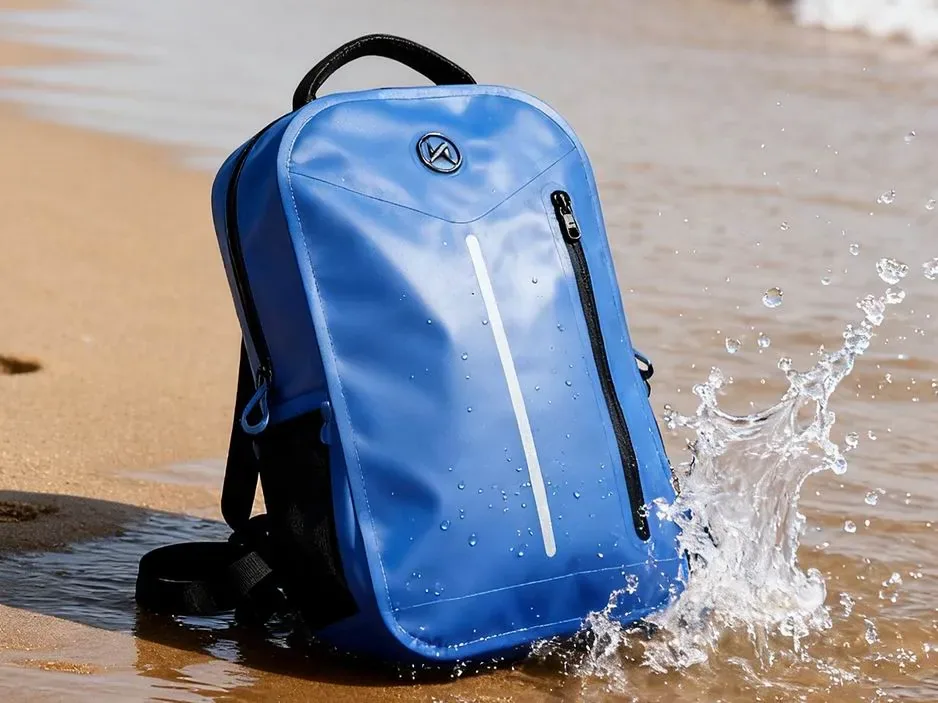
A neoprene sleeve protects by converting kinetic energy into compression of the cell structure over a short stroke, and the stroke is limited by the gauge. A 1.4 kg device falling 0.5 m carries close to 7 joules; a 3 mm panel can only absorb a part of that before the load reaches the contents, and 5 mm roughly doubles the usable stroke. Corners, fit and the closure decide at least as much as the millimetre figure.
Shock absorption claims on soft protective articles are almost never written down, which is odd given that protection is the reason the category exists. A buyer asks for a protective neoprene sleeve for a laptop or a tablet, receives a quote at 3 mm, and approves a sample because it feels thick. Nothing about the energy arithmetic was discussed, nobody agreed what drop the article should survive, and the first customer whose device is damaged becomes the test programme. This page sets out the physics in the units a buyer can actually check, then shows why the gauge is only one of five variables.
What Actually Happens to Impact Energy in a Neoprene Panel?
The energy at impact is fixed by the mass and the drop height, not by anything the designer chooses: potential energy becomes kinetic energy, and on contact something has to absorb it. In this material three things absorb it. The cell structure compresses, converting energy into work done on the cell walls; a small part goes into the hysteresis of the elastomer itself, which is why the material does not return everything it absorbed; and the remainder goes into whatever is inside the article.
That last share is what the specification is really about. The useful stroke is the distance the panel can compress before it bottoms out, and it is roughly half to two-thirds of the gauge depending on density. A 3 mm panel therefore has one and a half to two millimetres of useful stroke where the impact lands, and a 5 mm panel has a third more again. Anything that reduces stroke — a rigid insert, a hard floor, a point load at a corner — pushes energy back into the contents.
| Dropped mass and height | Energy at impact | What a 3 mm panel can take | What a 5 mm panel can take | Verdict |
|---|---|---|---|---|
| 0.6 kg from 0.3 m | About 1.8 J | Well inside capacity | Comfortable | Either gauge |
| 1.0 kg from 0.4 m | About 3.9 J | Near the top of a flat face | Comfortable | 3 mm acceptable on the flat face |
| 1.4 kg from 0.5 m | About 6.9 J | Marginal at a corner | Acceptable with corner geometry | Specify 4 mm or inserts at minimum |
| 2.0 kg from 0.8 m | About 15.7 J | Outside capacity | Marginal even here | A soft case is the wrong article |
| Edge or corner impact | All of the above at a point | Worst case in any build | Better, still the weak point | Corner geometry before gauge |
How Much Fall Energy Does 3 mm Absorb, and How Much Does 5 mm?
The honest answer is that neither figure can be quoted alone, because capacity depends on how much of the impact area is loaded and how fast the load arrives. What can be said usefully: the absorbed energy scales close to linearly with the usable stroke, so going from 3 mm to 5 mm buys roughly two-thirds more capacity at the same density. That lands a 5 mm build comfortably inside drop cases where a 3 mm build is marginal.
What it does not buy is protection against a point load. A corner hitting a hard floor concentrates all of the energy into a few square millimetres of panel, the local stress exceeds what the cell structure can resist, and the panel bottoms out locally no matter how thick it is. This is why doubling the gauge buys less than doubling protection, and why every heavy protective build should spend its millimetres at the corners before it spends them in the walls.
Why Do Corners Decide More Than Gauge Does?
Two reasons. The first is geometric: a flat-face impact spreads across perhaps twenty square centimetres, while a corner impact concentrates into two, so the local stress is an order of magnitude higher. The second is that the corner is where construction and material depart from each other — it is where the seam is, where the binding sits, where two panels meet at ninety degrees, and therefore where there is often no foam at all.
The practical answers are all about geometry rather than material. A radiused corner keeps three-dimensional coverage across the impact instead of letting two panels part company at a right angle. A seam placed away from the corner, or a continuous wrap panel that reaches round with no join at the corner, removes the missing-foam problem entirely. And where the article carries heavy contents, a reinforced corner pad of denser material protects better than an extra millimetre distributed everywhere.
How Does Density Change the Absorption Curve?
Density decides where on its compression curve the panel sits for a given load. A low-density sheet compresses easily, so under a light impact it bottoms out early and offers little resistance at the end of the stroke; under a heavy impact it transmits a sharp spike because there is nothing left to compress. A higher-density sheet resists harder from the start, so it protects a heavier load better and transmits more of a light one.
In other words, density has to be matched to the load, and the matching is done backwards from what is being carried rather than forwards from what the mill stocks. A sleeve for a light tablet wants a softer, lower-density sheet with a long gentle stroke; a case for a dense piece of equipment wants a firmer sheet that will resist early. Specifying gauge without density effectively lets the mill pick your impact curve.
- Contents and mass
- Stated, with the heaviest variant covered
- Drop height
- Stated to represent the worst realistic fall, not a floor-to-desk figure
- Impact surface
- Concrete, timber or vinyl tile, named rather than assumed
- Panel gauge
- By position: face, back, base, corner pad
- Density
- Stated with a tolerance, matched to the load
- Corner geometry
- Radius, seam placement and whether a corner pad is used
- Fit tolerance
- Gap allowance at the tightest and loosest dimension of the device
- Drop test method
- Free-fall logic adapted from ASTM D5276, stated height and surface
- Acceptance
- Three units, two drops each, no damage to the dummy load
- Dummy load
- A mass-and-geometry stand-in, not the customer device
What Role Does the Face Fabric Play?
More than most buyers assume, and less than the mill literature suggests. The bonded face carries no meaningful compression duty — it is a few tenths of a millimetre against three or five of foam — but it does three useful things. It distributes a point load over a larger area of foam, which reduces local stress at a corner. It resists abrasion at the surfaces that slide. And it constrains the lateral expansion of the foam under compression, which stiffens the panel in a useful way.
A fourth effect is negative: a heavy or stiff face can prevent the foam from compressing, which shortens the usable stroke and transmits more energy. A four-way-stretch jersey moves with the panel and preserves almost all of the stroke; a heavy bonded tricot or a laminated woven face holds the panel flat and can reduce effective compression by a noticeable amount. Where maximum protection is the goal, the face should be the lightest and most extensible fabric that survives the duty.

How Should a Drop Test Be Written and Judged?
As a protocol with six named items: the dummy load and its mass, the drop height, the impact surface, the number of units, the number and order of drops per unit, and what counts as failure. Without those six the test cannot be repeated, and a result that cannot be repeated is not evidence. There is no standard written specifically for a soft protective sleeve, so programmes adapt the free-fall logic of ASTM D5276 and set their own acceptance, which is legitimate as long as every party agreed it first.
Judgement should be asymmetric. Drop each unit on its flat faces first, then on each corner, and treat a corner result as governing, because that is what a customer will do by accident. Three units with two drops each is a workable minimum; requiring every unit to pass every drop is unrealistic for a soft article, and requiring two of three to pass is a defensible rule that most programmes adopt.
It also helps to test the article as it will actually be packed, because articles rarely travel empty. Put the dummy load inside the sleeve, close the closure the way a customer would, and repeat the drop sequence with the load in place: a closure that stays shut at the bench and opens on impact changes the result completely. Record which face was struck rather than only the pass verdict, since the pattern across six drops tells you where to spend the next design cycle.
| Design lever | What it buys | What it costs | Return per unit of spend |
|---|---|---|---|
| Extra gauge, 3 mm to 5 mm | Roughly double the usable compression stroke | Two-thirds more polymer per area, more cube | Moderate; best on flat-face impacts |
| Radiused corners | Keeps coverage across a corner impact | A pattern change and a new die-cut proof | High; often beats two millimetres of gauge |
| Seam moved off the corner | Removes the uninsulated zone at the impact point | Usually free at the drawing stage | Highest of any lever listed |
| Higher density sheet | Resists earlier, suits a heavier load | More weight at the same gauge | High for dense contents, wrong for light ones |
| Semi-rigid insert | Protection against crushing rather than falling | An extra component and operation | Only where stacking duty exists |
| Tighter fit tolerance | Whole panel loads at once instead of locally | Tighter cutting and a tighter assembly window | High, and often overlooked |
Does a Neoprene Sleeve Need a Rigid Insert?
Sometimes, and the honest test is where the load comes from. A fall is a short high-energy event, and soft cellular absorption handles it well. Sustained stacking — a case under other luggage in an overhead bin, a stack of boxes on a pallet — is a low-energy event applied for hours, and sustained load is exactly what a foam of moderate density does least well, because it creeps.
Where the duty includes both, the right answer is usually hybrid: a neoprene shell for the drop and a thin semi-rigid sheet in the panel for the crush case. That costs less than adding two millimetres everywhere, keeps the gauged protection where it matters, and stops the article taking a permanent set in transit. Specify the insert by material and thickness rather than by description, and make sure the seam is designed around it, because an insert changes the panel thickness at exactly the point where the machine has to turn the corner.
How Do Fit Tolerance and Closure Change Protection?
Fit is the least expensive protection available and the one most often given away by sizing generosity. If the device can move inside the sleeve, it accelerates independently before the panel starts to load, and the impact arrives locally rather than distributed. A close fit means the whole panel starts absorbing at once. The practical target is a near-slip fit at the nominal dimension, with the tolerance written for the largest device variant the sleeve has to accept rather than for the nominal size.
The closure matters for the same reason. A rim that gaps means the device can slide out of the protected envelope; a rolled or folded closure adds thickness where the edge impact lands, which helps; and a zipper at the opening puts a hard component right where a corner might hit. Where a closure is required, place it off the corner and across the face with a covered flap, and check that the slider cannot press against the contents.
What actually absorbs the impact
- Energy at impact is set by mass and height; only its distribution is a design choice.
- Usable stroke is roughly half to two-thirds of the gauge, so thicker genuinely does help — up to a point.
- Corner impacts concentrate energy into a small area where there is usually no foam at all.
- Match density to the load: soft for light contents, firm for dense equipment.
- Write a six-item drop protocol and let two of three units decide, with corner drops governing.
What Does the Protection Build Cost in Weight and Cube?
Going from 3 mm to 5 mm across a sleeve adds roughly two-thirds more polymer by area, which on a small part is a modest absolute cost and a visible absolute weight. What usually costs more is the corner treatment and any insert, because both add operations rather than material. Request the cost both ways — uniform gauge increase against corner treatment at the original gauge — and the comparison often favours spending on geometry.
Cube follows gauge directly, and it matters more here than on most articles because sleeves are sold with a retail hangtag and packed individually. Ask for units per carton at both gauges before choosing. On FOB Xiamen terms the difference lands in the freight the buyer pays, and at five hundred pieces it is usually larger than the material difference.
Programme numbers do not flex with the protection specification: MOQ 500 pcs per style and colourway, sampling 6-10 working days from a signed-off tech pack, bulk production 35-50 days from sample approval, inspection at AQL 2.5 under ISO 2859-1 General Inspection Level II, T/T 30/70, quoted FOB Xiamen. What a protective build does change is the sampling content: a drop protocol has to be run on production-made units, which sits inside the sampling window and cannot be compressed afterwards.
Bring the drop case, not just the device size
Tell us the contents, the mass and the fall you need covered. You get a gauge and corner recommendation with a drop protocol behind it, within one business day.

Frequently Asked Questions
How much impact can neoprene absorb?
It absorbs by compressing through roughly half to two-thirds of its gauge. A 3 mm panel handles a light tabletop fall of a small device comfortably; a 5 mm panel roughly doubles usable stroke for the same area.
Is 5 mm neoprene protective enough for a laptop?
For desk-height falls onto a flat face, yes, with sensible corner geometry. It is not a substitute for a rigid case in checked-baggage or stacking duty, where a semi-rigid insert earns its place.
How much energy is in a 1.4 kg drop from half a metre?
Roughly 6.9 joules, from mass times gravity times height. That figure sets the target and it does not change with the material chosen.
Does thicker neoprene always protect more?
It protects more against distributed impacts and less than you expect against corner impacts, which concentrate energy into a few square millimetres and often land where there is no foam.
What density is best for impact protection?
Match it to the load: a lower-density sheet gives a long gentle stroke for light contents, and a higher-density sheet resists early for dense equipment. Specify both gauge and density.
Do I need a hard insert in a neoprene sleeve?
Where the duty includes sustained stacking or crushing rather than only a fall, yes. A thin semi-rigid sheet in the panel costs less than extra gauge and prevents permanent set.
How should fit be specified?
A near-slip fit at the nominal dimension, with the tolerance written for the largest device variant to be accepted. Movement inside the sleeve defeats the panel.
Which test applies to a soft protective sleeve?
No standard is written for this article specifically. Programmes adapt free-fall logic from ASTM D5276 and state height, surface, units, count and failure definition themselves.
How many units should be drop tested?
Three units with two drops each is a workable minimum, flat faces first and then corners, with two of three passing. Corner drops should govern the verdict.
Does the face fabric affect protection?
Yes, both ways. A stretch jersey preserves nearly all the stroke; a heavy bonded face can hold the panel flat and shorten the stroke by resisting compression.
What is the MOQ for a protective neoprene build?
MOQ 500 pcs per style and colourway, with repeat programmes open to discussion at 300 pcs.
Can drop testing be done during sampling?
Yes, and it should be. It runs on production-made units inside the 6-10 working day sampling window and cannot be squeezed afterwards.
People Also Ask
Does neoprene protect against drops?
Yes for short high-energy falls, by compressing the cell structure. It protects less against sustained crushing, which calls for an insert.
How thick should neoprene be for device protection?
Four to five millimetres, or 3 mm with 5 mm inserts at the base and corners, depending on the mass and the drop height to be covered.
Why does a corner hit do more damage?
The same energy concentrated into a much smaller area, usually at a point where the seam has left no foam at all.
Do I need a rigid case inside a neoprene sleeve?
Not for falls. For overhead bins, pallets and stacked luggage, yes, because sustained load makes foam creep.
How do I test shock absorption?
Free-fall drops from a stated height onto a stated surface with a dummy load, corner drops governing, two of three units passing.
Sources and further reading
Every figure on this page is either our own programme data or attributed below. Open the originals before you write them into a specification.
- ASTM D5276 — Drop Test of Loaded Containers by Free FallASTM International
- ASTM D1056 — Flexible Cellular Materials, Sponge or Expanded RubberASTM International
- ISO 2859-1:1999 Sampling procedures for inspection by attributesInternational Organization for Standardization