How to Choose a Cooler Bag Factory: 7 Red Flags from a Sourcing Partner
Seven signals predict a difficult programme: no named film or foam supplier, no recorded weld parameters, samples made off the production line, no thermal test capability, an inspection plan with no class list, agreement to everything, and no statement of the bulk trigger.
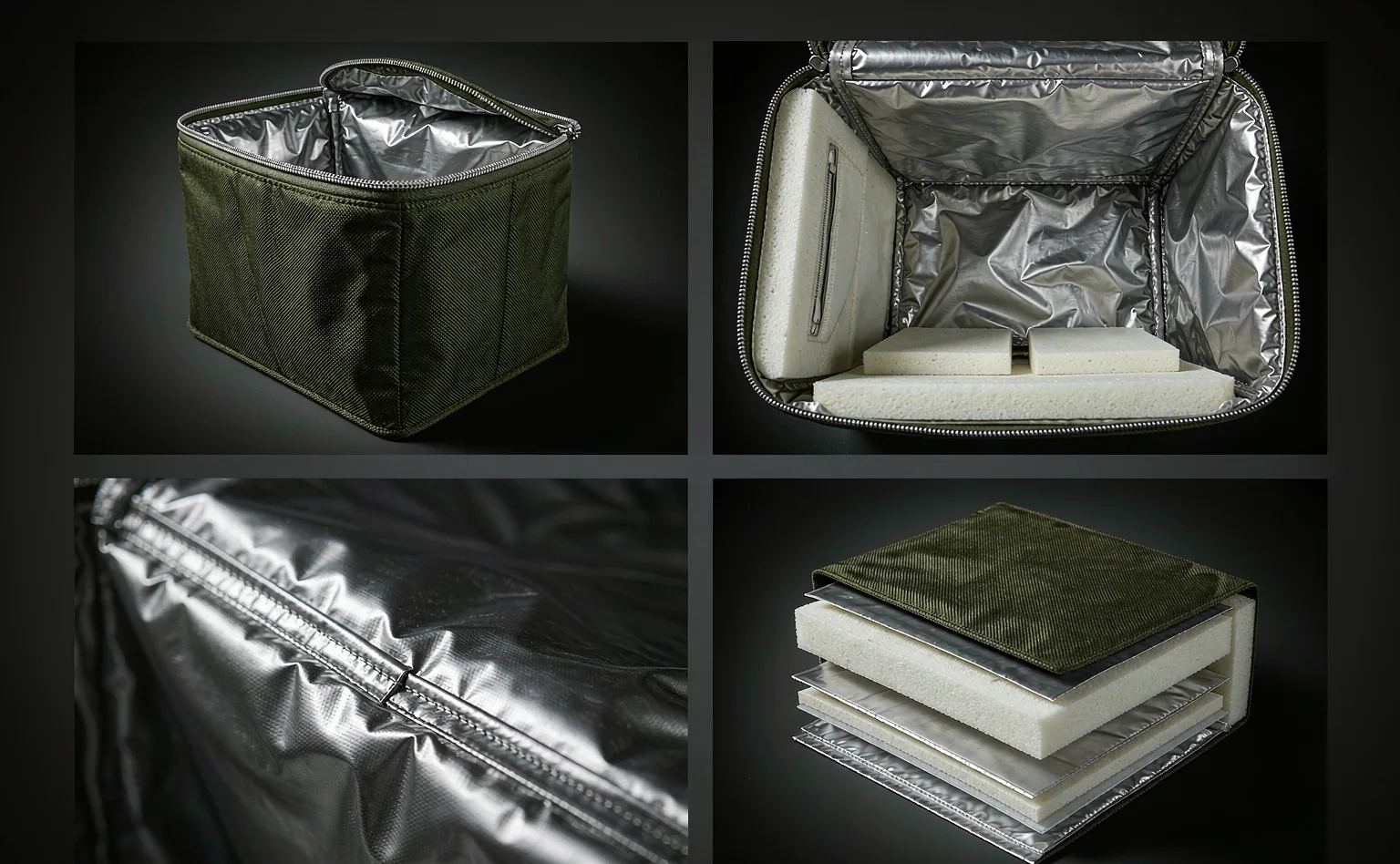
Seven signals predict a difficult cooler bag programme: no named film or foam supplier, no recorded weld parameters, samples made off the production line, no thermal test capability, an inspection plan with no class list, agreement to every request without a question, and no statement of what starts the bulk clock. Any two of them together are worth a conversation before the order.
Choosing where a cooler bag gets made is usually done on price and on the quality of the sample, and both are weak evidence. The sample is the best unit in the building and the price is quoted against a specification that has not been normalised. What actually predicts a smooth programme is whether the production side can answer specific questions in writing — about materials, parameters, testing and what starts the clock. This piece sets out the seven signals we watch for when we qualify a production floor, and what a good answer to each looks like.
Why Is a Cooler Bag Harder to Place Than a Plain Bag?
Because the two things that decide whether it works — the thermal result and the seam integrity — are invisible in a finished unit and cannot be judged from a photograph. A plain bag can be assessed by looking at it: the stitching, the material, the print. An insulated bag with excellent stitching and a beautiful print can hold ice for six hours instead of twelve, and nobody can tell by looking. That puts the burden on documentation rather than on appearance.
The second reason is that the failure modes are slow. A weld that is marginally under-powered passes a leak test on the day and lifts in month four. A foam that is a grade lighter passes incoming inspection and creases in the first summer. Both are discovered after the container has landed, which is the most expensive place to discover anything.
Red Flag 1: No Named Material Supplier?
Ask which film and which foam the bag will be built from, by supplier and grade. A quotation that says "PEVA liner" and "8 mm foam" without a supplier cannot be held to anything, because those phrases cover a wide range of weld behaviour, density and compliance position. The supplier and the grade are what make the specification re-orderable, and they are also what allow a food-contact declaration to be requested from the right place.
The good answer names the grade, the supplier and the gauge, and offers a declaration with the lot. The weak answer restates the acronym. Where the answer is weak, the first order will be built from whatever is in stock, and the second will be built from something else.
Red Flag 2: No Recorded Weld Parameters?
A welded liner is made by a machine set to four or five numbers: power or temperature, dwell or speed, pressure, cooling time under pressure, and, for radio-frequency welding, the electrode gap. If those numbers are not recorded with the approved sample, the second run will be set by an operator from memory, and the seam will be different. That is the single most common cause of a reorder leaking when the first run did not.
The good answer is a parameter sheet with numbers and permitted ranges, tied to the sample reference and the film lot. Where the floor runs an ISO 9001 system, that sheet should already exist as a work instruction; where it does not exist, ask for it to be created at sampling rather than at bulk.
| Signal | What it looks like in practice | What it costs later |
|---|---|---|
| No named film supplier | The quotation says "PEVA" with no grade or gauge | A substitution changes the weld window and the compliance file |
| No weld parameters recorded | The operator sets the machine from memory | The reorder seam differs from the approved one |
| Sample-room sample | A unit made by the best person, off the line | A pattern or weld problem appears in bulk |
| No thermal protocol | A figure quoted from a catalogue | The claim cannot be defended or repeated |
| No defect class list | The inspection is a matter of opinion | A container ships with defects the buyer would have rejected |
| Agreement to everything | Yes to a four-hour sampling window | The problem is deferred into the bulk schedule |
| No bulk trigger stated | The clock is undefined in the order | The delivery date is argued about later |
Red Flag 3: Samples Made Off the Production Line?
Ask whether the sample was made on the production tooling by the production team, or in a sample room. A sample-room unit is made by the most skilled person in the building, with more tolerance and more time, and it routinely hides a pattern problem, a weld problem or a compression problem that appears when the production tools run at speed. A programme approved on a sample-room unit is approved against an article that will not be produced.
The good answer is a tagged production sample with a build date and the material lots on the tag. Where a sample-room unit is unavoidable for a first concept, insist on a production-made confirmation sample before approval, and treat that as the unit the bulk is measured against.
Red Flag 4: No Thermal Test Capability?
Ask what the thermal number is and how it was measured. A floor that cannot state an endpoint, an ambient, a load and a refrigerant mass cannot hold a thermal claim, and a floor that has never run the test will quote a figure from a catalogue or from a previous programme. Neither is evidence about your bag.
The good answer is a protocol, even a simple one, with the fields filled in and a curve rather than a single number. Where the floor has no chamber, the test can be run by a third party under ISO/IEC 17025; what matters is that the protocol exists and that the units sent were production units.
| Question | Answer that reassures | Answer that should worry you |
|---|---|---|
| Which film and foam, by supplier and grade? | A named grade, supplier and gauge with a declaration | "PEVA" and "8 mm foam" |
| What were the weld parameters? | A sheet of numbers with ranges, tied to the sample | "The operator sets it" |
| Was the sample made on production tooling? | Yes, with a tagged unit and lot numbers | A sample-room unit presented as production |
| How was the thermal figure measured? | A protocol with fields, run on production units | A catalogue figure or a previous programme |
| What is in the defect class list? | A written list of critical, major and minor for this duty | "We inspect everything" |
| What starts the bulk clock? | Written sample approval, stated in the order | Deposit, or purchase-order issue |
| What happens if a lot fails? | Four outcomes, each with an owner and a cost | A discussion when it happens |
Red Flag 5: An Inspection Plan With No Class List?
AQL 2.5 is a number, not a plan. A plan has a standard, an inspection level, a code letter, a sample size and a defect class list written for the product. Without the class list, the inspection is a matter of opinion on the day, and the opinion will be the one that gets the container shipped. Ask for the list in writing, with examples per class.
The good answer is a one-page list with real examples: what counts as critical, what as major, what as minor, for this bag and this duty. Where the duty is food, a leaking liner is major. Where the bag is for children, a hardware issue is critical. Those are decisions, and a floor that has made them is a floor that has thought about the product.
Red Flag 6: Agreement to Everything?
A partner who agrees to a four-hour sampling window, a thermal claim without a protocol, and a dyed-to-order shade inside the standard window is not being helpful; they are deferring the problem to the bulk schedule. The questions a good production partner asks are uncomfortable and useful: what is the endpoint, what ambient, what load, what starts the clock, and what happens if the sample misses.
This is the flag that is easiest to read in the first email. A reply that asks three specific questions about the brief is worth more than a reply that says yes to all of it and attaches a price.
Red Flag 7: No Statement of What Starts the Bulk Clock?
The bulk window is 35-50 days on this programme and it starts at written sample approval. A quotation that does not say so has left the most important date in the schedule undefined, and the argument will happen later, when the sample is being reviewed and the production slot is already being discussed. Ask the question directly and get it in the order.
The good answer names the trigger, the exclusions — public holidays, dyed-to-order fabric, the inspection and re-work cycle — and the milestone dates. A schedule with milestones is a plan; a single promise of "about 40 days" is not.
What to ask before placing a cooler bag programme
- Name the film and the foam by supplier and grade, with a declaration.
- Record the weld parameters as numbers with ranges against the sample.
- Approve a production-made sample, tagged with its material lots.
- Ask for a thermal protocol with fields, run on production units.
- Get a defect class list and state what starts the bulk clock.

A related question is worth asking at the same time: who else does this floor build for, and what do those programmes have in common with yours. A floor that runs insulated bags every week has the weld windows, the foam grades and the inspection habits already in place; a floor that does one cooler programme a quarter is learning on your order. Both can be qualified, and the second needs more documentation.
Then ask what happens when something goes wrong. The useful answer describes a specific occasion: a lot that failed, what was found, what changed and what the record shows. A floor that has never had a failure worth describing either has an unusually good record or an unusually short memory, and the way to tell the difference is to ask for the record.
What Does a Good Qualification Visit Actually Look At?
Five things, in order: the incoming material store, where foam and film lots can be identified; the weld station, where a parameter sheet should be visible; the sample area, and whether it is separate from production; the inspection area, with its gauges and its calibration dates; and the records, where a previous programme file can be opened and read. None of that requires a certificate folder.
The question to ask in each place is the same: show me the record for a programme from last year. A floor that can open a file with the parameters, the inspection report and the reference sample for a programme that shipped twelve months ago can do the same for yours, and that is the capability that matters.
How Does Price Fit the Qualification?
Last, and on a normalised specification. Two quotations built on different panel build-ups, different films and different hardware are not comparable, and the difference between them is usually a specification difference rather than a price difference. Normalise first, then compare, and compare on landed cost rather than on unit price, because cube and weight move the freight.
Where a quotation survives normalisation and is still lower, ask why. Sometimes the answer is a genuinely more efficient line. Sometimes it is a lighter foam, a thinner film or a shorter weld cycle, and those are the three places where a lower price is stored up as a later problem.
What Are the Programme Terms That Apply Regardless?
MOQ 500 pcs per style and colourway, sampling 6-10 working days from a signed-off tech pack and 12-15 for a complex build, bulk production 35-50 days from written sample approval, inspection at AQL 2.5 under ISO 2859-1 General Inspection Level II, T/T 30/70, FOB Xiamen. Any production floor working on this programme works to those numbers, and a quotation that quietly assumes different ones is a quotation that will be renegotiated later.
Where a buyer is comparing two floors, the terms are a useful test in themselves. A floor that states the trigger event, the exclusions and the inspection plan in its quotation is telling you how it will behave on the difficult day, which is the only day the qualification is for.
One more question belongs on the visit, and it is the one that separates a partner from a vendor: what does this floor do when a specification cannot be met as written. The useful answer proposes a specific change with a reason — a heavier film because the weld window is too narrow, a wider seam allowance because the foam compresses, a different closure because the flap does not cover — and then asks for a decision. The unhelpful answer is a sample that quietly differs from the tech pack, which is a change made without a decision and discovered at inspection.
Freight and packaging belong in the qualification as well, because an insulated bag is a bulky, light product and cube, not weight, sets the cost. Ask for the packed carton dimensions and the units per carton, then compare on landed cost: a quotation that looks lower per unit and packs 20 per cent fewer per carton is not lower when it arrives. Ask too whether the foam is compressed for shipping and how long it takes to recover, because a bag that is packed flat and recovers badly arrives looking like a rejected one.
Finally, ask about the second year. Ask what has changed on the floor since last year — a new weld machine, a second foam supplier, a new inspection gauge — because a floor that is investing intends to be running this programme when you reorder, and a floor that is standing still is a floor you will be qualifying again from the beginning.
Qualify the floor before you price the bag
Send the brief and the target quantity. You get a qualification checklist and a schedule with milestones within one business day.

Frequently Asked Questions
What are the red flags when choosing a cooler bag factory?
No named material supplier, no recorded weld parameters, samples made off the production line, no thermal test capability, an inspection plan with no class list, agreement to every request, and no statement of what starts the bulk clock.
Why is a cooler bag harder to place than a plain bag?
Because the two things that decide whether it works, the thermal result and the seam integrity, are invisible in a finished unit.
Should the sample be made on production tooling?
Yes. A sample-room unit is made by the most skilled person in the building and hides pattern, weld and compression problems.
Why do weld parameters matter?
Because without numbers recorded against the approved sample, the second run is set from memory and the seam will be different.
What should an inspection plan contain?
A standard, an inspection level, a code letter, a sample size and a defect class list written for the product and the duty.
Is agreeing to every request a warning sign?
Yes. A four-hour sampling window and a thermal claim without a protocol are problems deferred to the bulk schedule.
What starts the bulk production clock?
Written sample approval. It should be stated in the order, with the exclusions: public holidays, dyed-to-order fabric, and the inspection cycle.
How should price be compared?
After normalising the specification, and on landed cost rather than unit price, because cube and weight move the freight.
What does a qualification visit look at?
The incoming store, the weld station, the sample area, the inspection area and the records — and in each, the record for a programme from last year.
Why does a lower price sometimes hide a problem?
Because the difference is often a lighter foam, a thinner film or a shorter weld cycle, all of which are stored up as later failures.
Does ISO 9001 matter?
It is evidence that parameter sheets and inspection records exist as controlled documents, which is exactly what makes a reorder repeatable.
What are the programme terms?
MOQ 500 pcs per style and colourway, sampling 6-10 working days, bulk production 35-50 days from approval, AQL 2.5, T/T 30/70, FOB Xiamen.
How many units are inspected on a 500-piece order?
Code letter H at General Inspection Level II: 50 units, accept 3 and reject 4 at AQL 2.5 for major defects.
Is a certificate folder enough?
No. Certificates are easy to assemble and hard to verify. Ask for a parameter sheet, a test report and a previous programme file instead.
People Also Ask
How do I choose a cooler bag factory?
Ask seven questions about materials, parameters, samples, testing, inspection, terms and the bulk trigger, and judge the answers.
What are the warning signs of a bad bag supplier?
No named material supplier, no recorded weld parameters, sample-room samples and no thermal protocol.
Should I visit before placing an order?
If the programme will repeat, yes: look at the incoming store, the weld station, the inspection area and the records.
Why did my reorder leak when the first run did not?
Usually the weld parameters were never recorded against the approved sample, so the second run was set from memory.
What terms should a cooler bag quotation state?
MOQ, the sampling window, the bulk window with its trigger, the inspection plan and the payment terms.
Sources and further reading
Every figure on this page is either our own programme data or attributed below. Open the originals before you write them into a specification.
- ISO 9001 — Quality management systemsInternational Organization for Standardization
- ISO 2859-1:1999 Sampling procedures for inspection by attributesInternational Organization for Standardization
- ISO/IEC 17025 — Competence of testing and calibration laboratoriesInternational Organization for Standardization