What Happens When a Bag Order Fails AQL: Reject, Rework or Return?
A failed lot is not a verdict, it is a decision about money and time. Four paths exist — accept with allowance, sort, rework, or remake and return — and which one applies depends on where the fault sits. Decide the branch before production starts, not on the day the report lands.
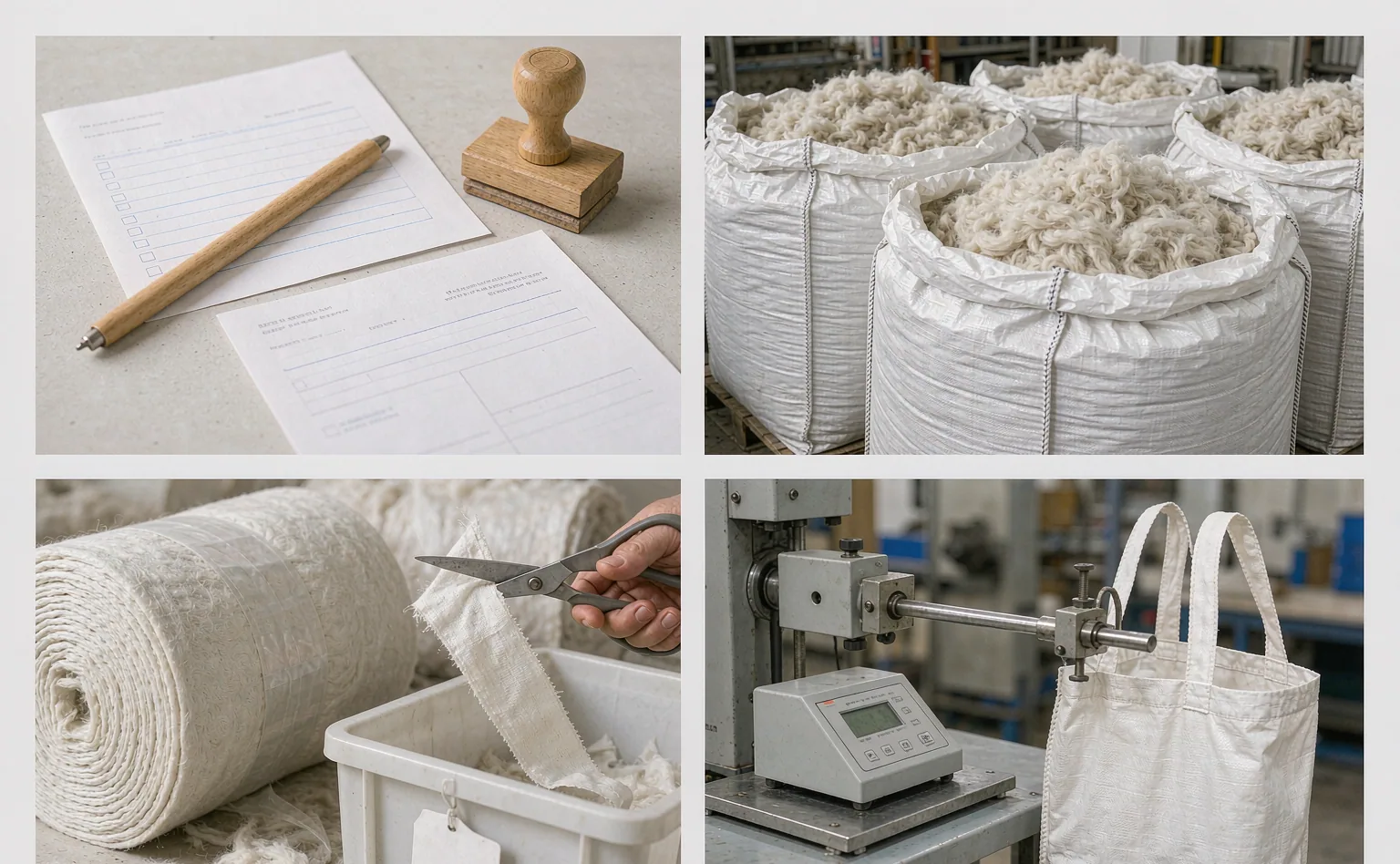
Write the failure branch into the purchase order: what happens per defect class, who pays, how many days each path costs, and what evidence ends the argument. Everything else follows from that one clause.
Every buyer handles a rejection eventually, and almost nobody has agreed in advance what the word means. The inspector writes "lot rejected" against the plan; the factory writes "minor issues, can be fixed"; and the two sentences describe the same set of bags. What follows is three emails, a delay nobody budgeted for, and a relationship dented by an argument that was entirely predictable.
The way out is to treat a failure as a routing problem. The plan divides faults into classes; the purchase order should divide outcomes along the same lines, with a named owner and a number of days attached to each. When that exists, a failed report triggers a decision instead of a negotiation.
What Does "Failed AQL" Actually Mean?
It means this and only this: against a stated plan, for the sample size drawn from that lot, the count of findings in at least one class reached the reject number, or a finding in the zero-tolerance class appeared. Nothing more. It says nothing about the other units in the lot, nothing about whether the goods are usable, and nothing about blame.
Because that reading is narrow, a failure has to be translated into a commercial sentence by somebody with authority. A count of majors above the reject number usually means the defect rate across the whole lot is probably too high to ship and the lot must be touched again. A single critical finding means the lot cannot ship regardless of how good the rest of it is, until the specific hazard is dealt with. Those are different problems with different remedies, which is why one word "reject" is not enough.
Who Decides What Happens Next?
The party that owns the goods at the moment of inspection, which in practice is set by the shipping term and by who booked the visit. Under a FOB Xiamen arrangement with a buyer-booked pre-shipment inspection, the buyer decides, because risk has not yet transferred and no payment balance is due until the goods are released. Where the mill booked the visit as part of its own release process, the decision is still the buyer's to confirm before the balance is paid.
The practical test is simple: whoever is asked to release the payment decides the outcome, and should say so in writing inside twenty-four hours of the report. Silence is itself a decision, and it is the expensive kind, because production capacity carries on being allocated elsewhere while everybody waits.
What Can Be Reworked on a Bag Order?
Rework means the unit is made correct without remaking it. On sewn goods that covers a surprising amount: a strap end can be reopened and re-stitched with a bartack where a bartack was missed; a lining seam opened at the turning hole can be closed properly; a care label in the wrong position can be moved if the panel allows it; a logo that has lifted at one edge can be re-pressed if the adhesive system tolerates a second cycle.
What decides whether rework is available is access and evidence. Access: can the operator reach the faulty element without opening a seam that then has to be re-closed to standard? Evidence: does the reworked area pass the same check again, and does it leave a mark the customer will notice? A re-wheeled zipper slider leaves nothing behind. A re-pressed heat-transfer print can leave a visible halo around the edge, which turns a rework into a new fault.
| Fault | Where it sits | What is available | What it costs in time |
|---|---|---|---|
| Missed back-tack or reinforcement | At a stress point, accessible from inside or outside | Open, re-stitch to the specified length, turn and press | Same day if the line is still running; up to a week once it has moved on |
| Loose thread ends and thread tails | Anywhere on the unit | Trim and re-check density on the affected seam | Hours; usually done before the inspector leaves the site |
| Hardware misaligned or wrongly fitted | Buckle, D-ring, slider | Remove and refit; replace the component from spare allowance | One to three days depending on whether components are on hand |
| Print misaligned or partly lifted | Logo panel | Re-press where the adhesive allows, otherwise replace the panel | Three to ten days if panels have to be cut again |
| Colour outside the approved shade band | Whole shell or a panel set | Nothing on the finished unit; only cutting replacement panels work | Remake territory rather than rework |
| Clean marks, soil, creasing from packing | Surface | Clean, steam, repack with interleaving | Hours; sometimes completed inside the inspection visit |
What Cannot Be Reworked?
Three categories. Anything that changes the material itself: a shell colour outside the shade band, a coating that has blocked or transferred, a fabric weight below specification, an insulation laminate that has delaminated. Anything where opening the unit destroys more than fixing it gains: an internal frame, a welded liner joint inside a cooler construction, a bonded seam that cannot be re-welded once cut. And anything in the zero-tolerance class, where the unit must be accounted for rather than corrected — needle fragments, sharp burrs on metal, a restricted substance above the limit.
Those last items deserve a sentence more. A metal-detection pass does not rescue a lot with a needle fragment in one unit; it tells you one unit was found. What matters next is the needle-control system: how broken needles are accounted for, whether every fragment is taped to a card, and whether the missing fragment has been reconciled. That is a question about records, not about the bag.
What Are the Five Outcomes, Plainly?
Strip away the wording that vendors use and there are five things that can happen to a lot with findings. Which one applies is mostly determined by the class of the finding and by whether the fault is reachable. Writing the five outcomes into the order, each with its own condition, removes most of the argument that follows a rejection.
| Outcome | What it means | When it applies | What must be written down |
|---|---|---|---|
| Accept as found | Ship the lot unchanged, with the deviation recorded | Findings sit below the reject number and nothing landed in the zero-tolerance class | Nothing beyond the report itself, beyond noting the counts |
| Accept with allowance | Ship the lot with a compensation for the higher defective rate | Minors above the reject number where the units are perfectly usable | The allowance, who bears it, and that it applies to this delivery only |
| Sort | Examine every unit for one named fault and remove what fails | A visible fault in an identifiable population | The one-sentence sort instruction, the population, and who sorts |
| Rework | Correct the units to specification | The fault is reachable and the repair leaves no visible evidence | Which units, who carries out the work, what they are rechecked against |
| Remake or return | Make the quantity again, or return what shipped | A material fault, a systemic one, or a finding in the zero-tolerance class | Quantity, dates, freight ownership and what happens to the original units |
When Is Sorting Enough?
Sorting — sometimes called 100% inspection of the lot for one specific fault — is the right answer when the defect is visible, confined to a known population, and not a systemic property of the run. Examples: a print that only failed on one machine head, so only units from that hour are suspect; a hardware batch with a plating fault that can be identified by eye; a colour lot that was cut on one specific roll.
Sorting works because it converts a statistical problem into a counting one. It fails when the fault cannot be reliably identified, when it only shows under load or after use, or when sorting requires judgement that two inspectors will make differently. If the sort instruction cannot be written in one sentence a temporary worker would understand, it is not a sort plan, it is a wish.
Two conditions make sorting honest. First, sort against the same written definition and the same reference samples used in the original visit. Second, re-inspect the sorted lot under the original plan before release — a sort plus no reinspection is just an opinion about your own work.
When Should You Remake Instead?
Remake when rework would leave visible evidence, when the underlying material is wrong, or when the numbers say so. That last one is arithmetic: if eighteen per cent of the units in a lot must be opened and re-closed, the rework touches more labour than cutting and sewing new units, takes longer, and lands with a higher risk of introducing secondary faults. At some proportion the answer stops being repair.
There is also a lead-time argument that points the same way. Bulk production runs 35-50 days from written sample approval, and a partial remake inside an existing slot is often faster than a full one — but only if materials are on hand. Fabric, lining, webbing and hardware are ordered against the original quantity with a cutting allowance, typically a few per cent. If the remake exceeds that allowance, new material has to be ordered and dyed, and the calendar restarts. Ask for the allowance figure before choosing this path.
What a rework decision must settle, in writing
- Which units: the whole lot, a named sub-population, or a stated number found during sorting.
- Who performs it, under whose supervision, and where the units sit while it happens.
- Whether the materials come from the original allowance or new orders, and what that does to the shipping date.
- What the reworked units are checked against — the same plan and the same level, not a lighter one.
- Who pays for labour, materials, the reinspection visit and any additional freight.
- What "passed" means afterwards: a fresh sample, a fresh verdict, and a report number that differs from the failed one.
What Happens to the Shipping Date?
Every path costs calendar days, and the decision that spends least money is rarely the one that protects the date. Sorting costs one to three days for a small lot and up to a week for a large one. Rework costs whatever it takes to get the line back plus re-operating time — commonly three to ten working days. A partial remake costs close to the original production window for the affected quantity. A return with full remake costs the whole window again.
Two things decide how much of that delay is real. The first is booking position: whether the original production slot can be held while the question is resolved, which is a commercial decision the supplier makes and worth securing early. The second is the booking window itself — the container or vessel slot. A four-day rework that misses the weekly cut-off costs the same as a nine-day one, because both land on the same vessel.
For that reason, the sensible order of operations is: establish defect counts per class, establish how many units each path touches, work out whether the recovery finishes before or after the next booking cut-off, and only then choose. Where a recovery lands after a fixed sailing slot, paying for air freight on a partial quantity to protect a launch can be the rational answer, provided the cost bearer is named in advance.
Who Pays for Rework and Reinspection?
Default position under a T/T 30/70 arrangement: the factory bears the cost of correcting its own work, and the buyer bears the cost of reinspection, because reinspection exists for the buyer's confidence. That split is reasonable and worth writing down, because it is predictable and neither side has to argue about it later.
Where the fault came from the buyer's own specification or a late change, the split reverses. A colour chosen against an unreachable reference, a logo position moved after approval, or a tolerance tightened after the first article was signed will produce findings that are genuinely not the supplier's doing. This is why the approved sample, countersigned and dated, matters more than any clause: it fixes what the work was supposed to be.
Two costs are routinely forgotten. Freight for a returned or partially returned shipment, which nobody budgeted, and storage for goods waiting on a decision, which accrues daily and nobody budgeted either. Name both in the clause even if the answer is "as incurred by the responsible party", so the principle is at least agreed.
What Should the Failure Rule Say in the Purchase Order?
Short, specific, and written before anything has gone wrong. It should state the standard and plan; define a critical finding with a zero acceptance number; set the accept and reject pair for majors and minors; and then name the outcome per class. Something along the following lines carries most programmes: on a rejection, the supplier shall within two working days submit a written cause statement and a corrective proposal; the goods remain unshipped until the proposal is agreed and carried out; the lot is then re-presented under the original plan; the cost follows responsibility.
Add the two mechanical details that make it work. Timing — how many hours the supplier has to respond, and who has authority to accept the proposal. And identification — every finding referenced to a numbered photograph and a location on the unit, so that later conversations are about photographs rather than adjectives.
What Records Should a Failed Visit Leave Behind?
More than the verdict. The file should hold the report with sample size and code letter, the full defect list with class and count per category, photographs referenced to each finding, the random-number or location method used to draw cartons, the measured values rather than pass marks alone, the cause statement, the agreed corrective proposal and its date, and the reinspection report with its own number. Six months later that file is what settles a recurrence.
It also earns its keep as a trend record. Count majors per hundred units across lots and the direction becomes visible: whether faults concentrate in one operation, one colour, one material batch, or one week of the schedule. A programme with four lots of history can predict its own failures; one that files reports and nothing else cannot.

How Does One Failure Change Later Lots?
Through the switching rules, if the plan says they apply. ISO 2859-1 is built as a continuing series: two rejections among five or fewer consecutive lots move the programme to tightened inspection, where the same sample size faces a stricter accept pair, and five consecutive acceptations return it to normal. Buyers often write AQL 2.5 into an order and never reference the switching rules, which leaves a useful mechanism unused.
The second effect is on the checklist. Whatever the fault was, it now has a line, a method and a limit, and it sits at the top of the list for the following three lots. That is how checklists get better — each failure buys a permanent improvement in detection, provided somebody updates the document the same week rather than promising to.
And the third effect is on the plan for the next order. If a construction failed twice at the same seam, the answer is not a tighter level; it is a reinforcement in the tech pack. Sampling detects. Only specification prevents.

Agree the failure clause before the first lot
Quantity, duty and shipping term — the branch per defect class comes back drafted, with payment ownership and reinspection stated.
Frequently Asked Questions
What is the first thing to do when a lot fails?
Confirm the arithmetic before anything else: sample size, code letter, and the accept pair actually applied. Mistakes happen at that step, and correcting one is far faster than any remedy that follows.
Who owns the decision to rework rather than reject?
The party releasing payment. Say who that is in the order, and give them a deadline to respond to the report in writing.
Is rework ever as good as new production?
Sometimes better, sometimes worse. An added reinforcement at a stress point improves the unit. A re-pressed print can leave a halo. What decides it is whether the repair leaves visible evidence.
Can we ship a lot that failed on minors alone?
Only by written agreement and usually with a compensation for the extra defective rate. Record it as a deviation against this delivery rather than changing the plan silently.
Does a failed lot mean the whole shipment is bad?
No. The verdict applies to what the sample found under that plan. It tells you the lot needs touching before release, not that every unit is unusable.
Who pays for the reinspection visit?
Commonly the buyer, since the reinspection protects the buyer's confidence, while the factory bears the correction itself. Write the split into the order so nobody has to argue later.
How long does rework usually take?
From hours for trimming and repacking to around ten working days when panels have to be cut again. Whether spared material covers the quantity is usually what decides it.
What if the materials cannot be replaced in time?
Then the answer is quantity rather than repair: ship the accepted portion and agree a second shipment for the balance, with freight ownership stated.
Should the failed report be sent to the factory immediately?
Yes, in full, the same day. Withholding findings to gain leverage loses more in delay than it gains in argument.
How do we stop the same fault recurring?
Two changes, not one: correct this lot, then add a line to the checklist with a method and a limit so the following lots look for it explicitly.
What is a sorting operation, and when does it work?
Examining every unit for one named, visible fault with a population that can be identified. It works when the instruction fits in one sentence and fails when identification needs judgement.
Do the ISO 2859-1 switching rules apply automatically?
Only if you write them in. A single lot plan quoted without the switching rules leaves that part of the standard unused.
Can we return goods that have already shipped?
Yes in principle, and through a claim rather than an inspection result — which means the photographic record from the pre-shipment visit becomes the evidence. This is why the file matters.
Is a zero tolerance list really necessary?
It is the one part nobody negotiates. Items that make a unit unsafe or unlawful have no accept number, and the list should be part of every programme regardless of the chosen level.
People Also Ask
What happens when a shipment fails AQL inspection?
The lot is not released. The next step is a written cause statement and a corrective proposal from the supplier, one of four actions — accept with allowance, sort, rework or remake — and then a reinspection under the original plan.
Can a failed lot be reworked and resubmitted?
Usually yes, when the fault is accessible and the repair leaves no evidence. Material faults such as colour outside the shade band cannot be reworked and the affected units have to be made again.
Who pays for rework after a failed inspection?
The party responsible for the fault bears the correction; the reinspection is commonly the buyer's cost. Both belong in the purchase order rather than in an argument.
How much delay does a failed inspection cause?
From hours to around ten working days depending on the remedy, and in practice whatever remains to the next booking cut-off. Ask that question before choosing the remedy.
Should I reject or accept a lot that failed on minors only?
Neither automatically. Minors above the reject number signal proportion rather than unsuitability, so look at the fault type and agree the disposition in writing.
Sources and further reading
Every figure on this page is either our own programme data or attributed below. Open the originals before you write them into a specification.
- ISO 2859-1:1999 Sampling procedures for inspection by attributesInternational Organization for Standardization
- Incoterms 2020 rulesInternational Chamber of Commerce
- ISO 9001 — Quality management systemsInternational Organization for Standardization