How to Write a Bag Inspection Checklist Into Your RFQ
A request for quotation is the natural place to put inspection terms, because nothing has been agreed yet. Write the plan, the defect classification and the failure route into the enquiry, and every quotation you receive is quoting the same product.
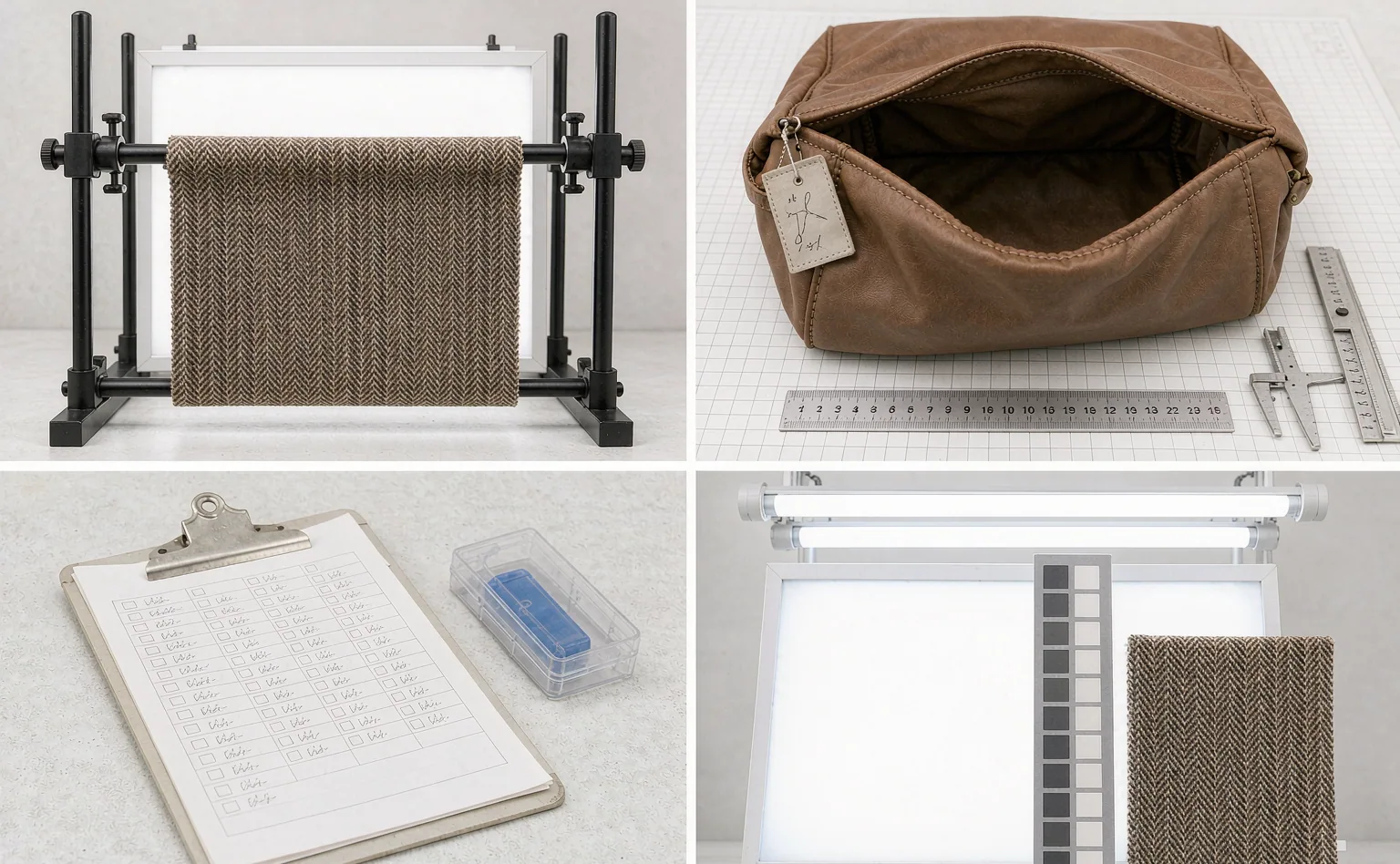
Put three things in every enquiry: the plan you will inspect against, the classification you will count with, and the route that follows a failure. Ask for those to be quoted rather than merely acknowledged.
The moment to set inspection terms is the moment nobody has committed to anything. Once a price has been agreed, every additional requirement becomes a concession somebody has to grant, and each concession costs goodwill that the programme will need later for something that actually matters.
Yet the great majority of enquiries mention inspection in a single line, or not at all. "Third-party inspection required" is typical. It tells the recipient nothing about what will be counted, what the tolerance is, what happens if it fails, or who pays — and every one of those questions will otherwise be settled later, when the other side is in a stronger position.
Why Do Inspection Terms Belong in the Enquiry Rather Than Later?
Because a price is a function of the specification. Two suppliers quoting the same construction against different realities are not quoting comparable prices — one has priced risk properly and the other has not included it. The difference does not show in the quotation; it shows in what happens when a lot comes close to the line.
Cost comes into it too, though it is the smaller argument. At enquiry stage the specification is still being discussed, so changes take a day. Later they take weeks and each one arrives carrying a request for something in return.
There is a second reason, quieter and stronger. An enquiry sets the terms of the conversation that follows. A supplier who has read a three-line inspection block at quotation stage has already accepted it, and later clauses feel like implementation rather than imposition.
What Exactly Belongs in the Enquiry?
Eight items, in a single block, written once and reused for every style in the programme. They fit comfortably on a page and each one prevents a specific category of argument.
| Item | What it states | What happens without it |
|---|---|---|
| Sampling plan and level | AQL 2.5 at ISO 2859-1 General Inspection Level II unless agreed otherwise | The inspection level gets decided by whoever happens to be booking the visit |
| Defect classification | The critical, major and minor lists you will count against | Every report reflects the inspector's own judgement instead of your specification |
| Acceptance policy | What the programme does at each class of finding | A failed lot becomes a negotiation rather than a decision |
| Failure route | Who decides, how many days each outcome costs, who pays | Delay, then an argument about second visits and extensions |
| Documents required | Which reports accompany the lot and by when | Nothing arrives until somebody asks, and then it arrives slowly |
| Test evidence | Which laboratory reports the material must carry | Test validity discovered late, usually at the worst moment |
| Packing and carton specification | Quantity assortment, carton strength, marks | Packing failures appear at destination rather than at inspection |
| Cost ownership | Who pays for each visit and each reinspection | The most predictable argument in the whole programme |
How Specific Does the Enquiry Need to Be?
Specific enough that two people reading it separately would arrange the same inspection. That is the real test, and it is stricter than it sounds. "Inspect before shipment" fails it immediately; "sample fifty units at Level II and reject on the fourth major" passes.
| Enquiry field | Weak entry seen often | What to write instead |
|---|---|---|
| Inspection | Required before shipment | Pre-shipment inspection at AQL 2.5, ISO 2859-1 General Inspection Level II |
| Sampling | As per standard | Lot size 281-500 draws 50 units; three majors accepted, the fourth rejects |
| Defects | Per industry standard | Critical list attaches as Annex A; deflection follows the major and minor lists in Annex B |
| Testing report | Tested as required | Restricted substance testing from an accredited laboratory, valid at the date of shipment |
| Failure outcome | To be discussed | Sorting within a stated number of days at the supplier's cost, or remake with agreed dates |
| Second visit | Buyer's option | A failed lot that is re-presented is re-examined at the supplier's cost |
| Documents | Standard reports | Report issued within a stated turnaround, with photographs of every finding |
| Packing | Export standard | Stated units per carton, carton construction, and the assortment across cartons |
A useful test before sending: hand the enquiry to somebody who has never made this product and ask them what inspection they would arrange from it alone. If the answer involves a question, the document needs another line.
Should You Send Your Own Checklist or Ask for Theirs?
Send yours. A received checklist tells you what that supplier already does well, which is real information, but it is their definition of the product rather than yours. Take theirs as input, then attach your own with your tolerances and your classes.
Where suppliers resist your list, ask what specifically is difficult rather than assuming bad faith. Sometimes the objection is genuine: a tolerance impossible to hold on that equipment, or a test that requires apparatus nobody within reachable distance owns. Those are worth hearing, and agreeing another approach is legitimate. Resistance that is not specific is worth investigating.
There is also a category of objection worth accepting quickly: a tolerance that is genuinely tighter than the equipment can hold. Insisting on it does not improve the product; it simply moves the discussion to the day the first lot fails for a reason everybody could have foreseen. Ask what can be held, verify it against a trial, and then write that number down.
Where the objection concerns cost rather than capability, decide whether the requirement is genuinely needed. Enquiries accumulate clauses from previous programmes, and some survive long after the thing that justified them has gone. Reviewing once before sending is a few minutes spent against problems that take weeks to arrive.
How Do You Price Inspection Cost Into the Enquiry?
Say who pays and for what, in the same currency as everything else people will argue about. A third-party visit is normally charged by the man-day, and it is customary for the party who required the visit to bear it. Where a failed lot is re-presented, the second visit usually follows the responsibility for the failure rather than the original arrangement.
Ask for the cost of any tests you require to be shown separately. Bundled testing looks attractive until you want to change one item, at which point nobody can price the change. Itemised testing suites look trivial to quote and are easy to adjust later.
What Should the Enquiry Say About Samples and Approval?
The same principle applies one stage earlier. Sampling takes 6-10 working days from a signed-off tech pack, and that period is when the specification gets tested by reality — the tool that cannot reach a seam, the tolerance that produces visible rejections, the construction that behaves differently made at scale. Put the approval process in the enquiry so everybody knows what "signed off" means before it is needed.
Say who approves, how many rounds of sampling are included, what happens to the cost beyond that number, and whether the approved units are returned. State that bulk does not begin until approval is written rather than verbal, and state what bulk timing follows from it — 35-50 days from written approval rather than from the date somebody said something encouraging in a meeting.
Require the approved sample to be retained and labelled, and name what happens if it is lost. A missing reference sample is not a small inconvenience; it removes the only physical definition of the product that everybody agreed to, and everything after it becomes harder than it should be.
How Do You Compare Two Quotations That Answer Differently?
Lay them against your own clause rather than against each other. Score each answer as accepted, qualified or silent, and you immediately see which supplier engaged the block and which merely acknowledged it. Two quotations can appear similar in price and be entirely different in what has been accepted.
Weight the qualifications. "We can hold ±1.0 cm on this seam and not less" is a considered answer from somebody who read it. "Accepted as standard practice" is not an answer at all, and it tends to be resolved later in whichever direction is currently favourable to whoever wrote it.
Do the arithmetic on the inspection cost before deciding. Where one quotation includes the visits and the other does not, the apparent price difference may vanish or reverse once the cost of what you actually require is added. Comparing prices without adding inspection, testing and any travel is the most common way to pick the wrong supplier on a close call.
What Should the Quotation Actually Return?
Beyond price and timing, three things that will save you later: confirmation that each clause in the inspection block is accepted, named substitutes for any clause that is not, and identification of the laboratory that will produce each test report. A quotation that simply says "accepted" without engaging the second and third has usually not been read by anybody technical.
Ask how long the offer stands and what happens to the inspection terms if the quantity changes. A lot size moving across a code letter boundary changes the sample size, so a much larger or smaller order changes what the visit actually does. Better to agree that now than to discover it at booking.
What Changes Between the Enquiry, the Order and the Invoice?
Ideally nothing, and that is the point of putting it in early. In practice the sequence is enquiry → proforma invoice → purchase order → booking, and each handover is an opportunity for a clause to disappear quietly.
Guard it mechanically: carry the inspection block verbatim into every document in the chain, reference the same annex letters, and never summarise. A summary is a new document with its own interpretation, which is precisely what you were avoiding.
Where something genuinely must change — a tolerance relaxed after a trial, or a level adjusted after experience — revise the annex and bump the version. Everyone works from version 3 rather than from an email describing a change to version 2.
Do not negotiate it into the email trail. Revisions agreed in correspondence end up half-applied: somebody remembers the conversation and somebody remembers the document, and they are not the same people.
What Should Be Attached to the Enquiry?
The documents that make the rest interpretable. Most programmes send enough to be quoted but not enough to be made, and inspection suffers first because it depends on every other definition being settled.
Nine attachments every bag enquiry should carry
- The technical drawing with dimensions, datum points and tolerances.
- The bill of materials naming each component, its material and its finish.
- The colour references and the light source for comparison.
- The artwork files with print positions and colour callouts.
- The critical defect list, referenced by version.
- The major and minor defect lists, referenced by version.
- The packing specification: units per carton, assortment and marks.
- The testing suite required, with the laboratory named for each item.
- The inspection clause itself: plan, classification, failure route and cost ownership.
Should the Enquiry State What Happens to Rejected Units?
Almost nobody does, and then everybody is surprised. Units removed during a sort, units from a lot that was rejected outright, and replacement units all need a destination before the situation arises. Otherwise the answer gets improvised under pressure by whoever happens to be standing there.
Cover four things: whether rejected units are returned, re-presented, repaired or destroyed; who arranges and bears that movement; when title in those units changes hands; and how their disposal is evidenced where it must be. The last matters more than it sounds — several markets require documented destruction for goods bearing a brand that cannot be released.
Replacements need the same treatment as the original lot. Say whether they are inspected again and at whose cost, whether the clock restarts on the delivery commitment, and what happens to the shipping booking that was made for the units that did not ship.
How Do You Keep the Checklist Version Controlled?
Number it, date it, and say which order it applies to on every page. Then reference it by number in each booking. Fewer than half of programmes do this, and every one of them eventually runs a visit against a version nobody can identify.
Keep an index: which version applied to which order. It takes one line per order and it is the difference between reconstructing an argument from memory and reading a document.
What Do You Do When Nobody Answers the Clause?
Treat silence as information. A supplier who acknowledges the price and timing but not the inspection block has read neither the block nor the significance of it. Ask once, directly, and see what comes back — the reply tells you a great deal about how the order will be managed.
Where the answer is an outright refusal, decide quickly. It may be legitimate commercial grounds, but it also means every close call later will be argued rather than resolved. That is a real cost, and it belongs in the comparison rather than being discovered during the first failed lot.
Does This Belong in the Enquiry or in the Order?
Both, and in that order. The enquiry establishes it, the order binds it, and the booking enacts it. Skipping the first means negotiating it at the second, which is the weaker position by definition — everything else has already been agreed and there is nothing left to trade.
Put it plainly into the terms as well: that the lot is not released until inspection passes and the required documents are received. That single sentence is what converts the clauses from intentions into something with commercial consequence.
Have your inspection clause drafted into the enquiry
Send the construction and the quantity — the plan, the classification and the failure route come back written, ready to attach to your RFQ.
Frequently Asked Questions
Should inspection terms go in the RFQ or the purchase order?
Both. The enquiry establishes them when nothing has been agreed; the order binds them. Putting them only in the order means negotiating them later.
How detailed should the inspection clause be?
Detailed enough that two people reading it separately would arrange identical inspections. A single line does not meet that test.
Can I ask suppliers to quote against my own checklist?
Yes, and you should. Their list tells you what they do well; yours tells them what you will accept.
Who normally pays for the pre-shipment visit?
Usually whoever required it. Settle it in the enquiry, along with who pays for a re-examination when a lot is re-presented.
What if a supplier refuses part of the inspection clause?
Ask for the specific problem. Some objections are genuine; a refusal that cannot be explained is information about how the order will run.
Should testing be priced separately?
Yes. Bundled testing cannot be adjusted later, and you will want to adjust it.
Does changing the order quantity change the inspection?
It can. Lot size determines the code letter and therefore the sample size, so a quantity moving across a band changes what the visit does.
Should each annex be versioned?
Yes — number, date and order reference on every page, and reference the version in every booking.
Is "industry standard" acceptable in an RFQ?
No. It means different things to everyone and will be resolved by whoever is least interested in resolving it.
What should the enquiry say about a failed lot?
Who decides, how many days each outcome takes, and who pays for each step. Deciding this under pressure is what produces bad settlements.
How many attachments should an RFQ carry?
Around nine for a structured bag: drawing, bill of materials, colour references, artwork, defect lists, packing specification, testing suite and the clause itself.
Can the same clause serve several styles?
The commercial block can. The defect lists are usually per construction, so they attach as separate annexes against the same clause.
What is the single line that makes the clause binding?
That the lot is not released until inspection passes and the required documents have been received.
People Also Ask
What should be included in a bag RFQ?
Drawing with tolerances, bill of materials, colour references, artwork, defect classification, packing specification, testing suite, and the inspection clause with its failure route.
How do you specify inspection requirements to a supplier?
In writing, at enquiry stage, stating the sampling plan, the defect lists by version, the failure route and who pays for each step.
Should the buyer provide the inspection checklist?
Yes. A supplier checklist shows what they already do well; yours defines what the programme will accept.
Who pays for third-party inspection?
Normally whoever required the visit, with re-examination usually following the responsibility for the failure. Settle it before quoting.
Why put quality terms early rather than later?
Because nothing has been agreed yet. Later, every requirement becomes a concession, and concessions cost goodwill needed for something else.
Sources and further reading
Every figure on this page is either our own programme data or attributed below. Open the originals before you write them into a specification.
- ISO 2859-1:1999 Sampling procedures for inspection by attributesInternational Organization for Standardization
- Incoterms 2020 rulesInternational Chamber of Commerce
- ISO 9001 — Quality management systemsInternational Organization for Standardization